Darrell Stephen Hughes |
In Memoriam
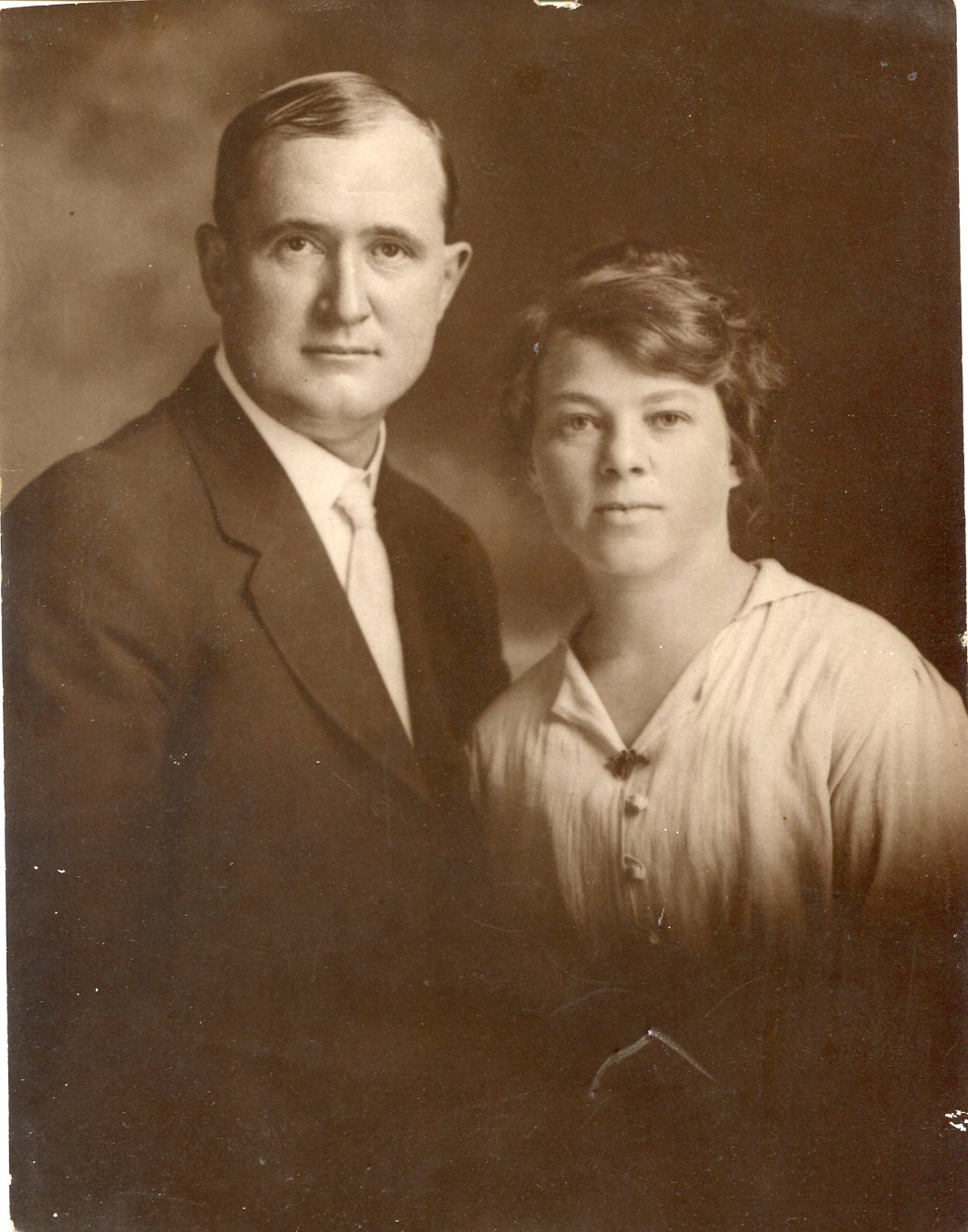
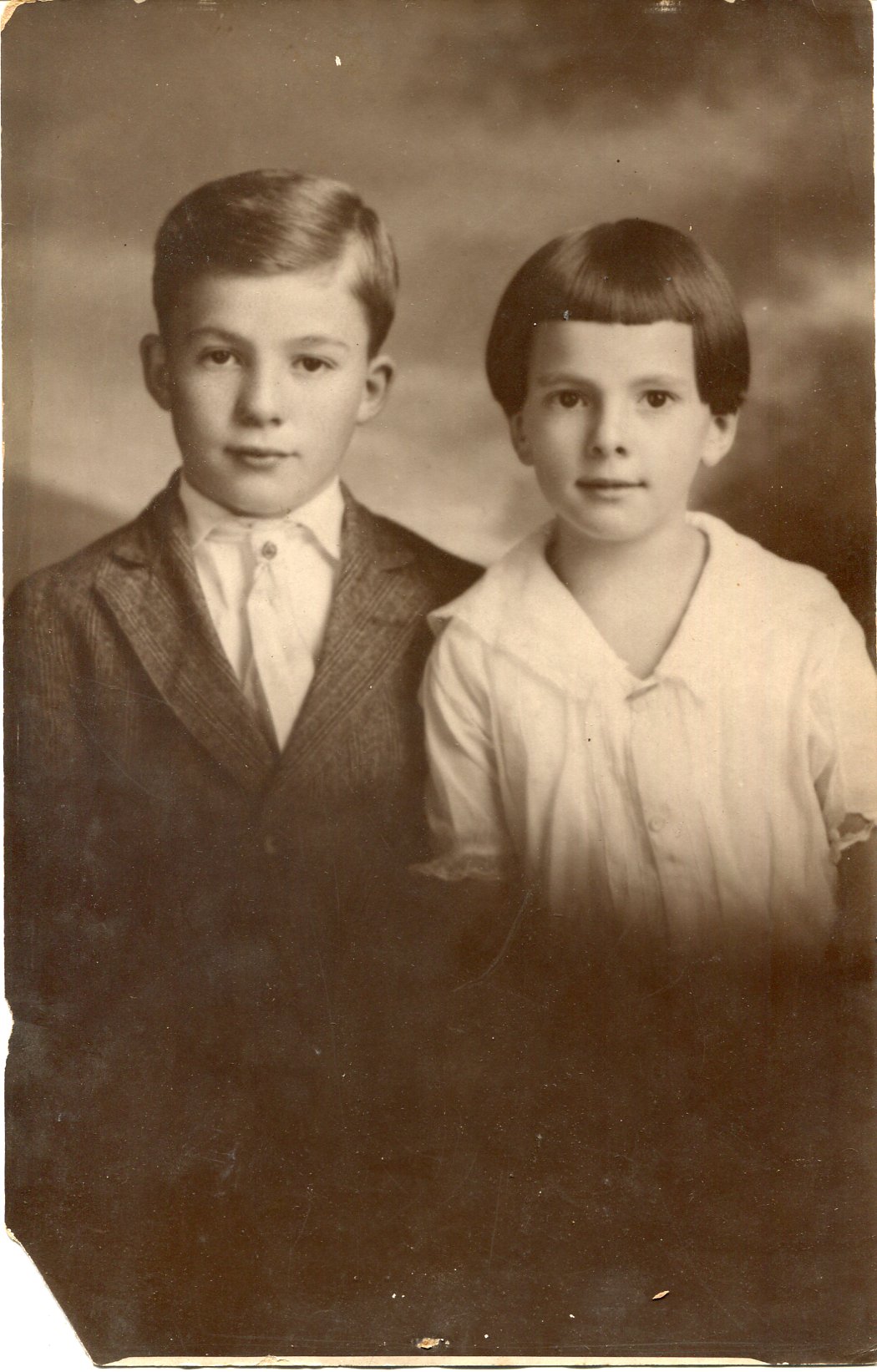
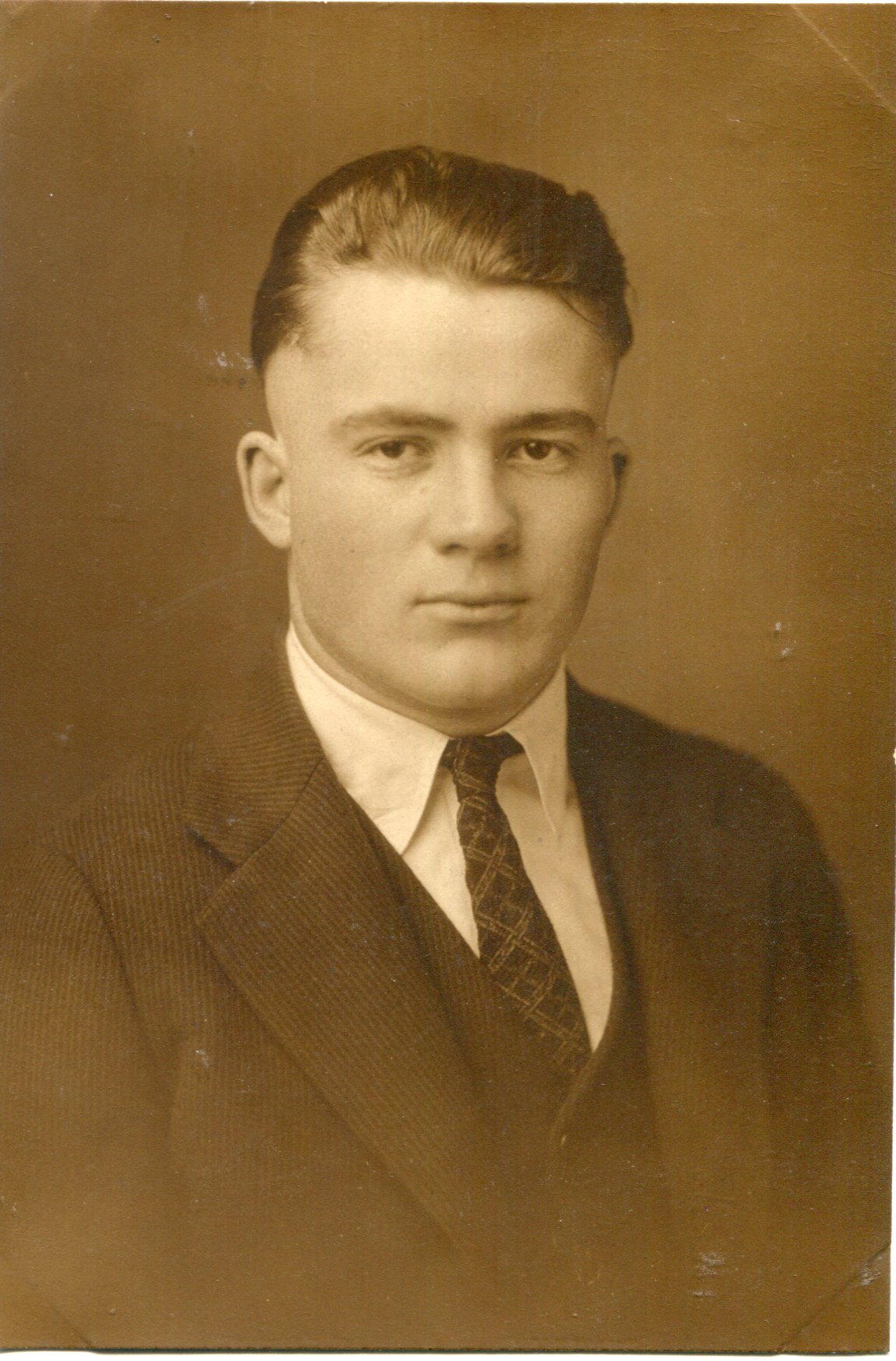
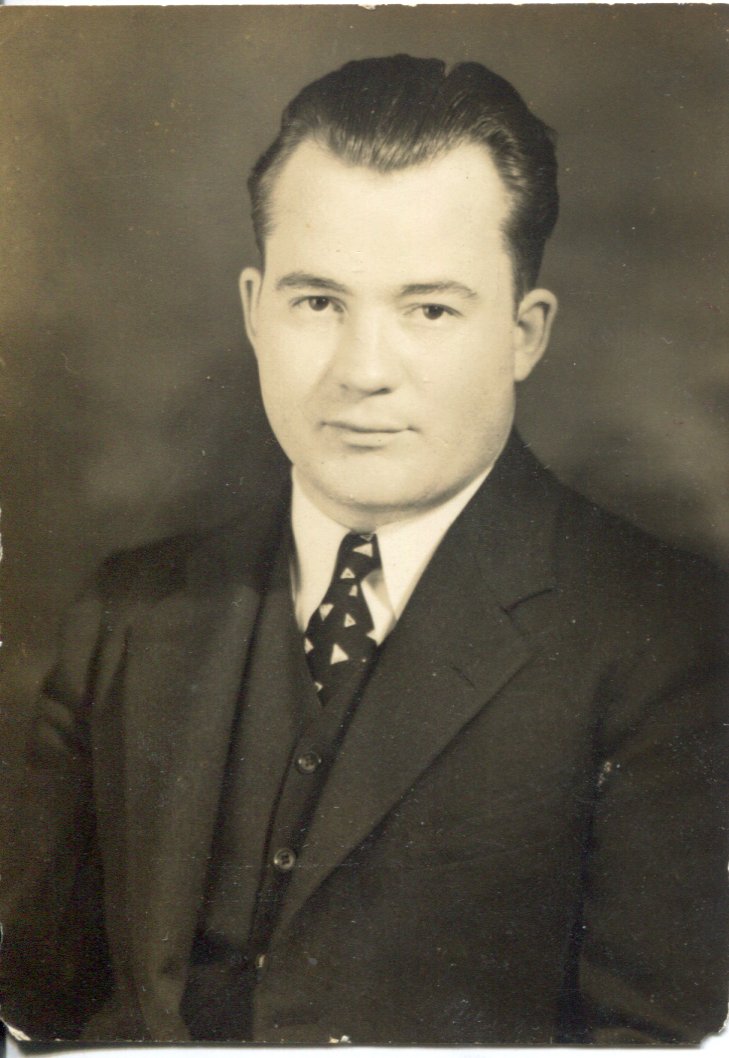
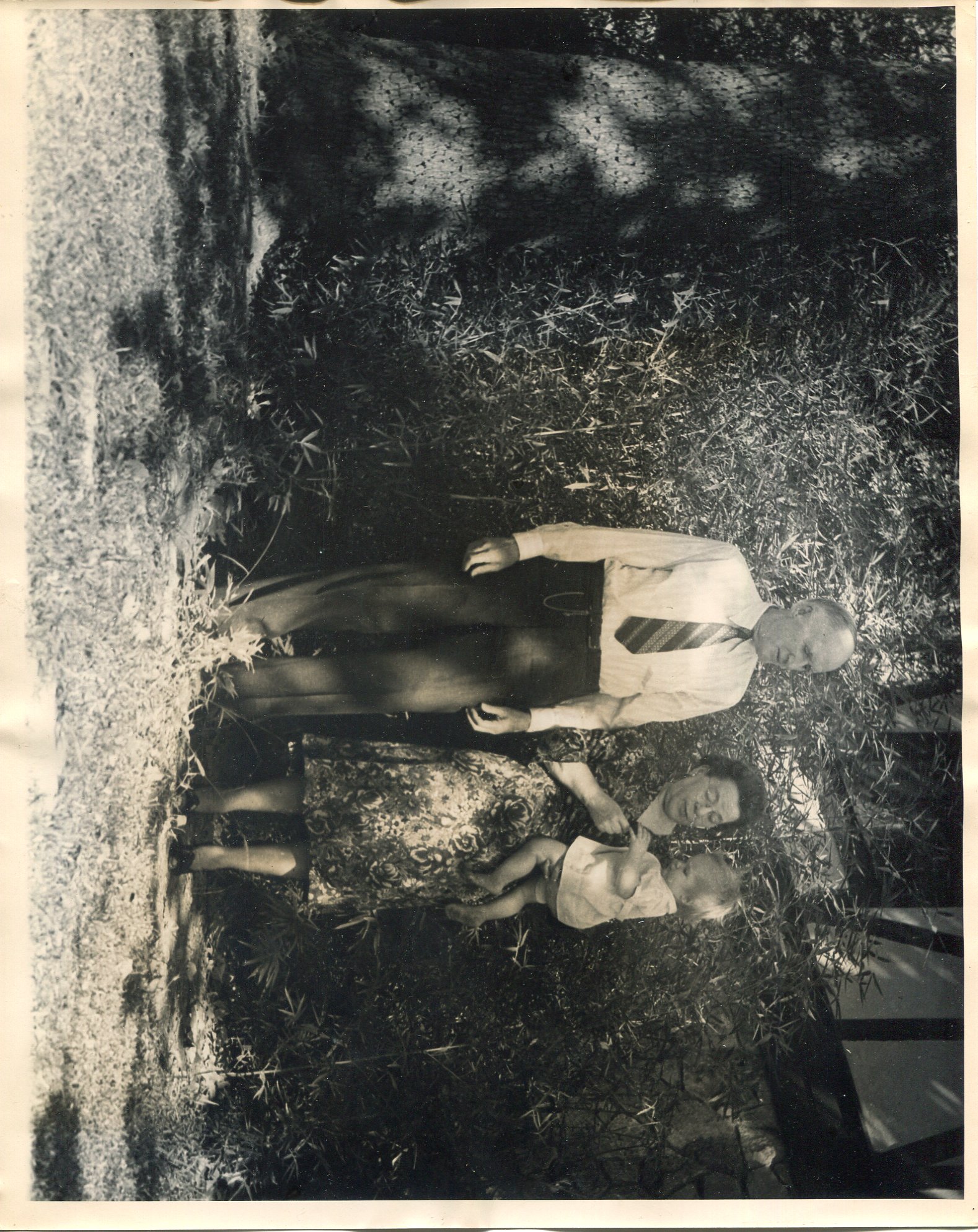
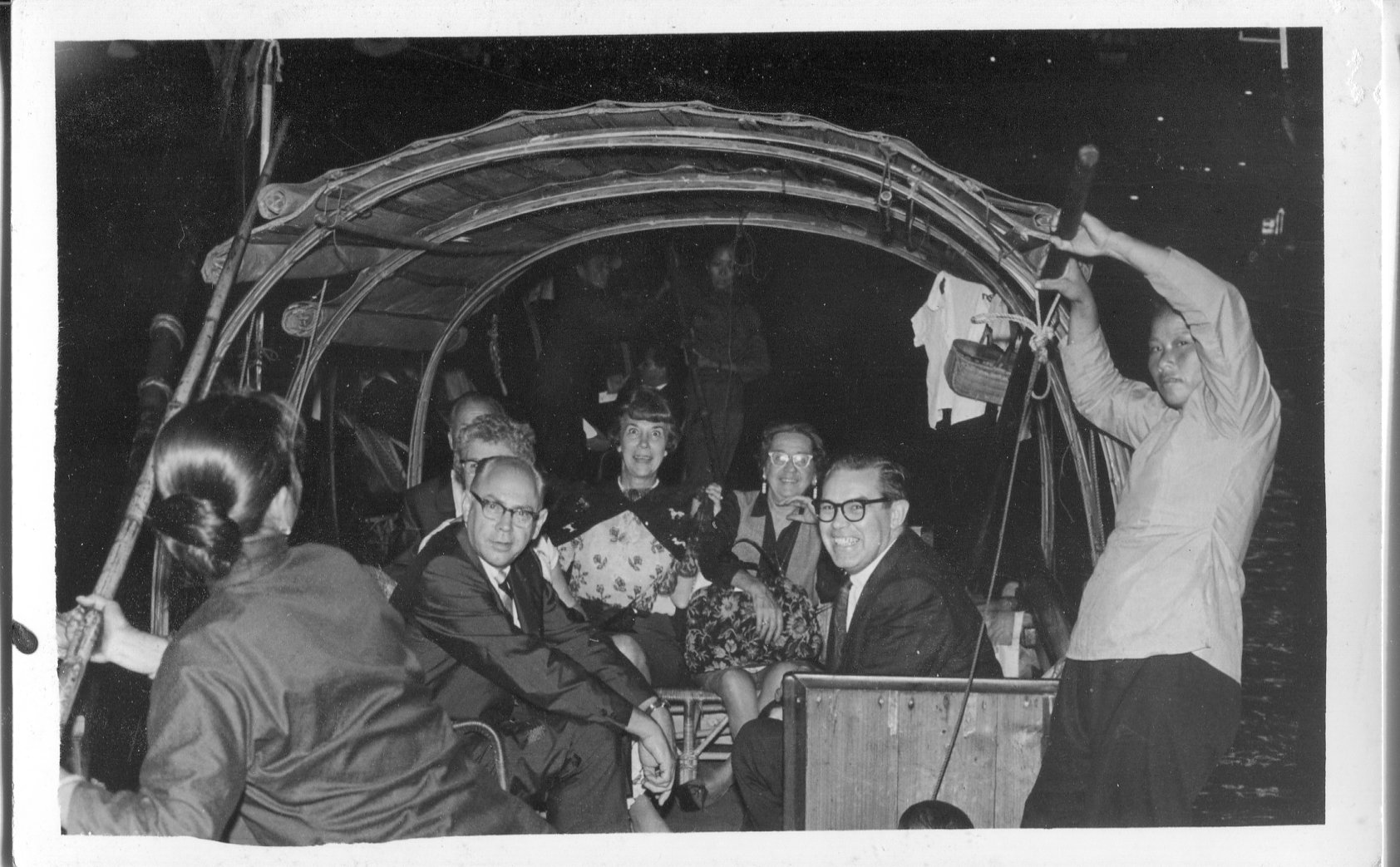
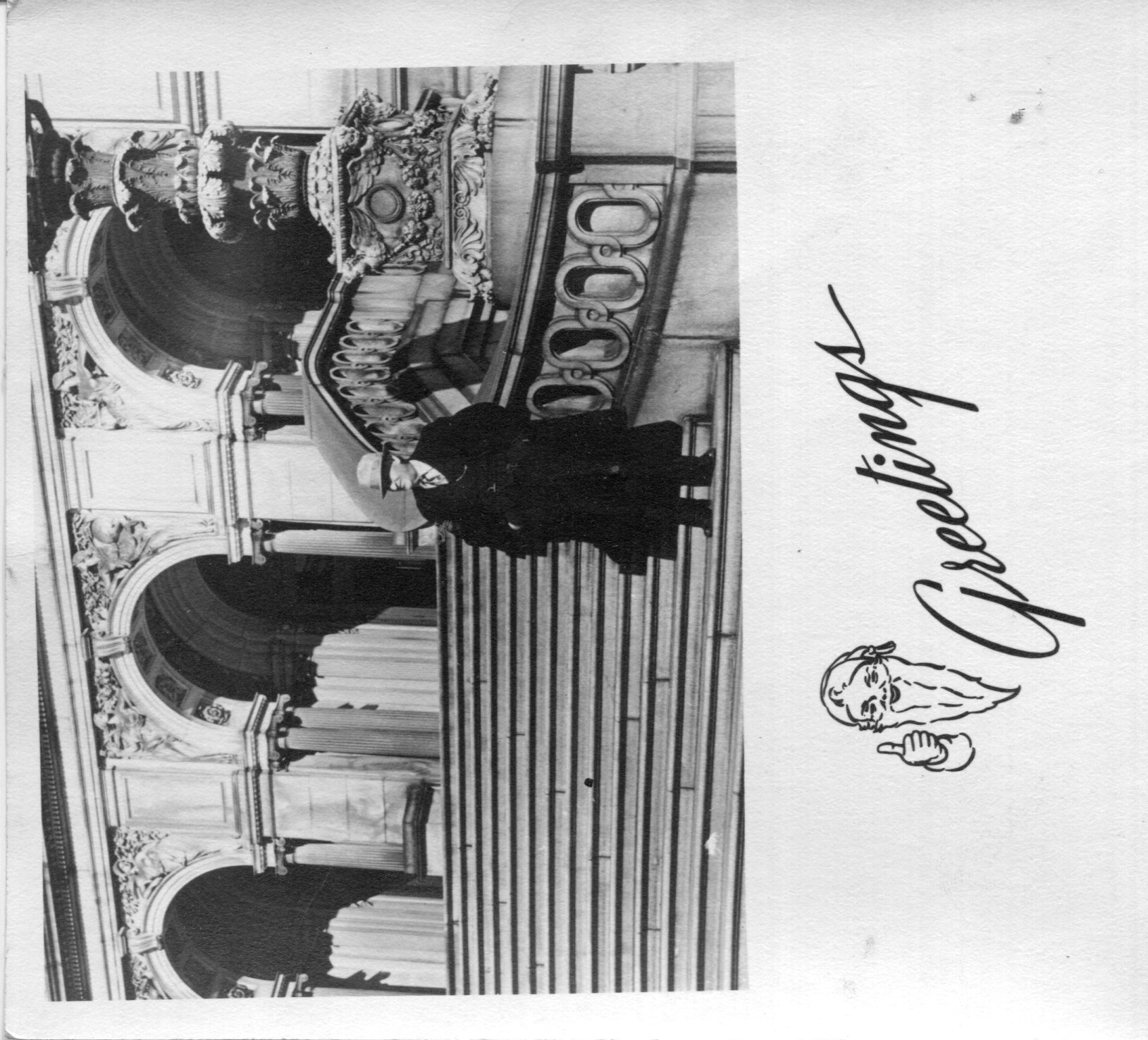
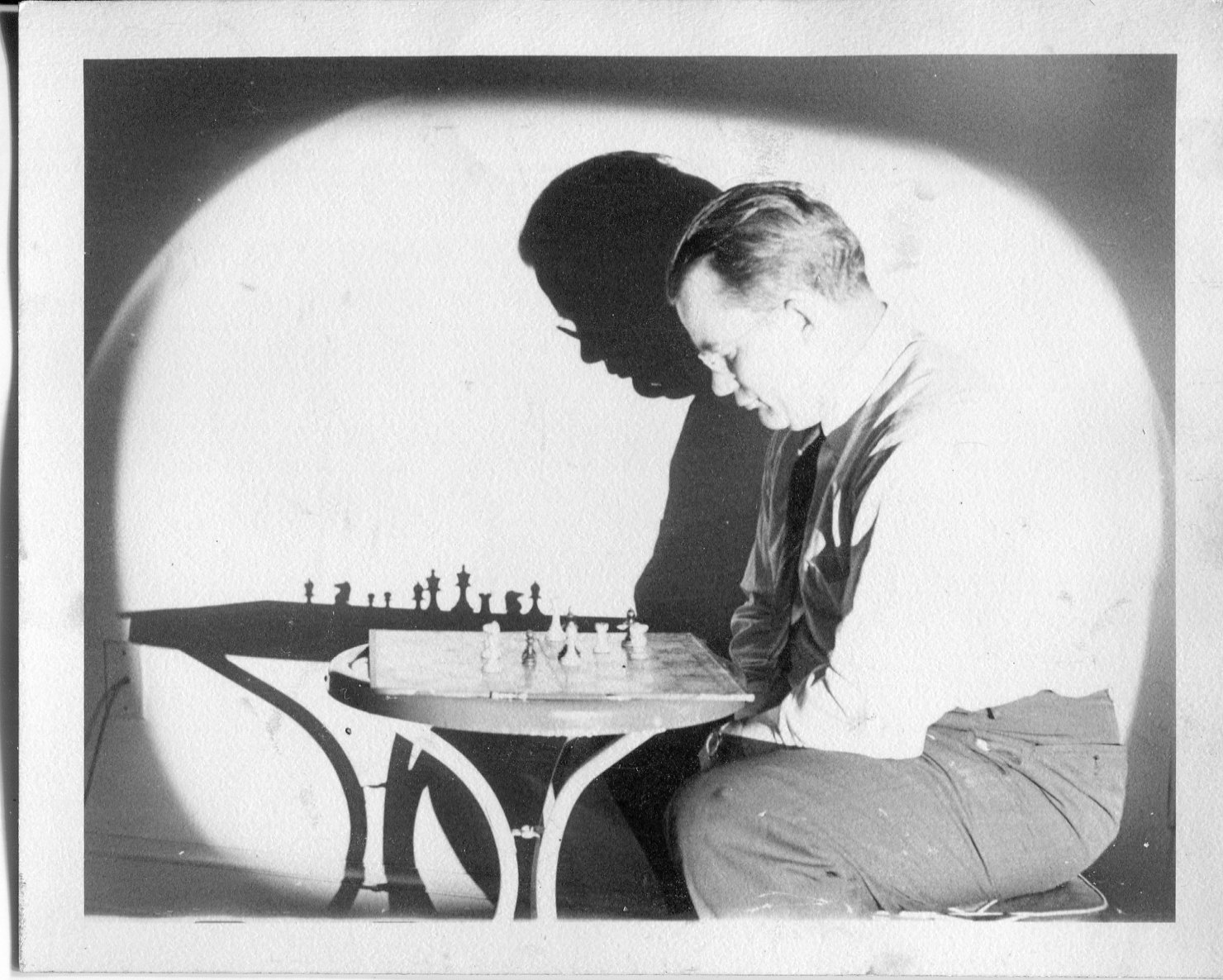
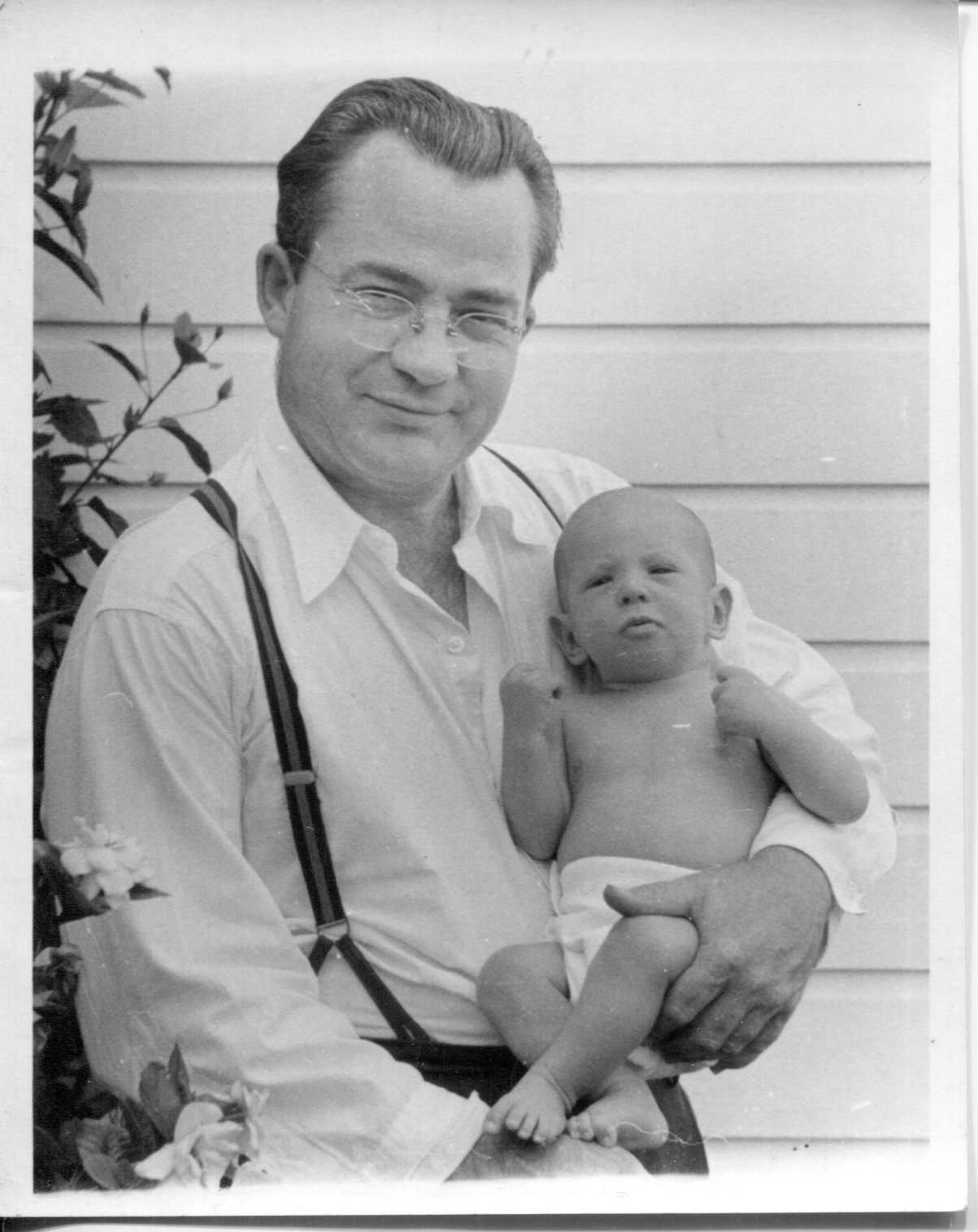
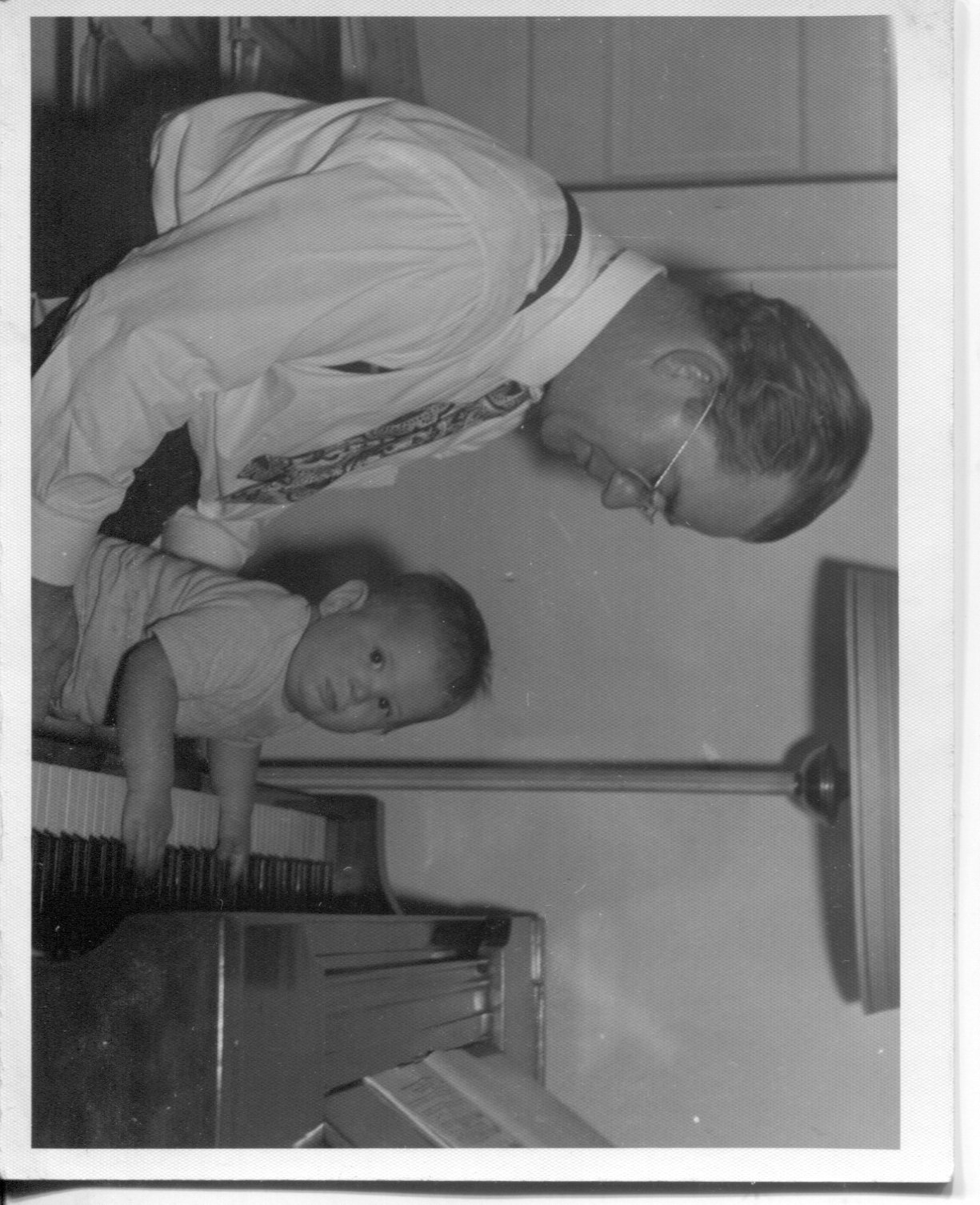
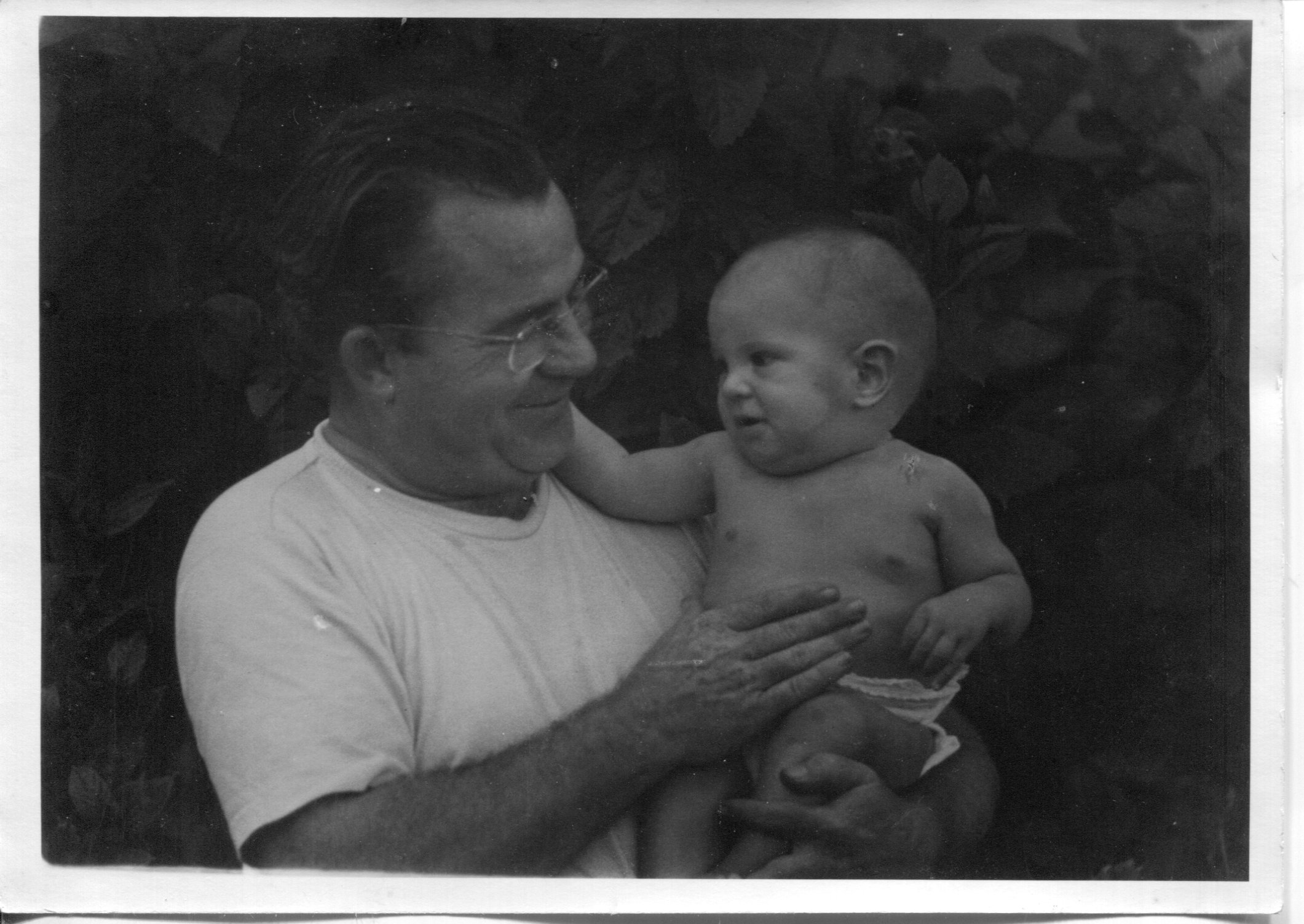
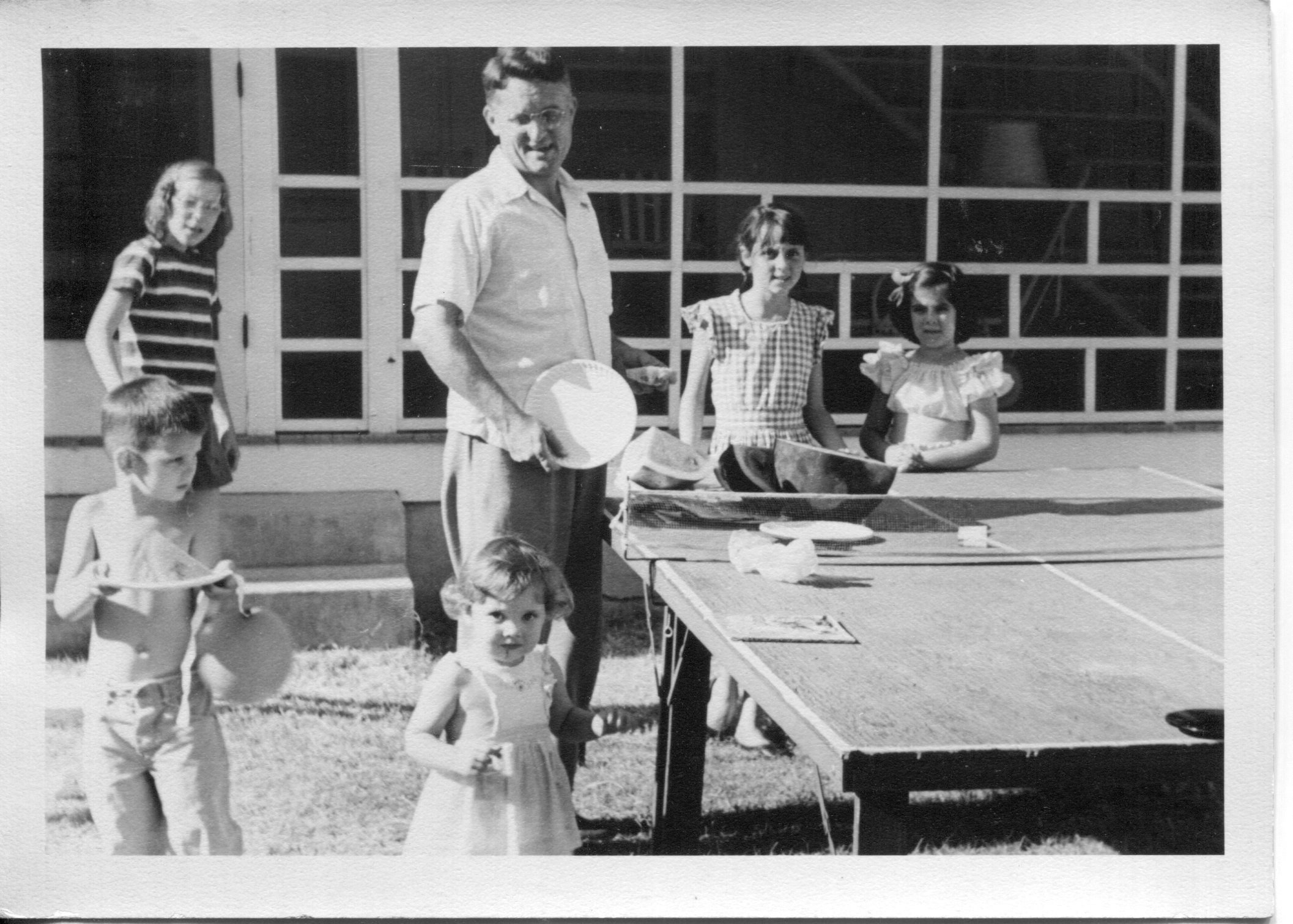
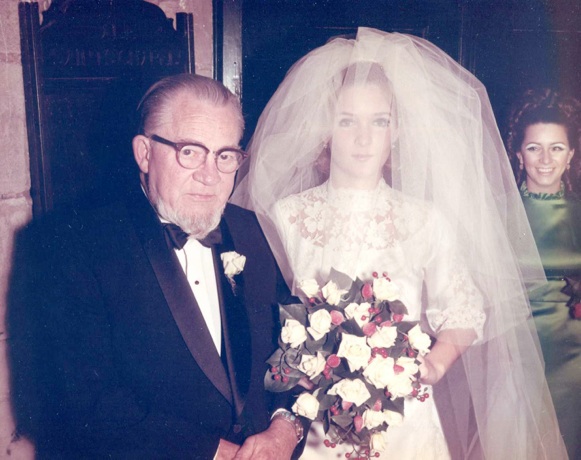
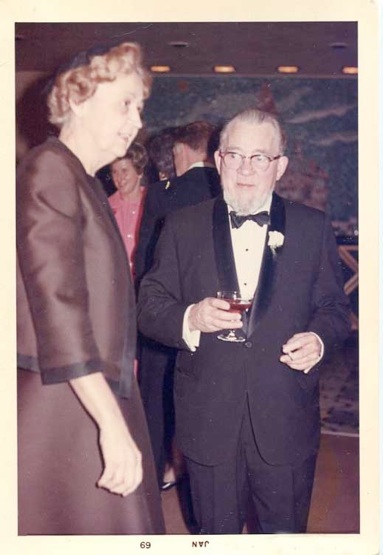
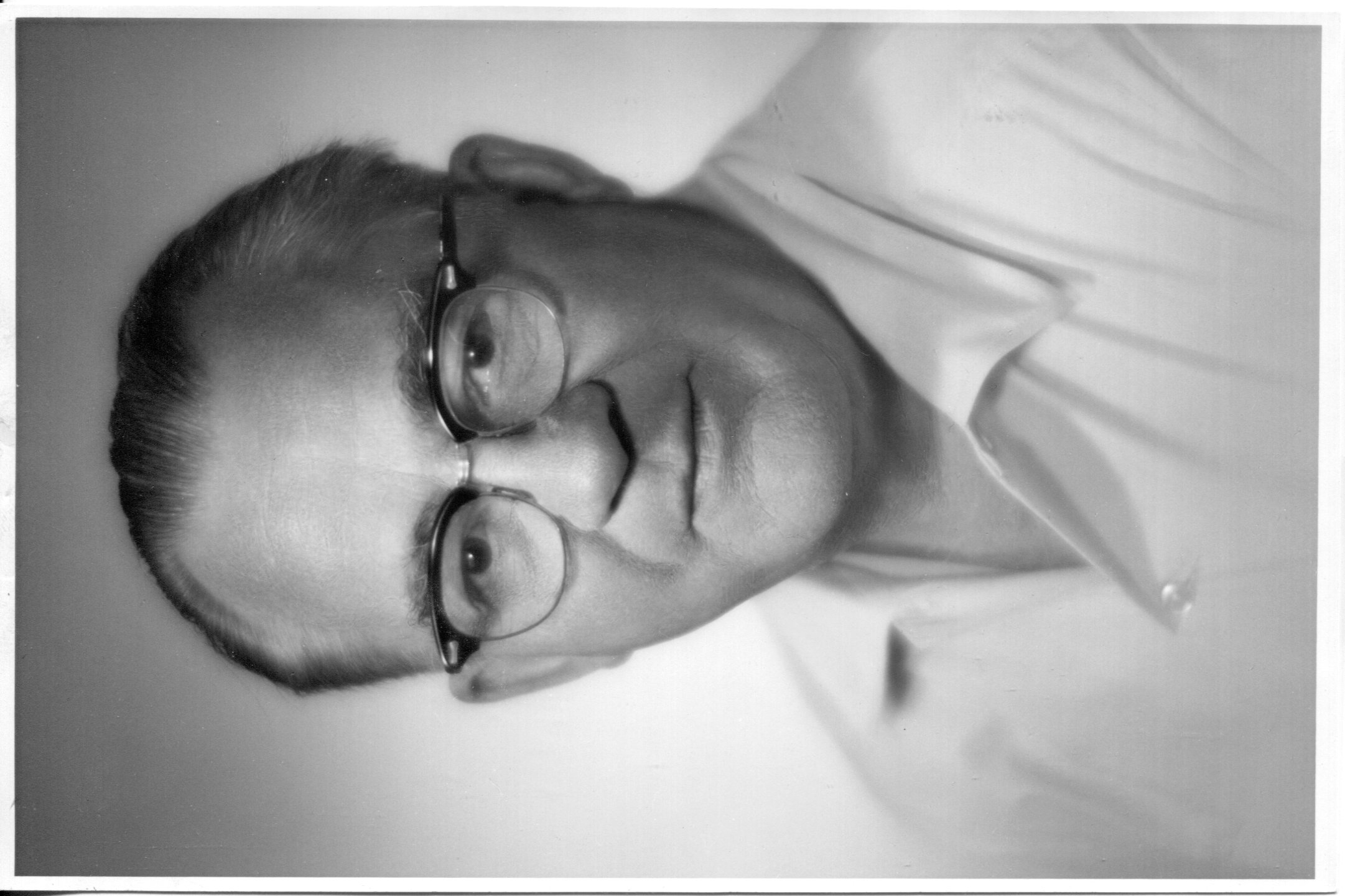
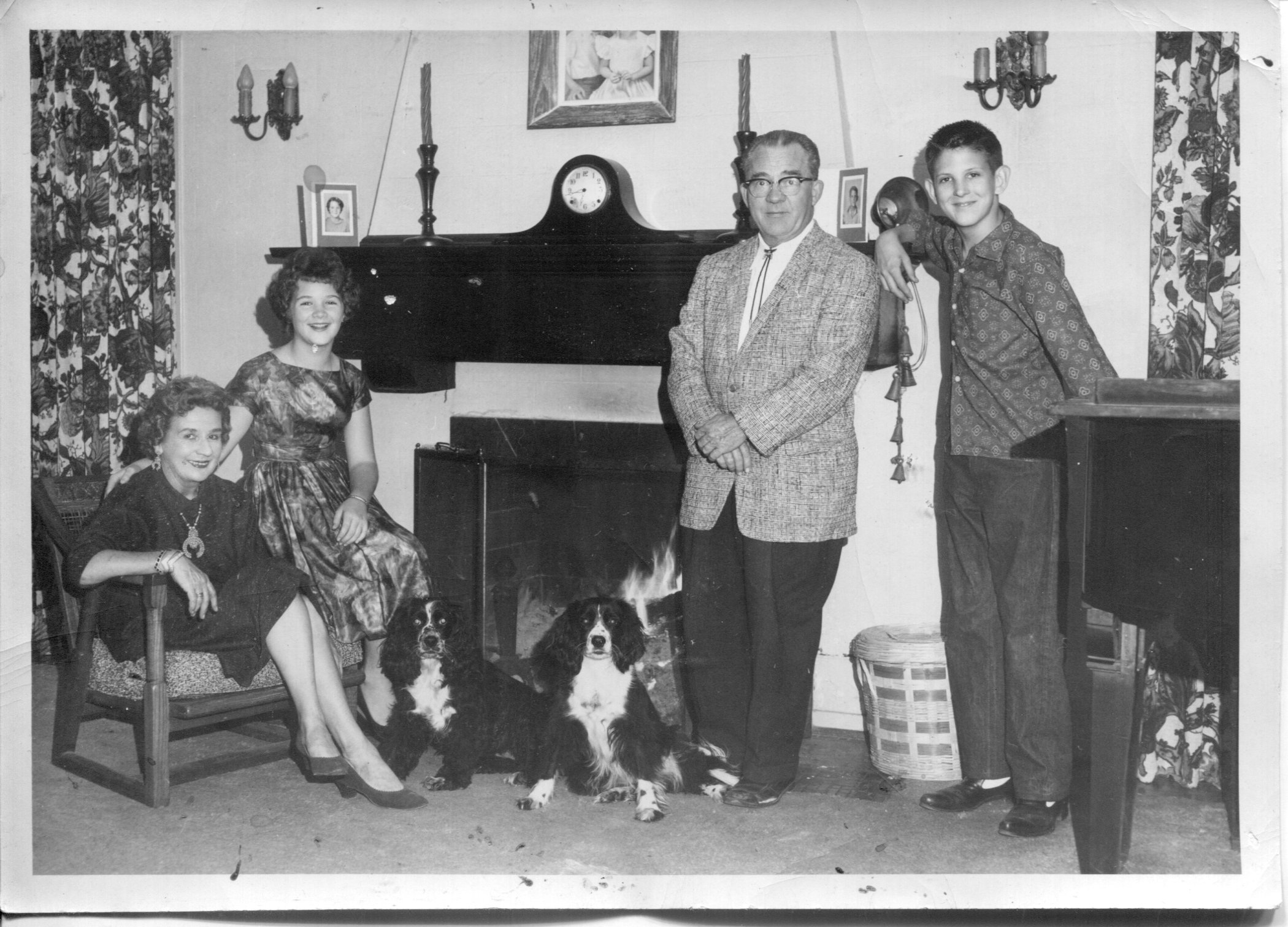
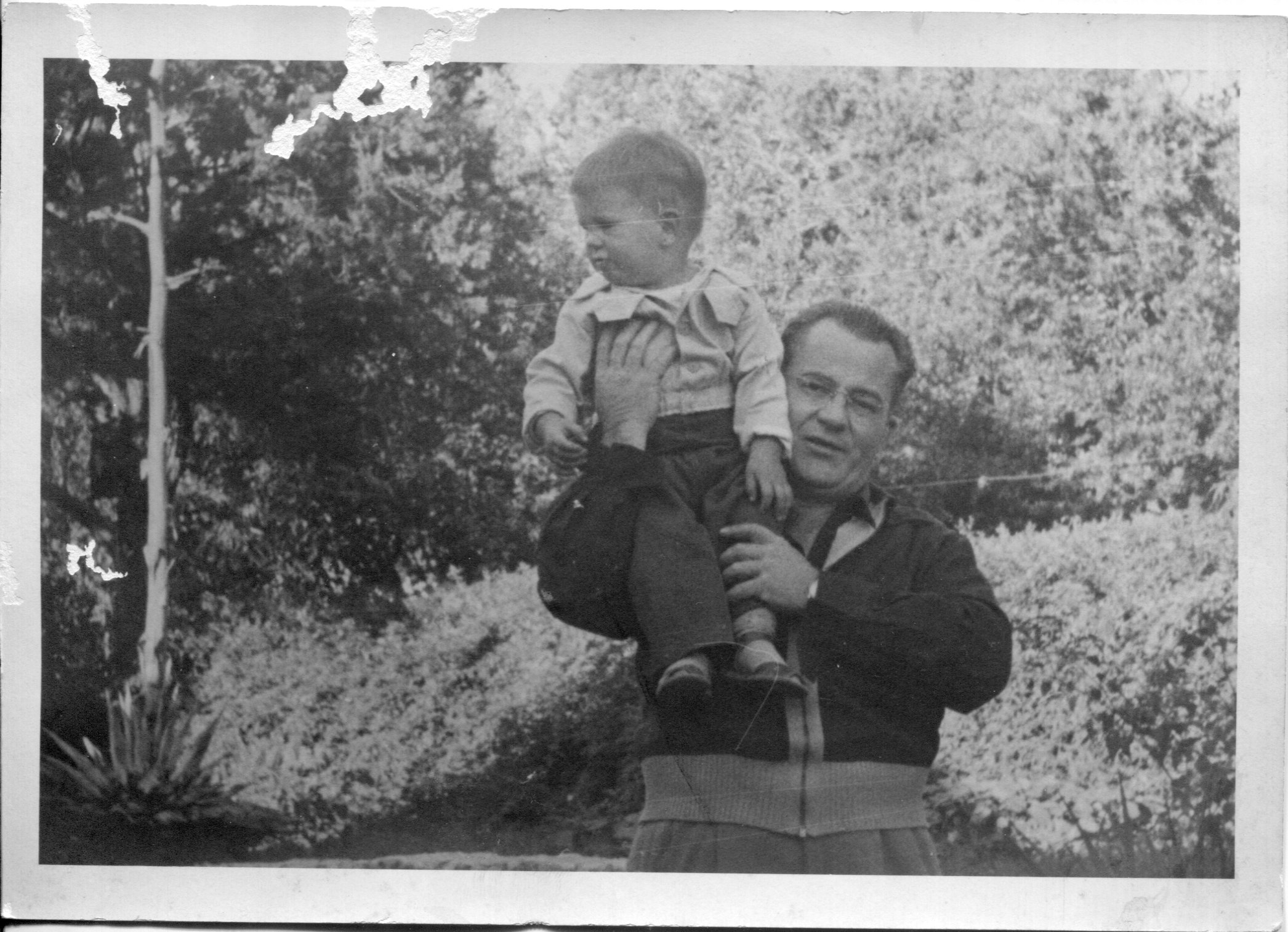
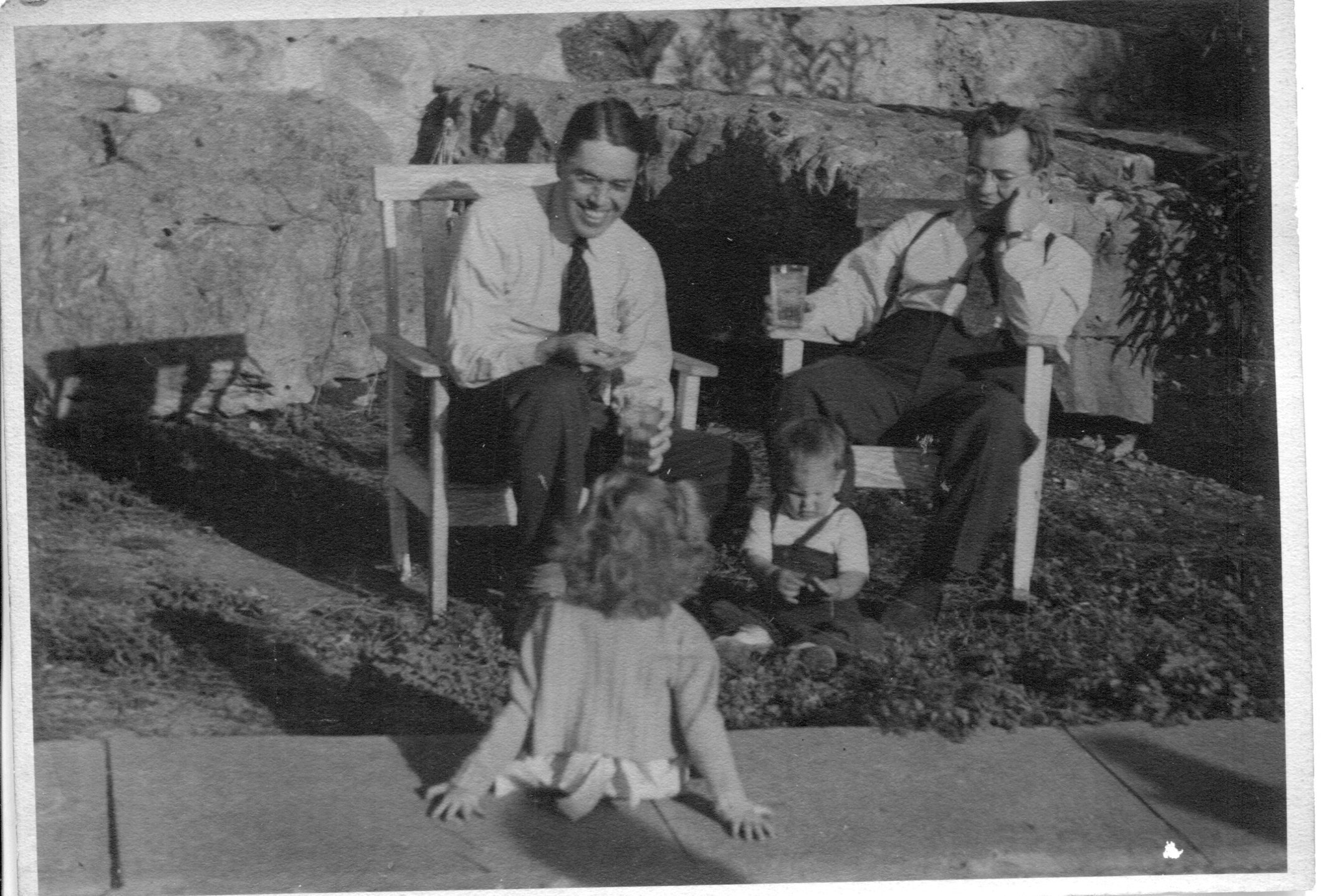
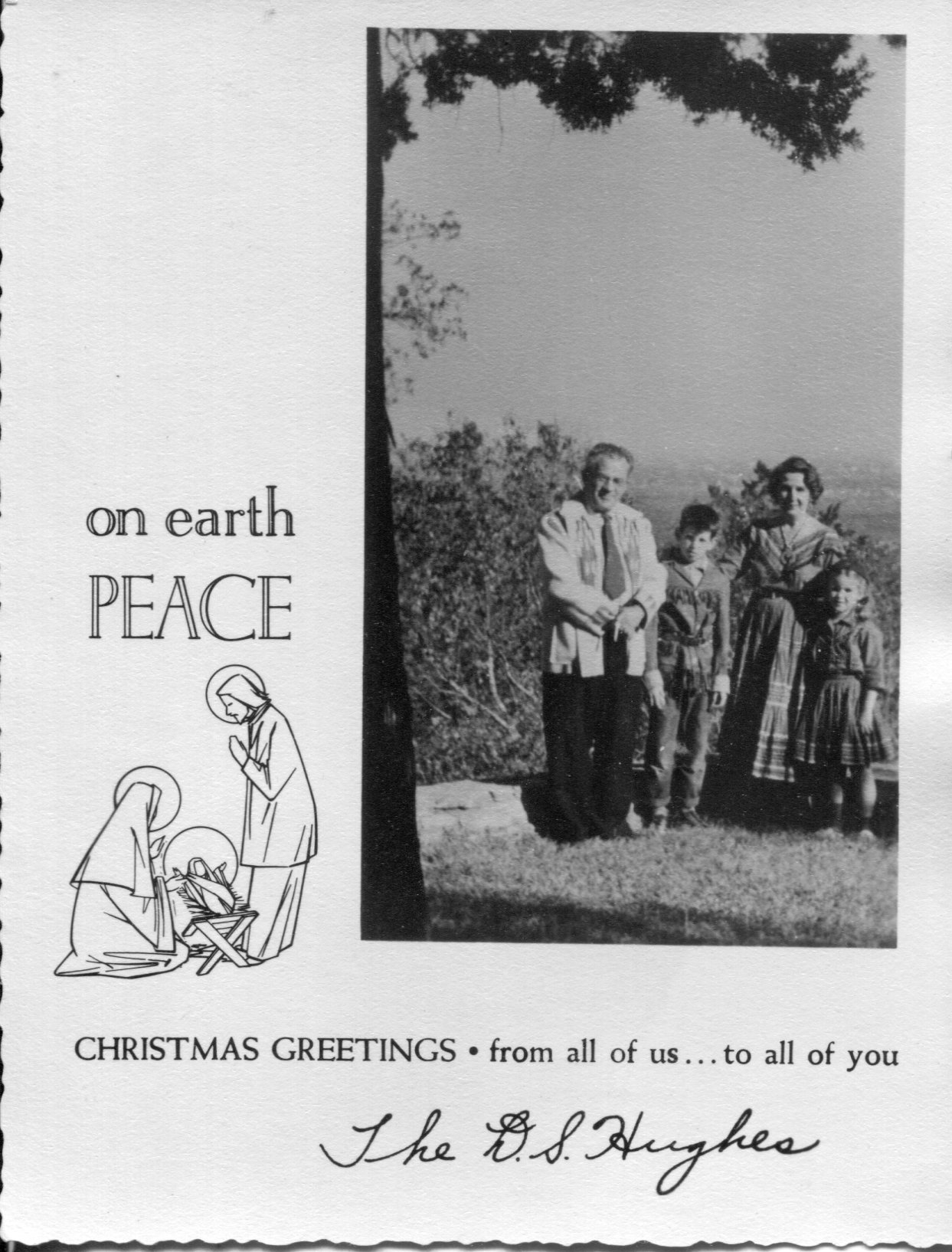
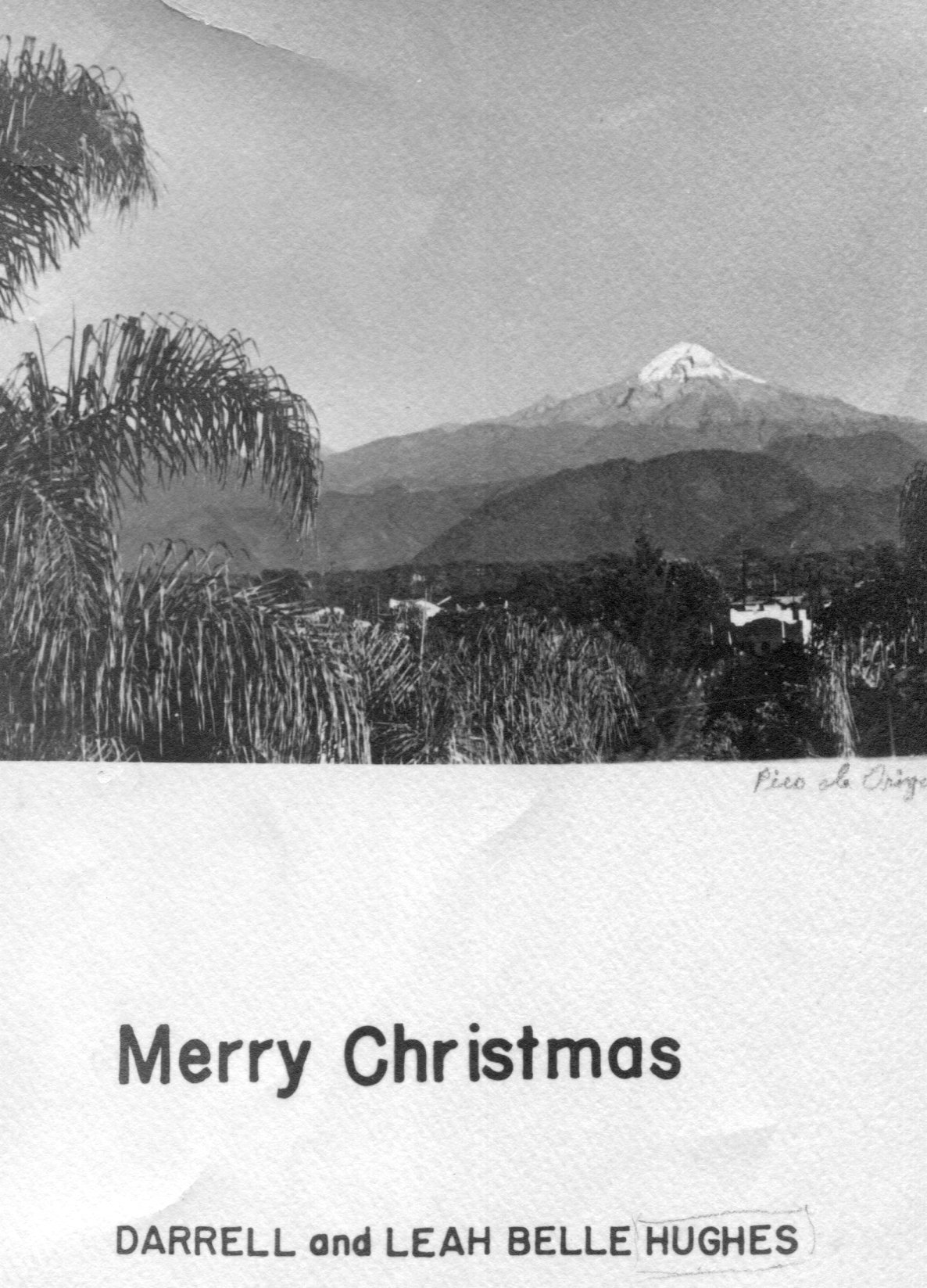
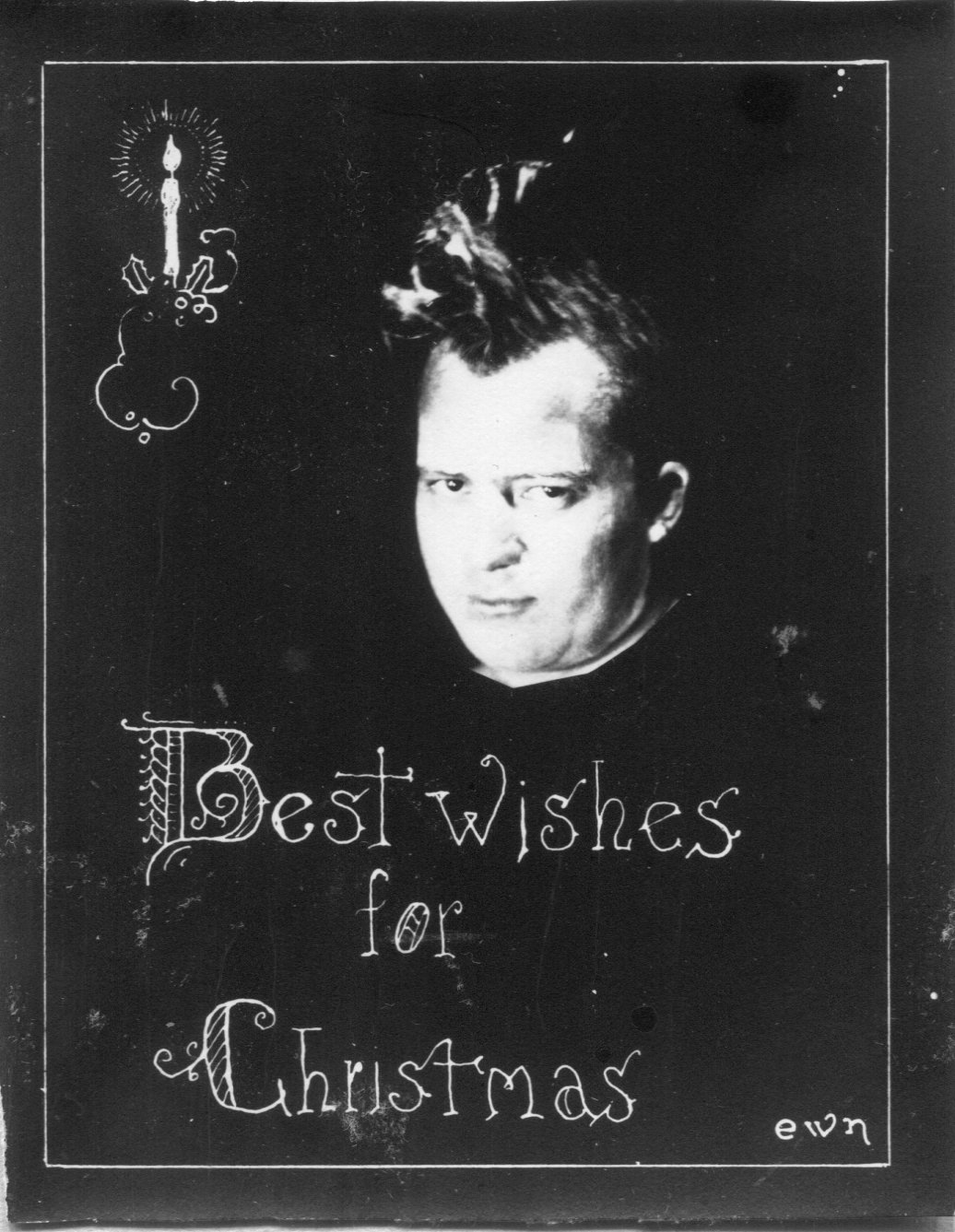
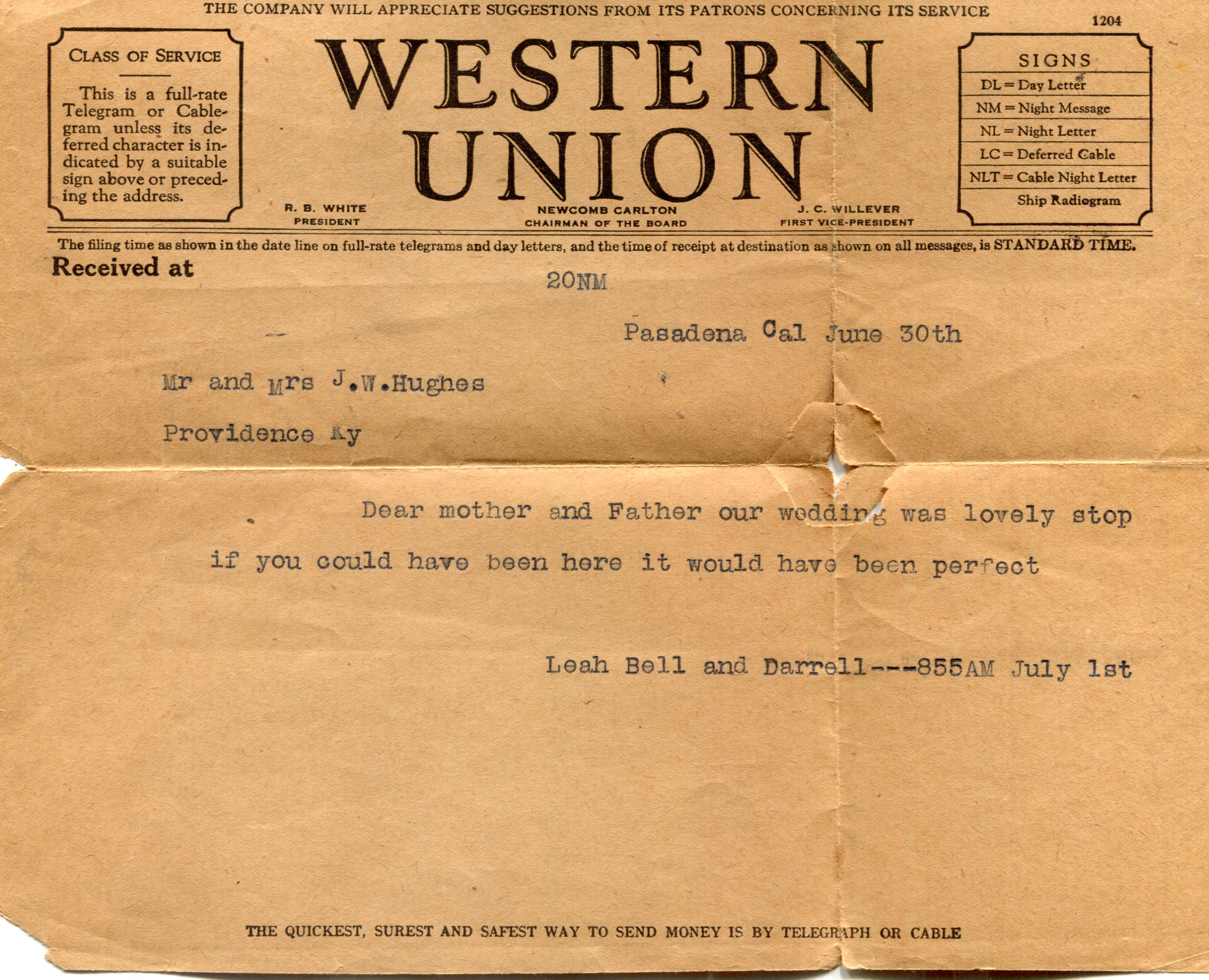
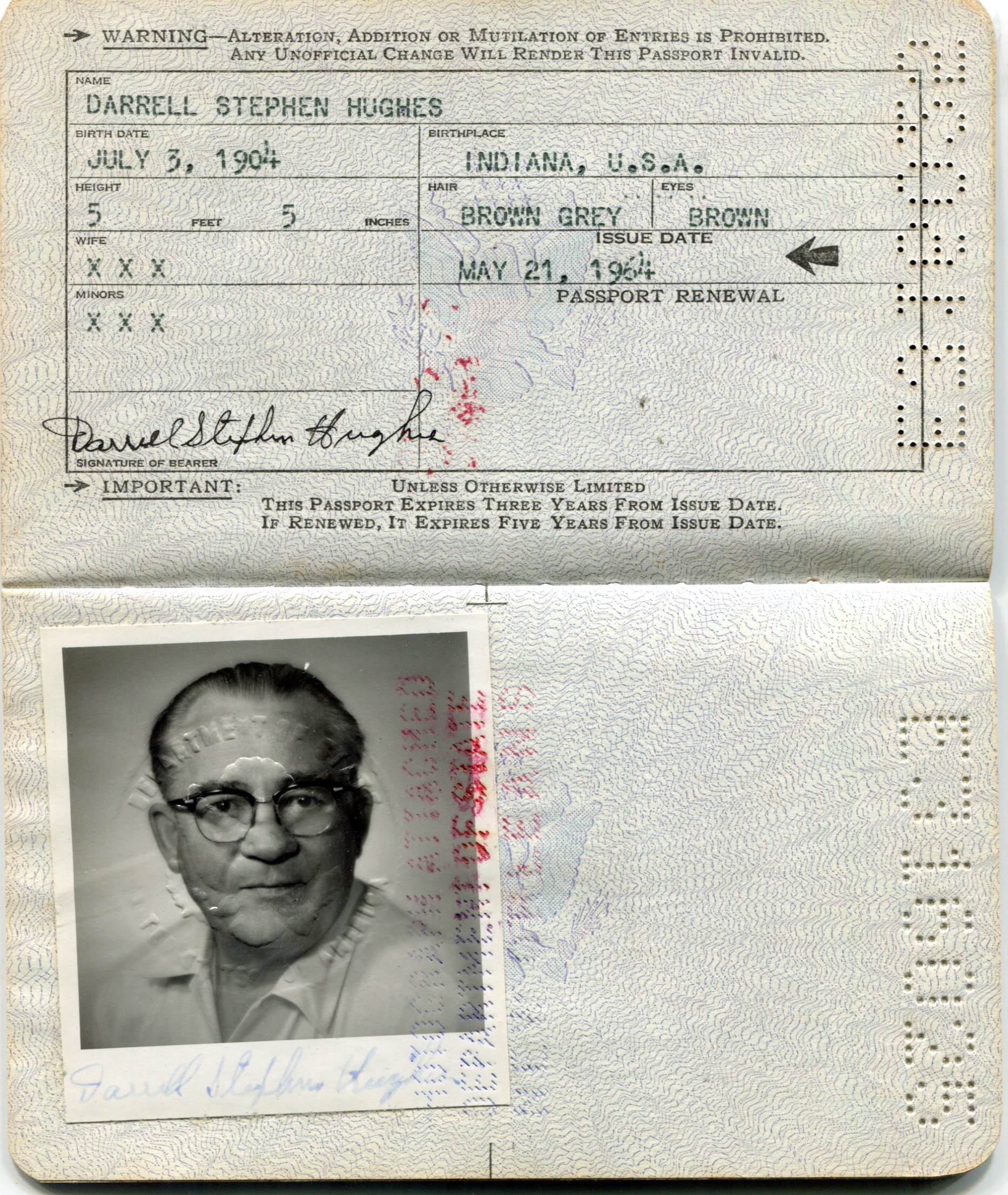
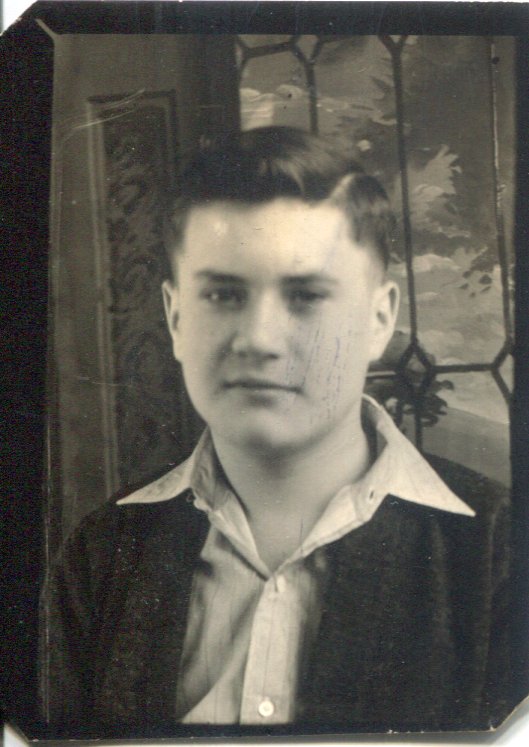
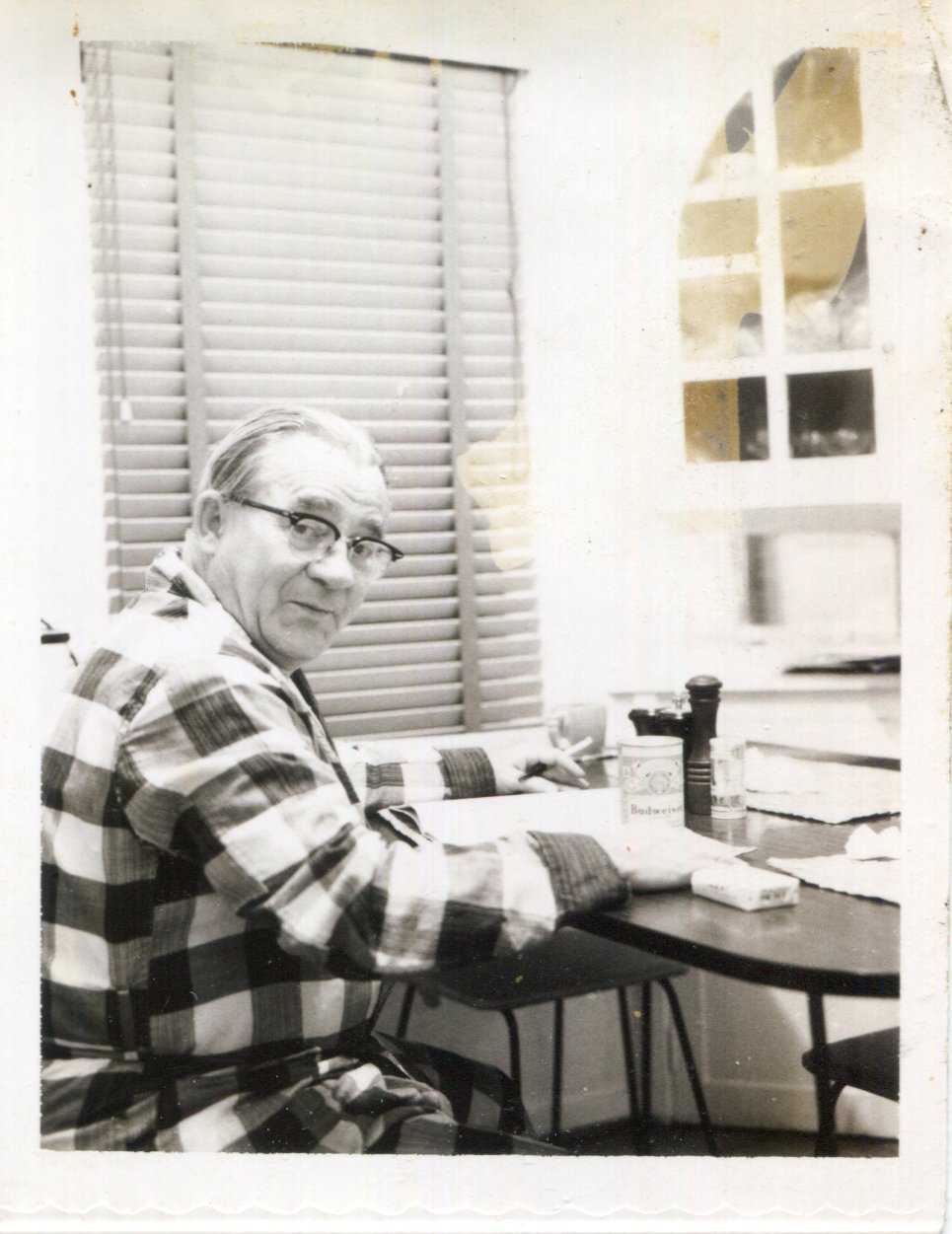
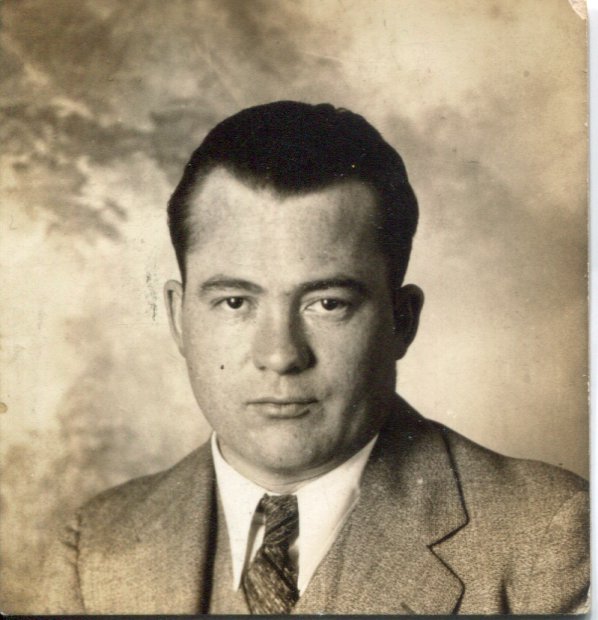
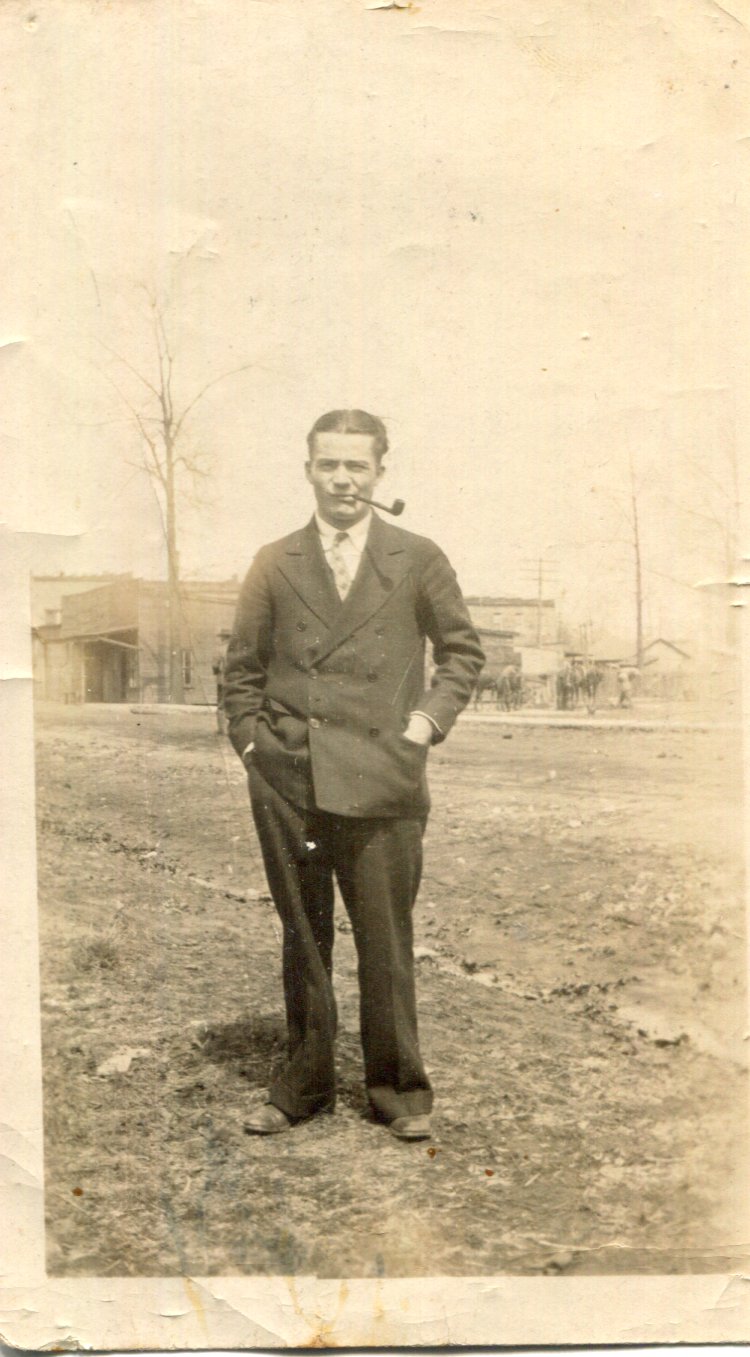
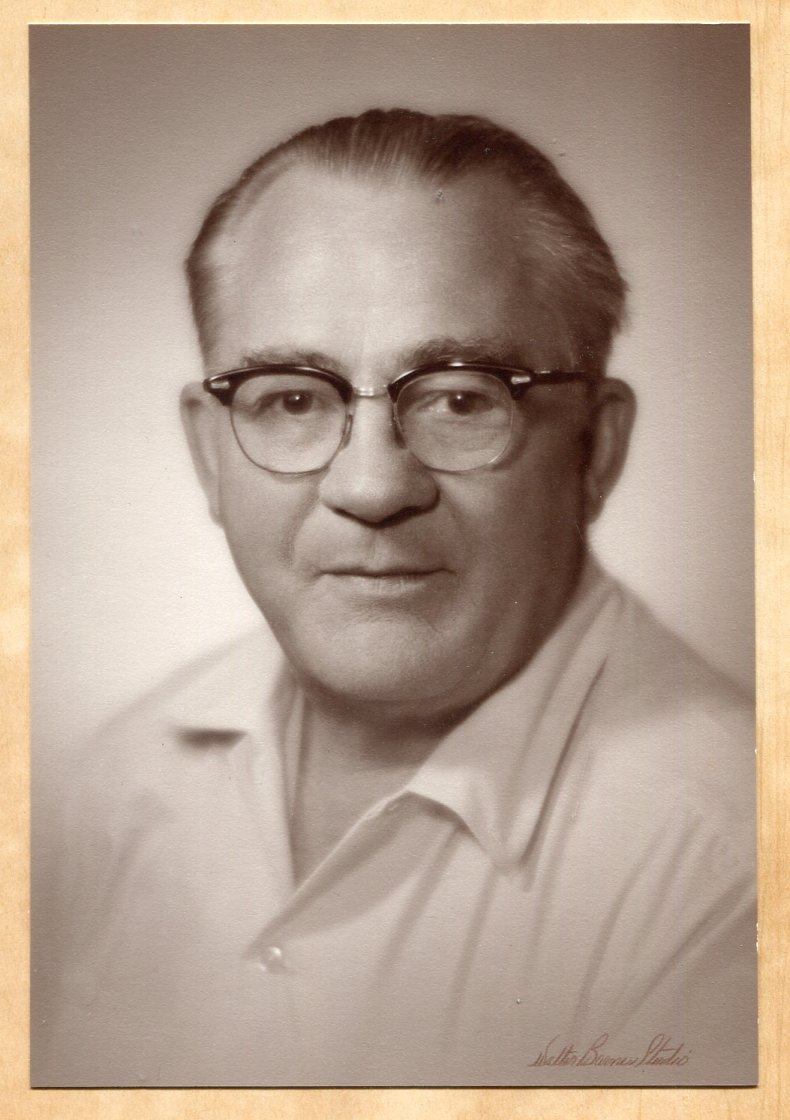
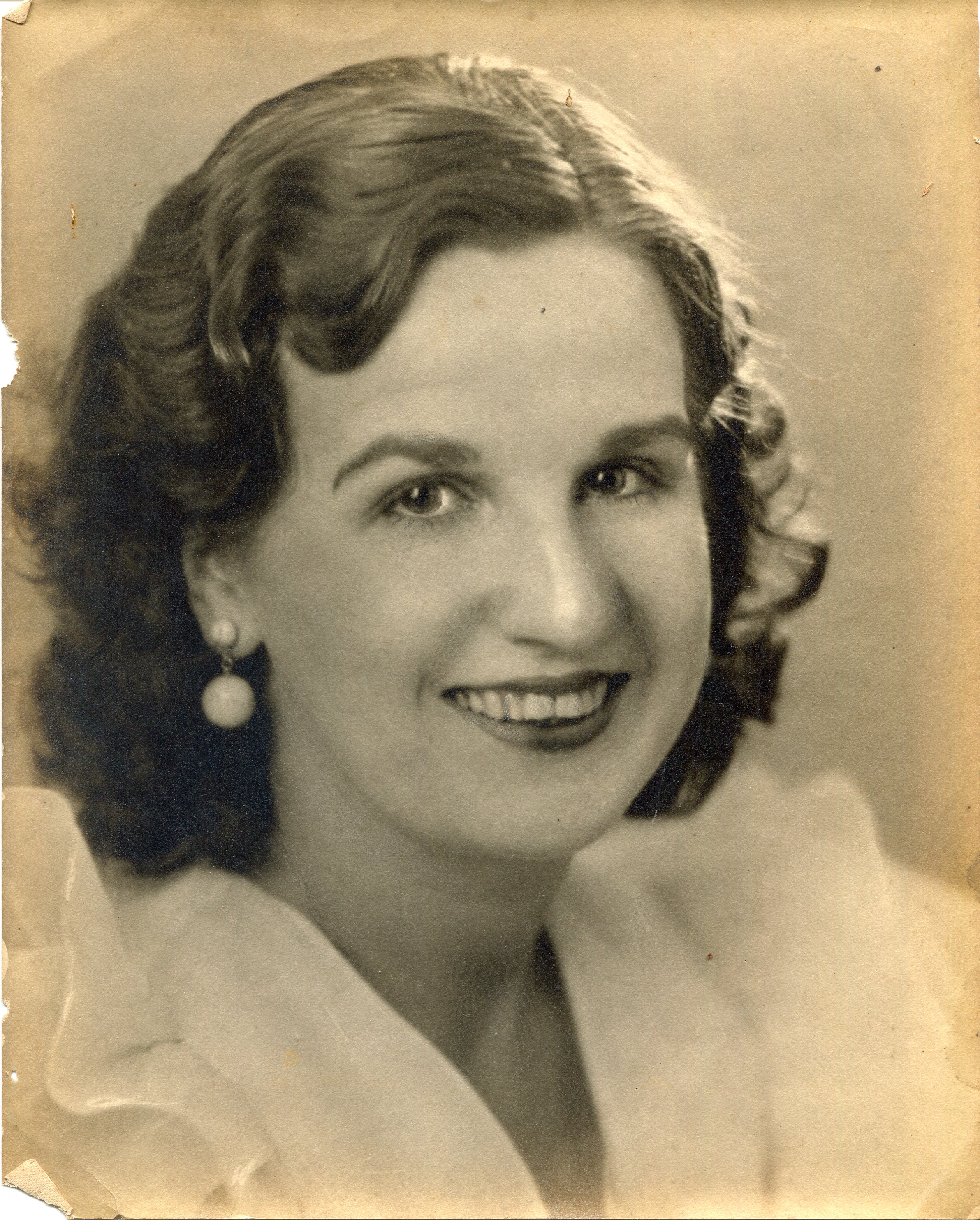
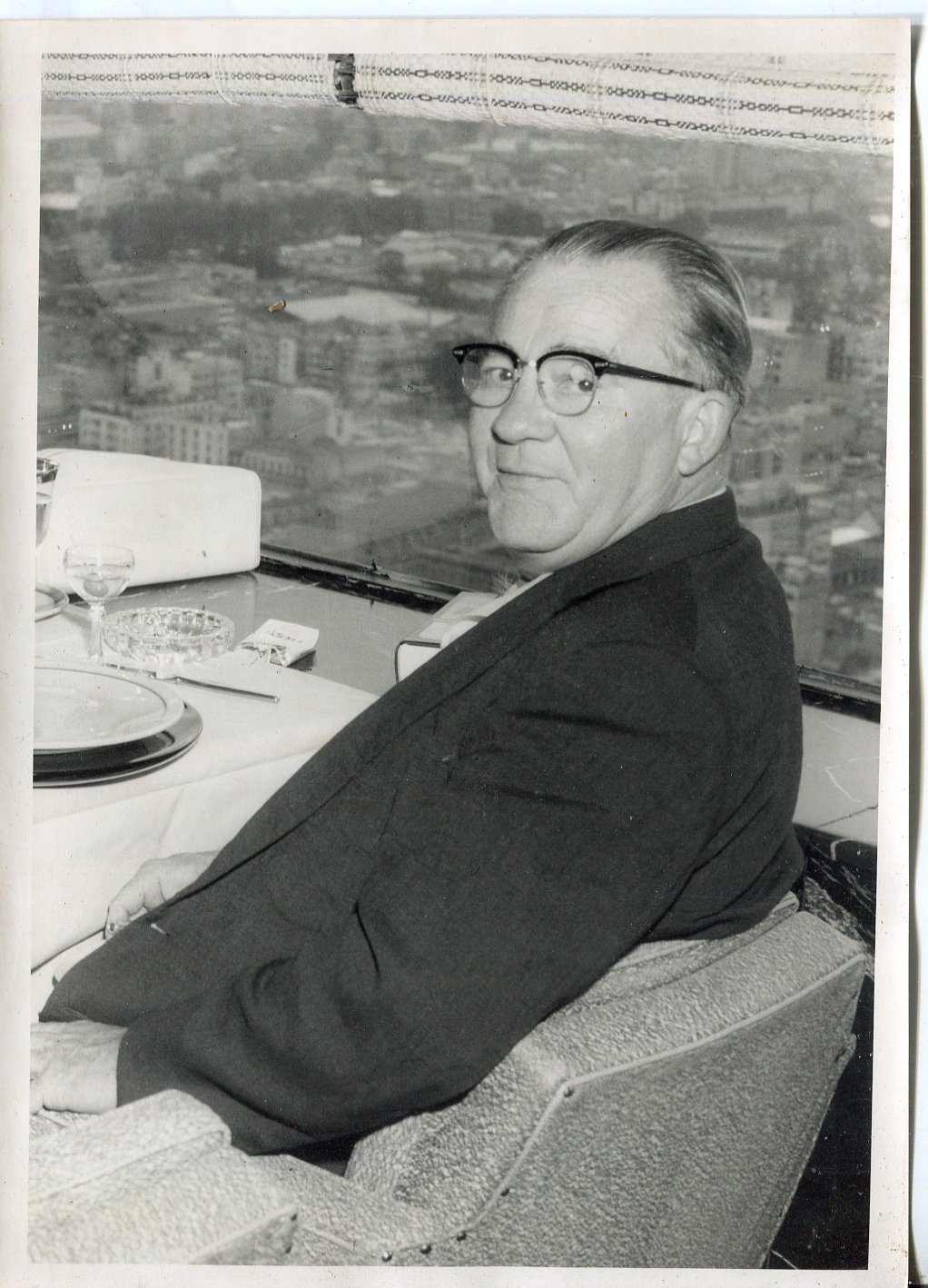
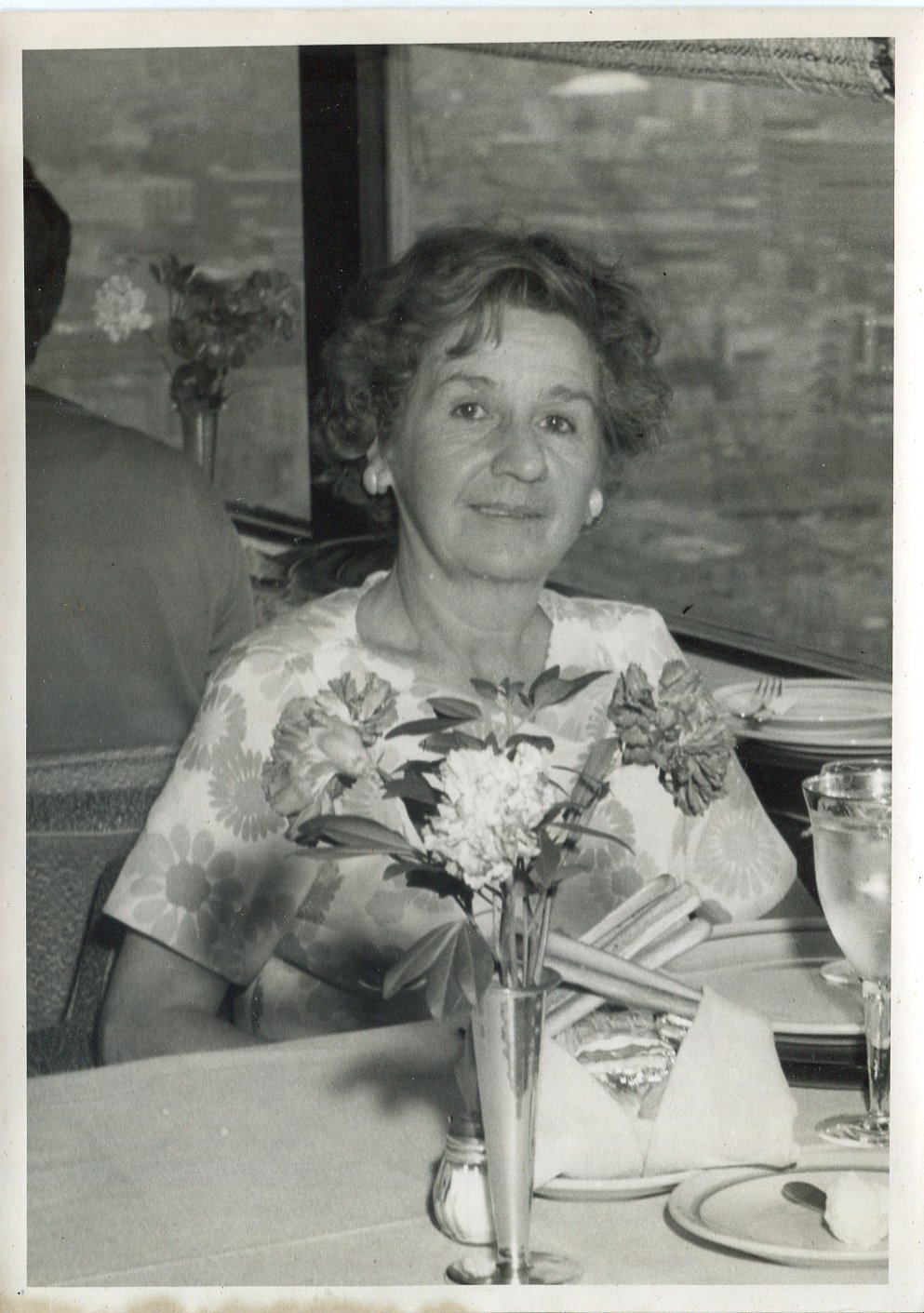
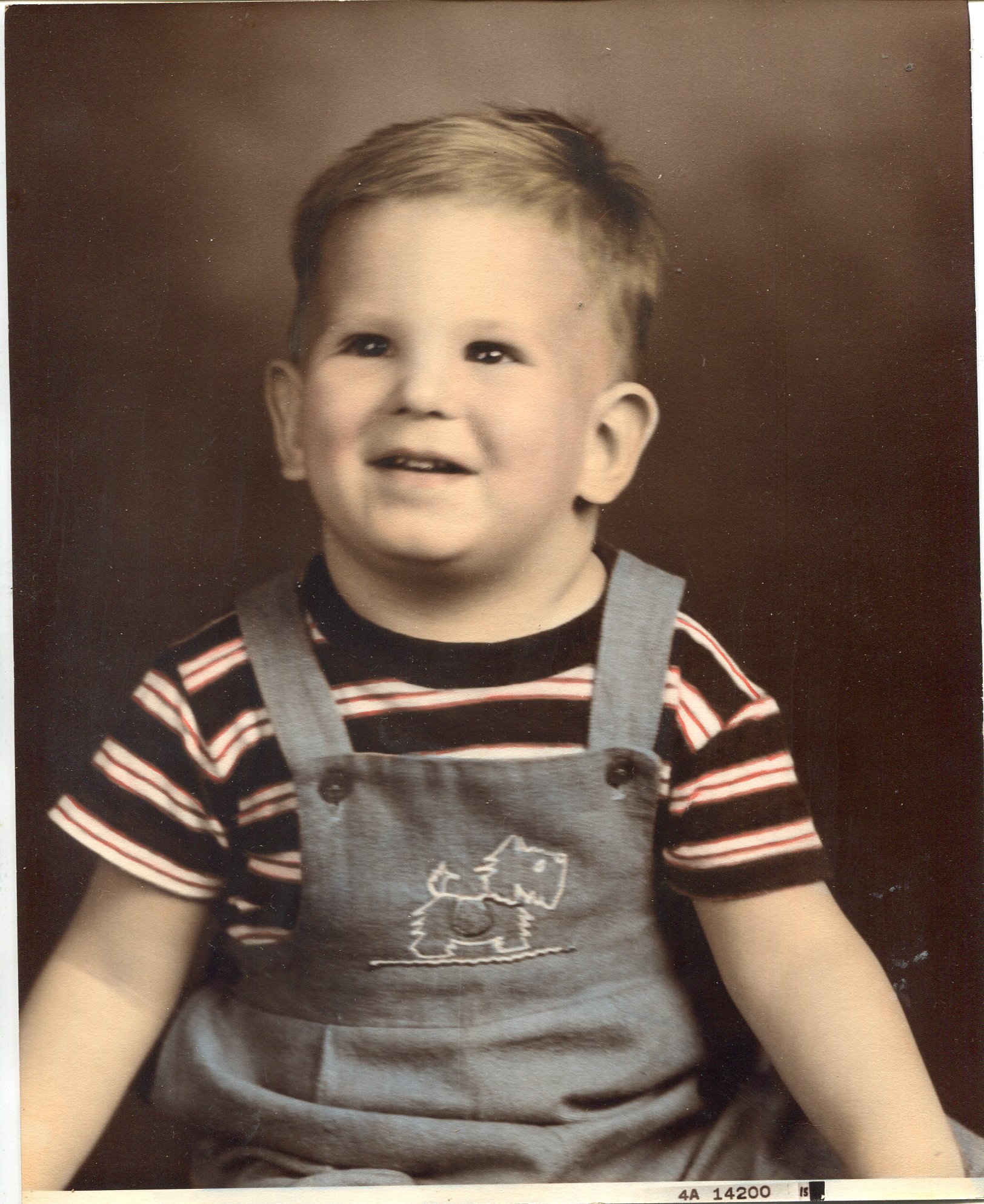
Professor Darrell Stephen Hughes (1904-1970), of the Department of Physics, died September 10, 1970, after a short illness. The last year of his life was greatly saddened by the loss of Mrs. Hughes (née Leah Belle Smith), who died suddenly on October 1, 1969, while on a visit to Nairobi, Kenya, Africa. They were married June 30, 1936, in California, and are survived by two children, James Frank and Cordelia Brooks (Mrs. Dunning Bright). (Portrait by Walter Barnes Studio, Austin)
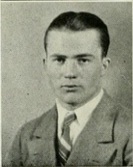
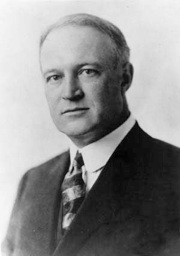

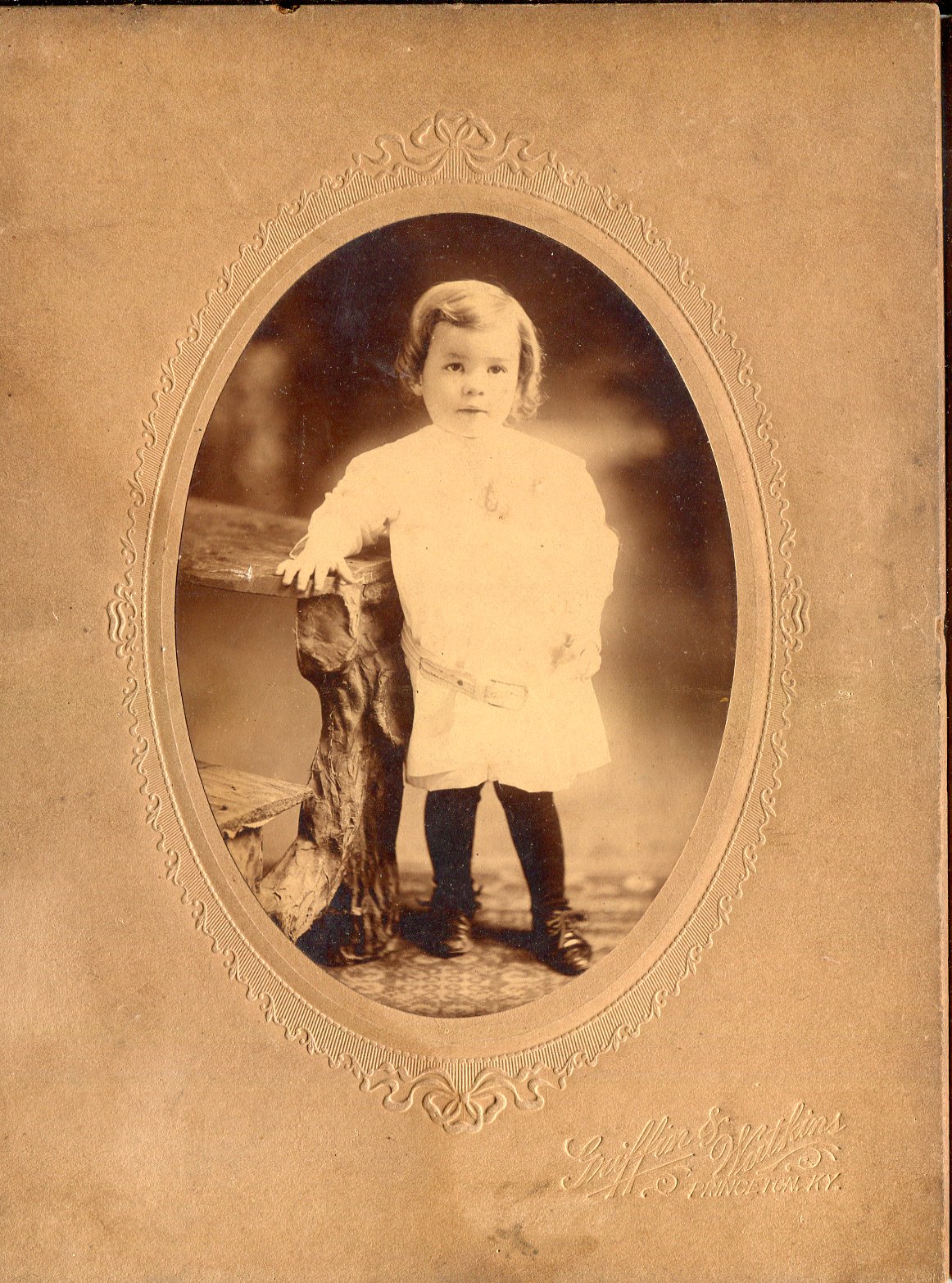
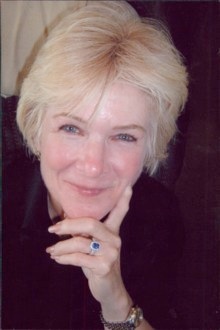
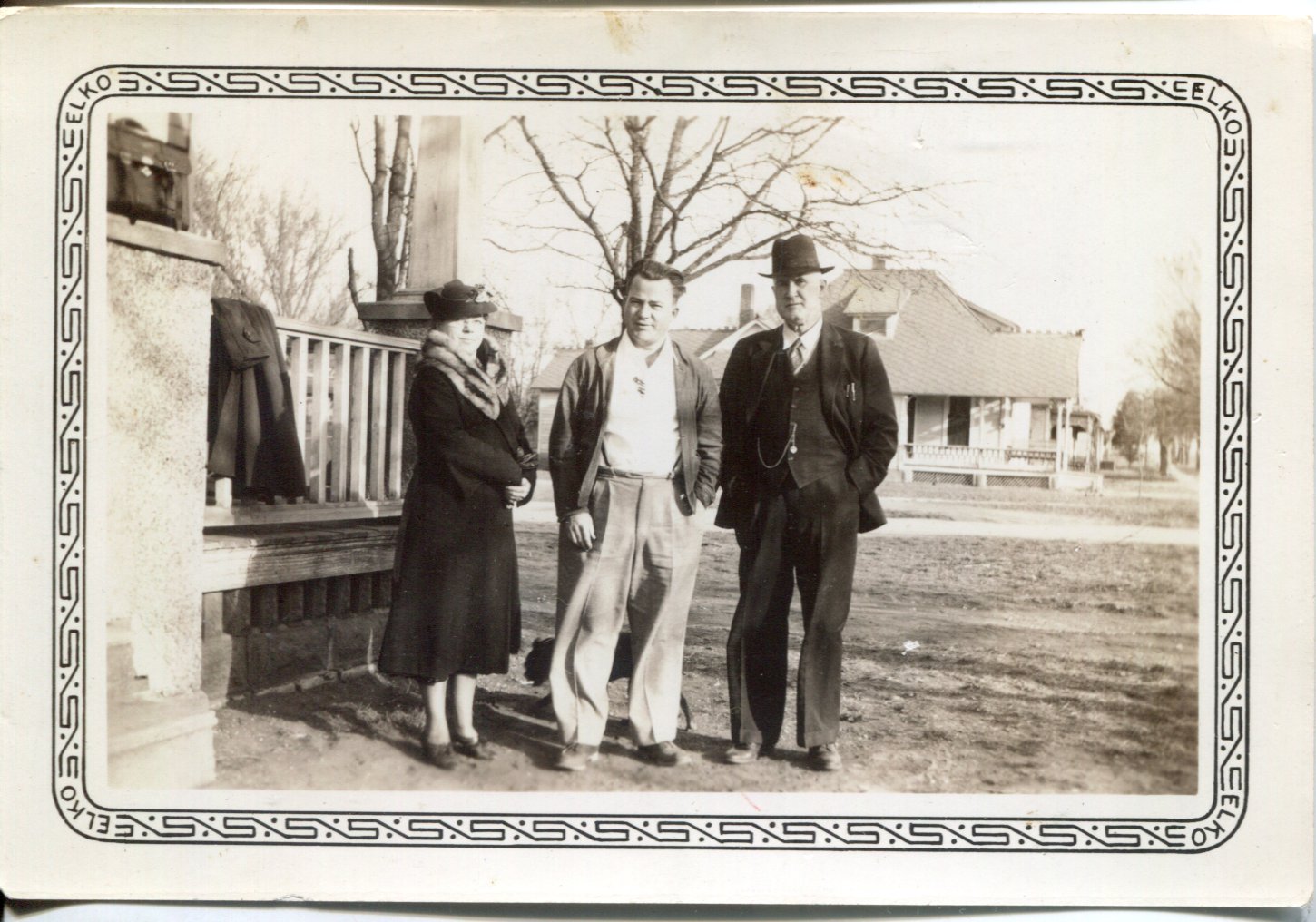
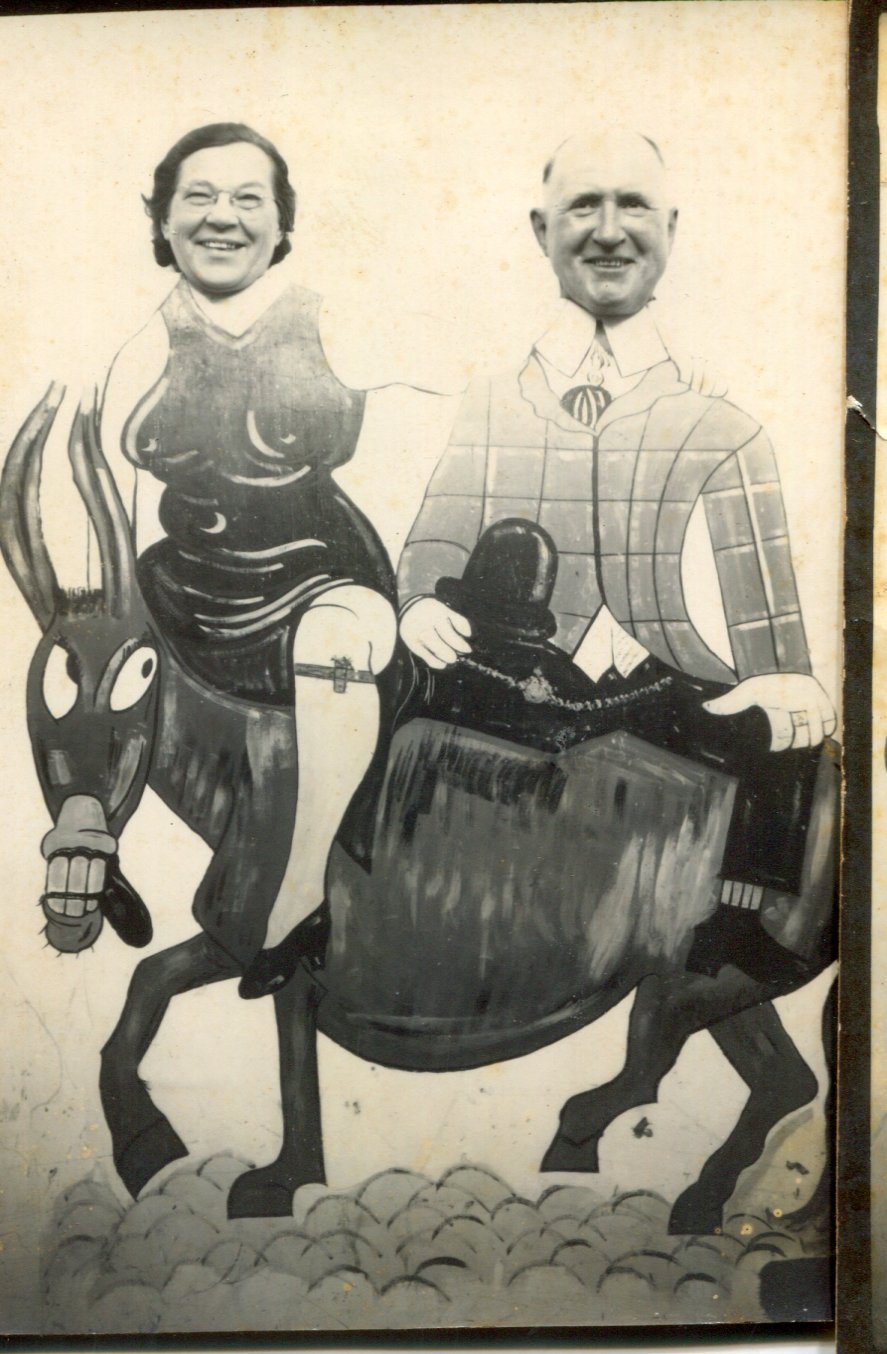
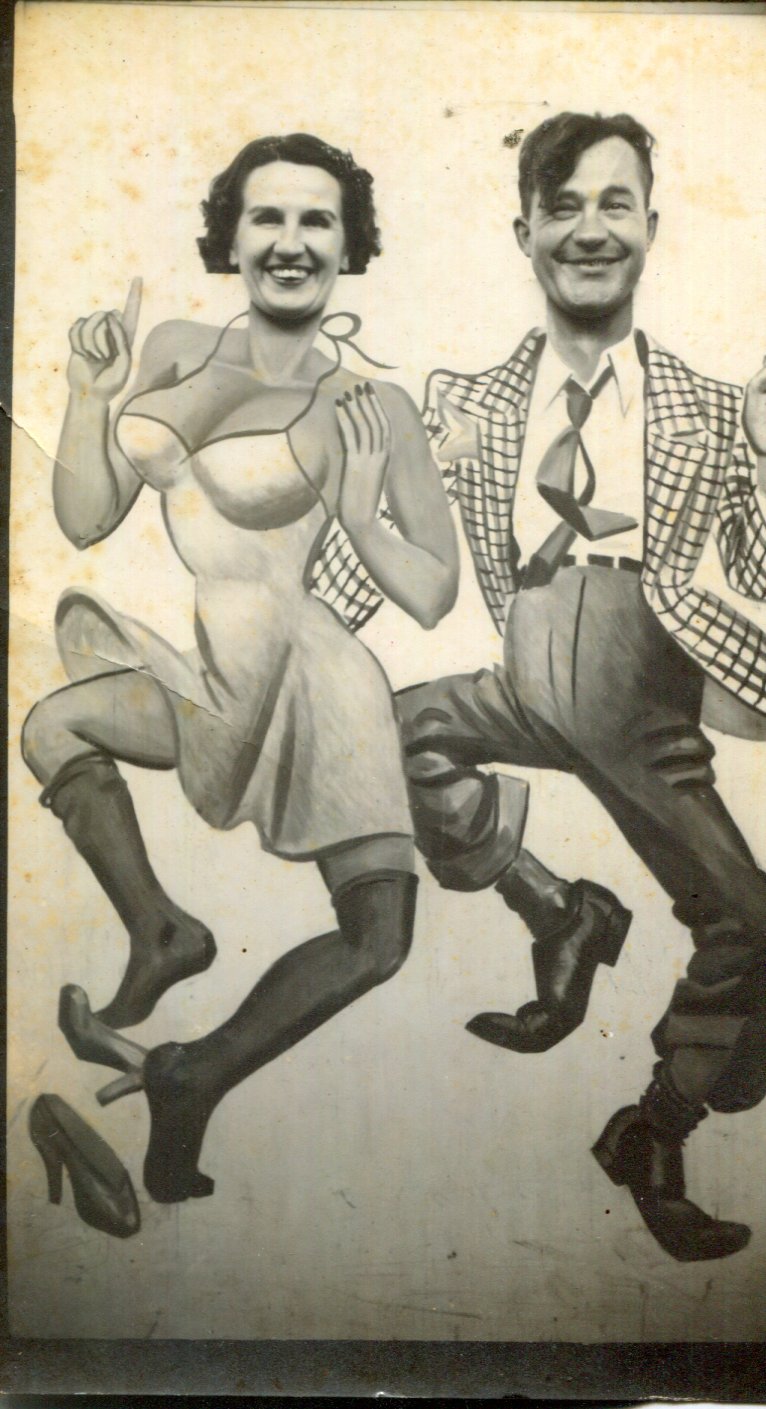
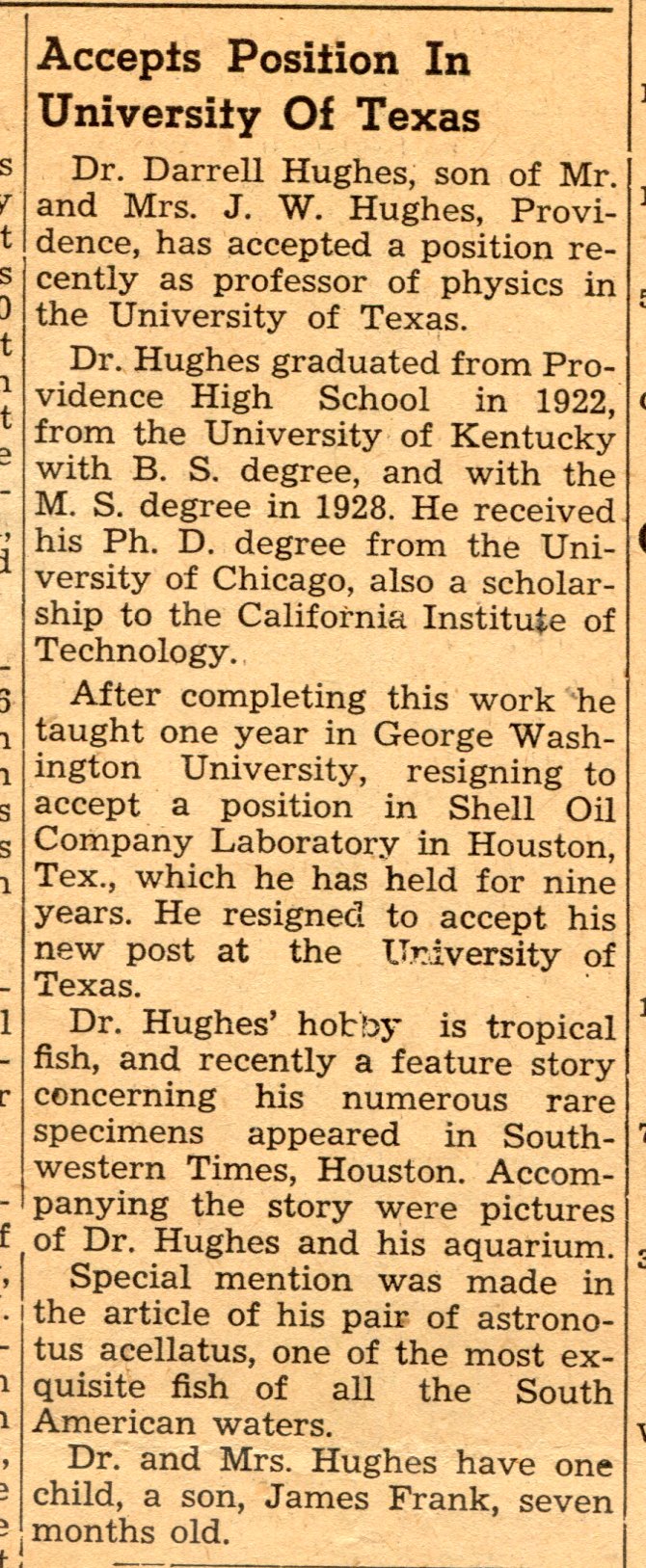
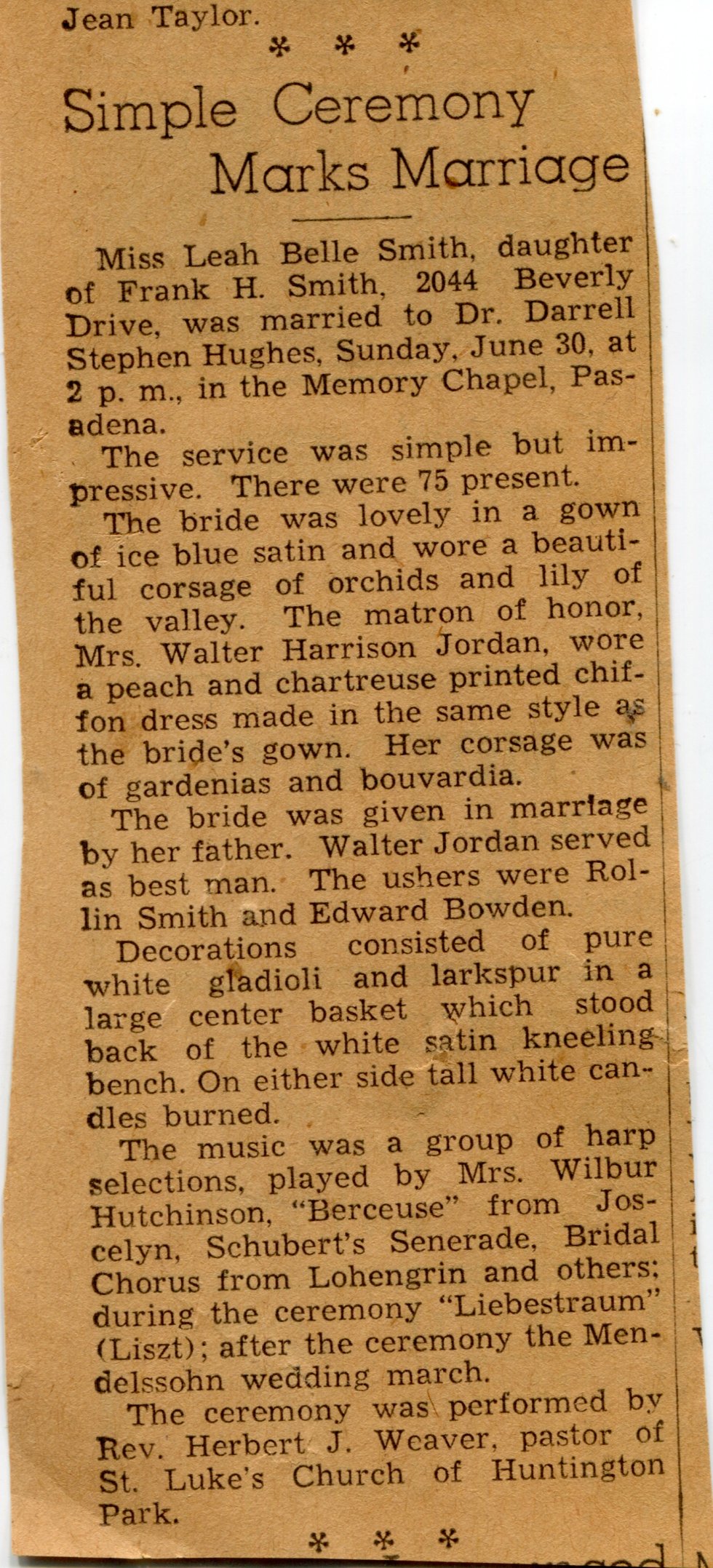
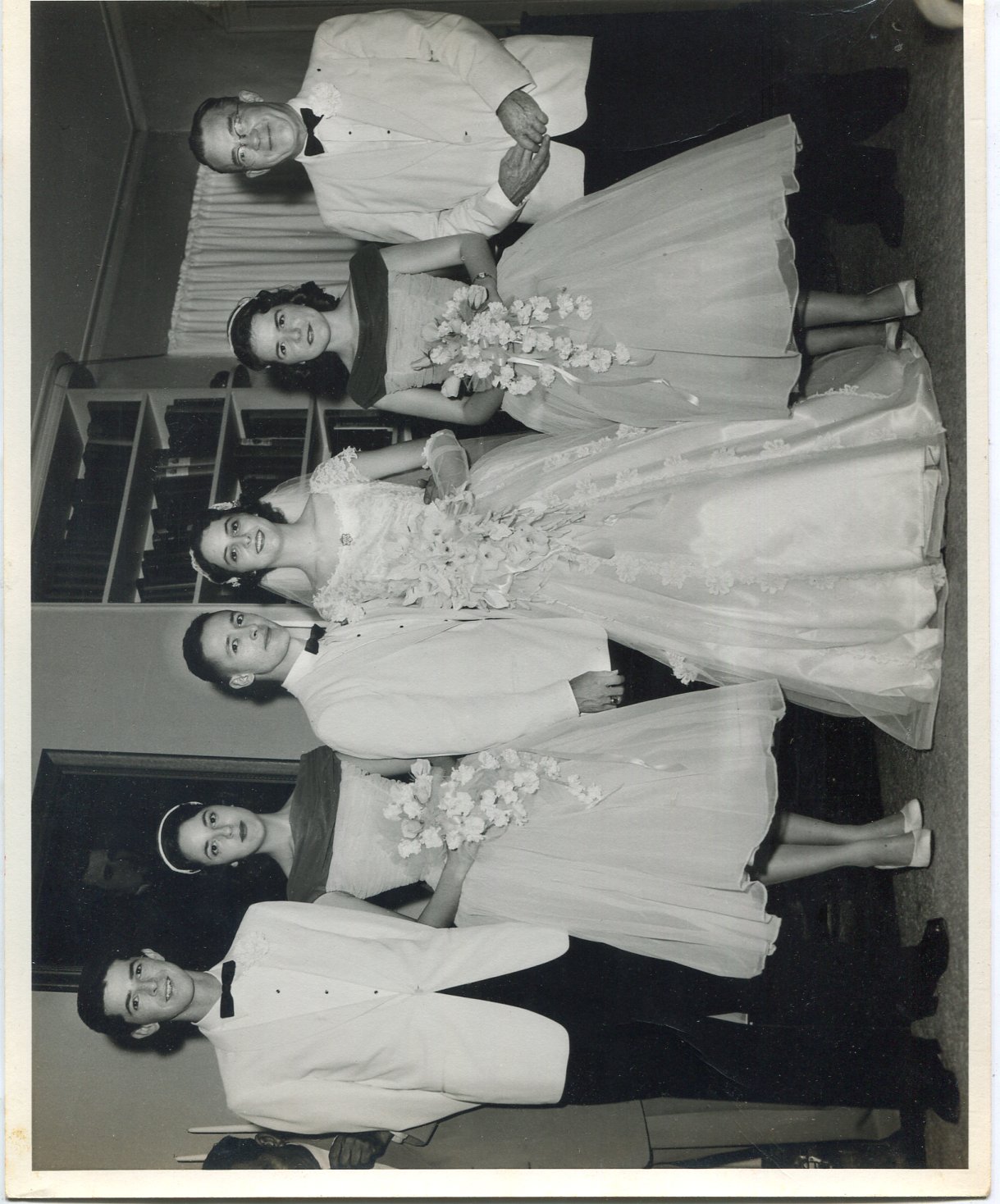
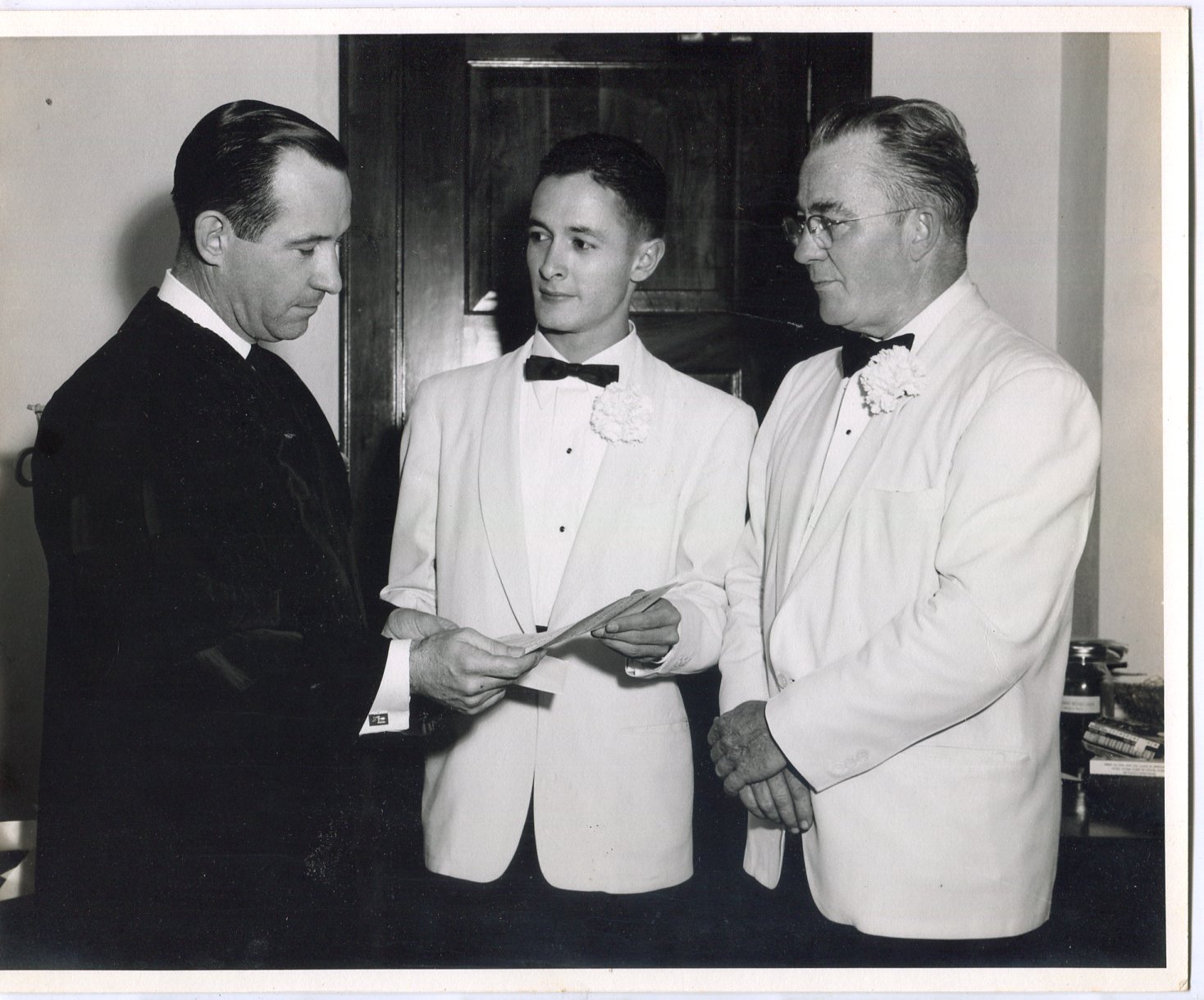
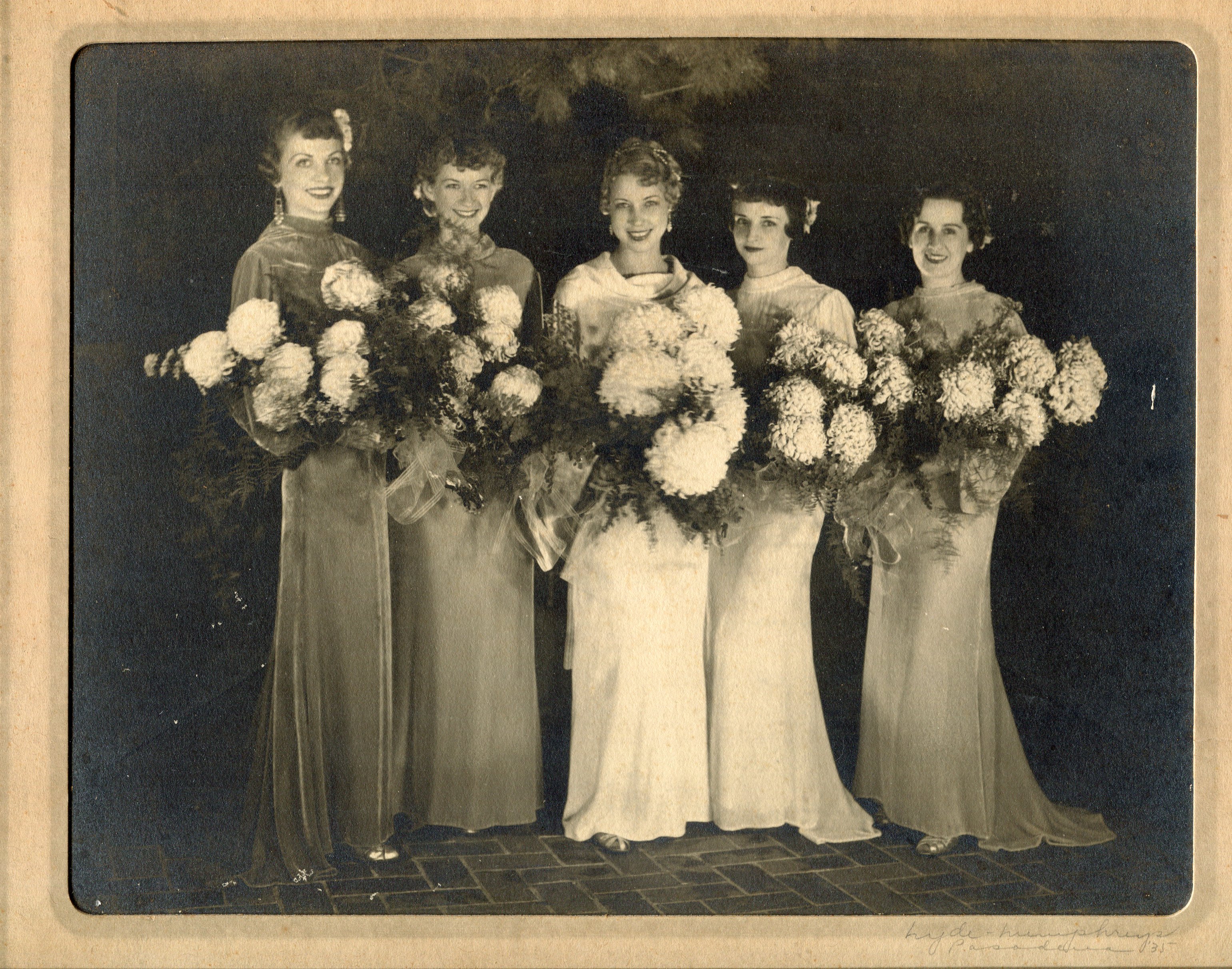
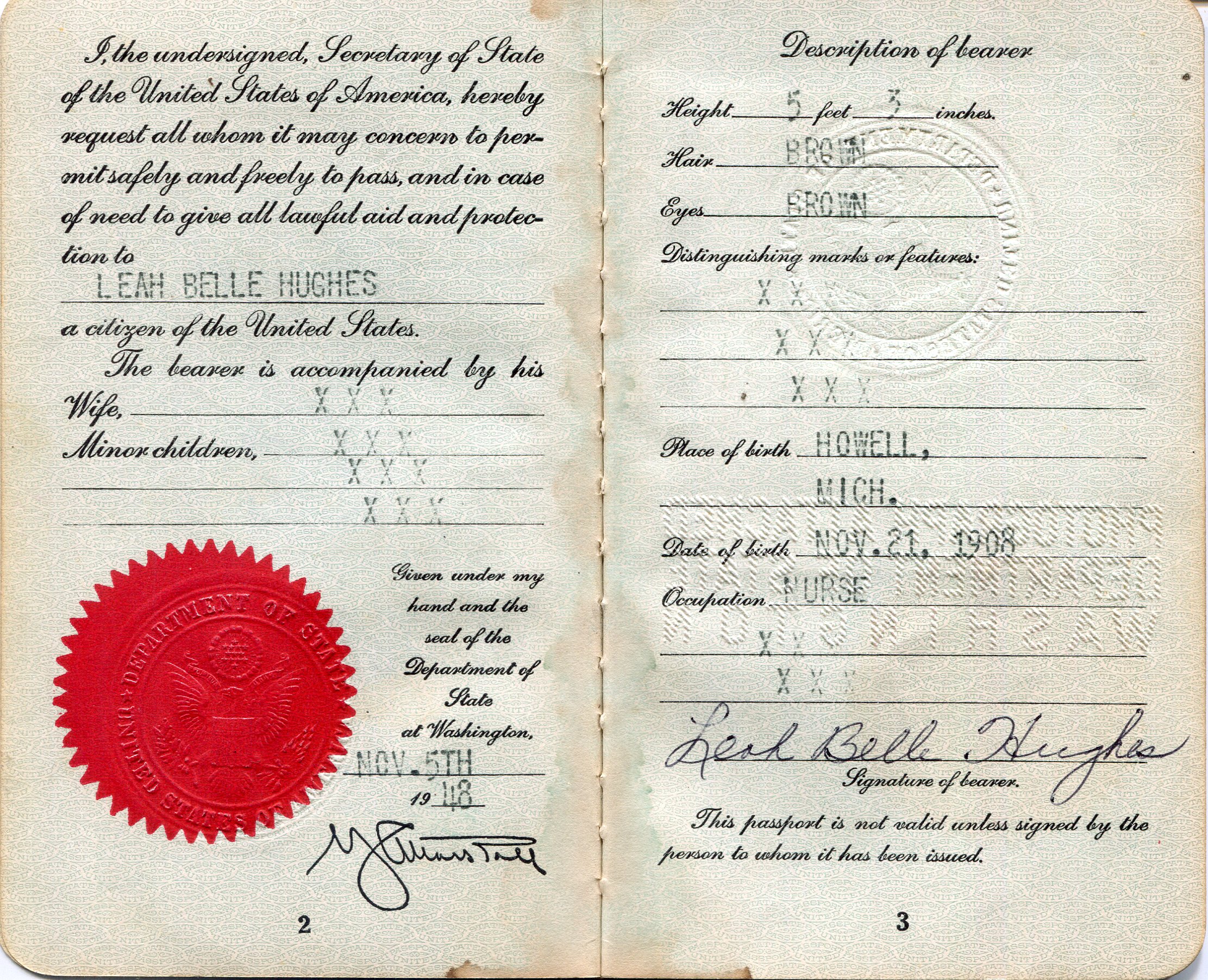
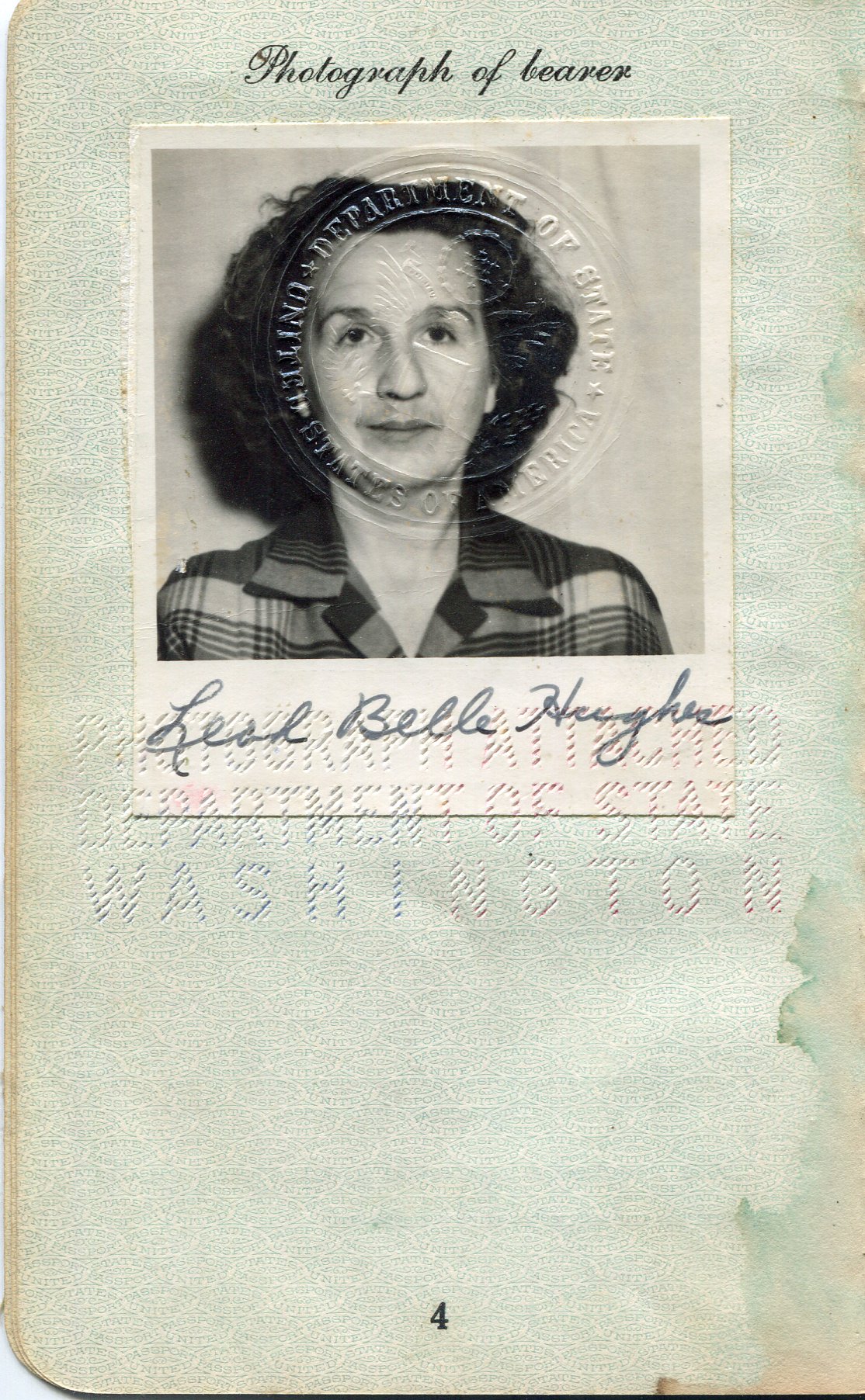
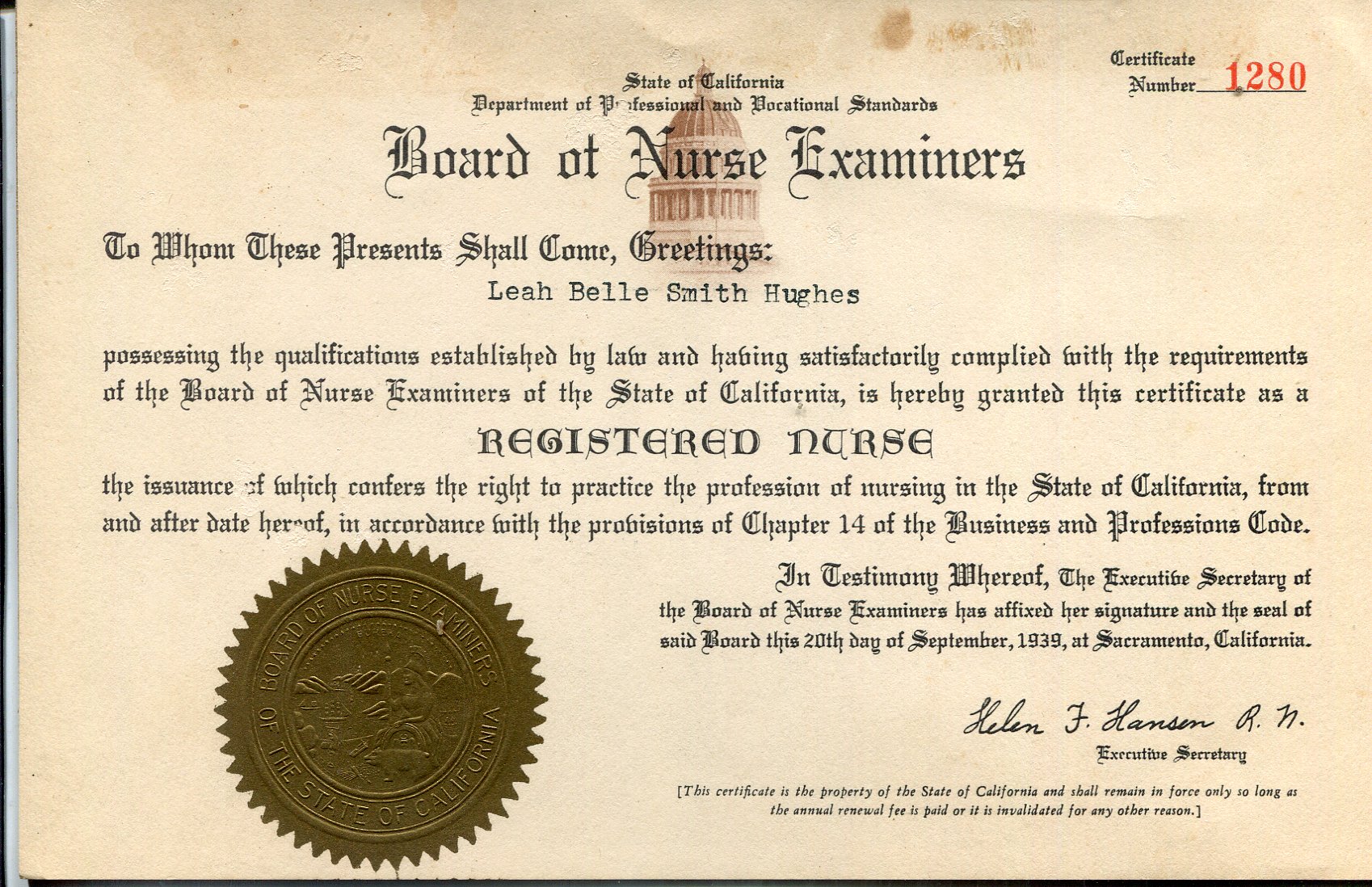
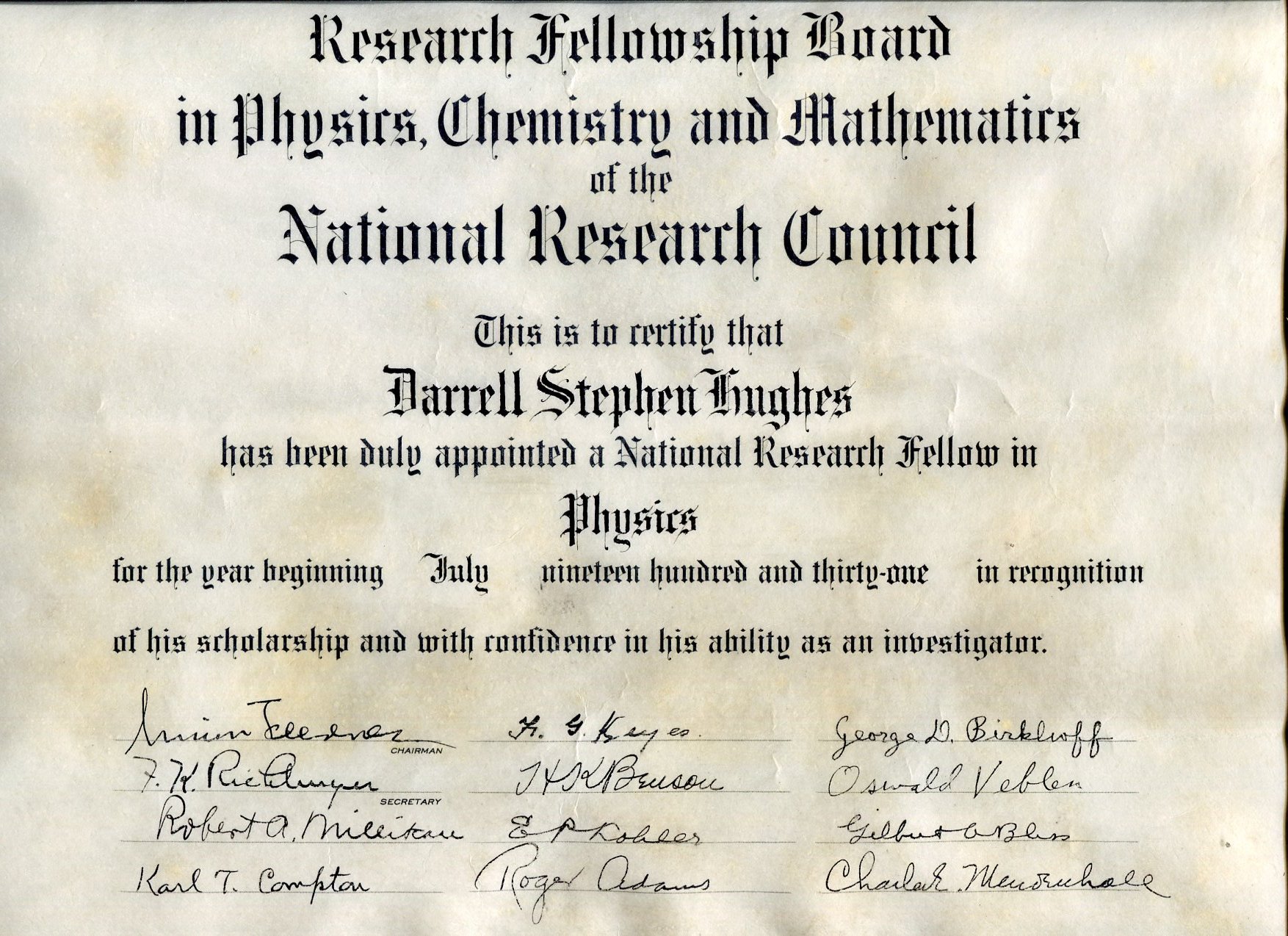
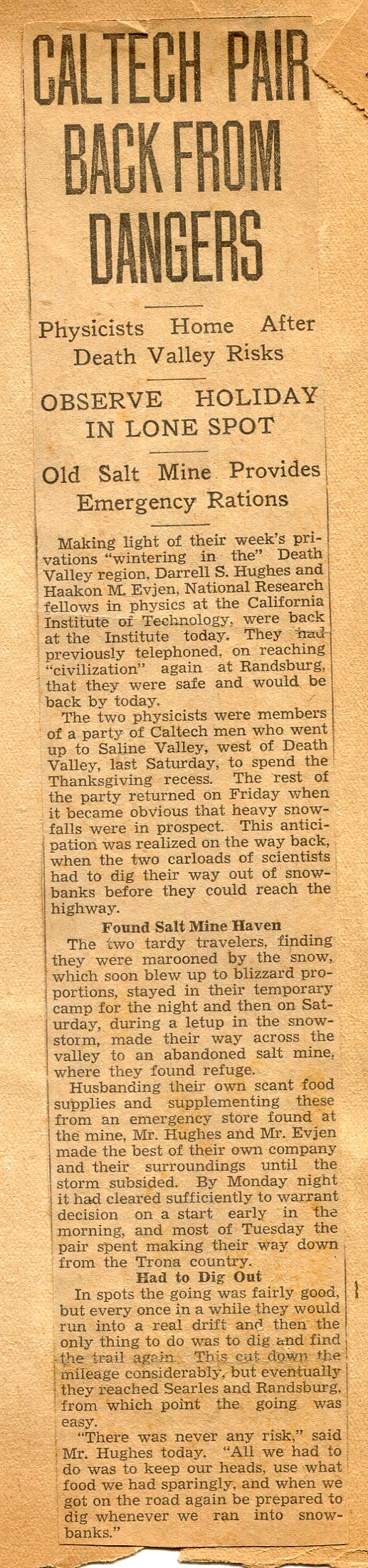
 Dr. Hughes was appointed for two years to a National Research Fellowship in 1931, which enabled him to do postdoctoral work for the next two years at the California Institute of Technology. At this time, he met fellowship holder, Haakon Muus Evjen, with whom he worked for several years. Haakon had graduated from Cornell and earned a PhD at CalTech in 1929. When the National Research Fellowship ended in 1933, all employment opportunities were limited. Dr. Hughes was an instructor in physics at Washington University, St. Louis, from 1933 to 1934, and then a Research Scientist, Kettlemen North Dome Association, Los Angeles, 1934-35, where he did research on petroleum production. It is likely that, during this time, Darrell met Leah Belle Smith who was a student nurse at the California Lutheran School of Nursing in Los Angeles. Leah Belle was born November 21, 1908, in Howell, Michigan to Frank H. and Belle Russell Smith. She was a descendent of John Adams through her mother. She later worked as a nurse in Austin. Darrell and Leah Belle were married June 30, 1935,. Walter H. Jordan was his best man. Walter later became Asst. Director of Oak Ridge National Laboratories. The picture at right may be a wedding picture. The photographer was Marler.

Later, Dr. Hughes was promoted to supervisor of seismic and gravimetric field operations and was located in the Houston office. Dr. Evjen was located in the Shell Research Laboratory and together they made significant contributions to the interpretation of gravity maps and developed a new technique of electrical exploration. During the last two years of Hughes' work with Shell Oil Company (1943–1945) he supervised the operation of their Geophysical Research Laboratory.
At the Board of Regents meeting on November 13, 1945, the appointment of Dr. Hughes to Professor of Physics and Consultant in Geophysics was approved. The latter title was in connection with the University Lands Geology Division. He came to Austin and began his duties in the Spring Semester 1946. This was a critical time for the Department of Physics. The need for physicists in the military research programs had virtually stripped the department of staff, and the enrollment was burgeoning because of the returning veterans. Professor Hughes participated enthusiastically in the planning of new courses and in the updating of old courses. He also instituted a program of experimental research in the properties of solids at high pressures. Measurements were made not only on metals, but also on rock samples, the composition of which made the results relevant to the interpretation of seismic wave velocities in the earth. Professor Hughes sought and obtained supporting grants from petroleum companies, the American Chemical Society's Petroleum Research Fund, and the Federal government for this work. Numerous excellent PhD dissertations resulted from this program. A Japanese geophysicist, Dr. Teruo Nishitake, took a leave of absence from Kyoto University to work for two years with Dr. Hughes, and earlier a French geophysicist, Christian Maurette, came to Austin to work with him. Later during the program the equipment was modified so that elastic properties could be measured as a function of temperature as well as of pressure.
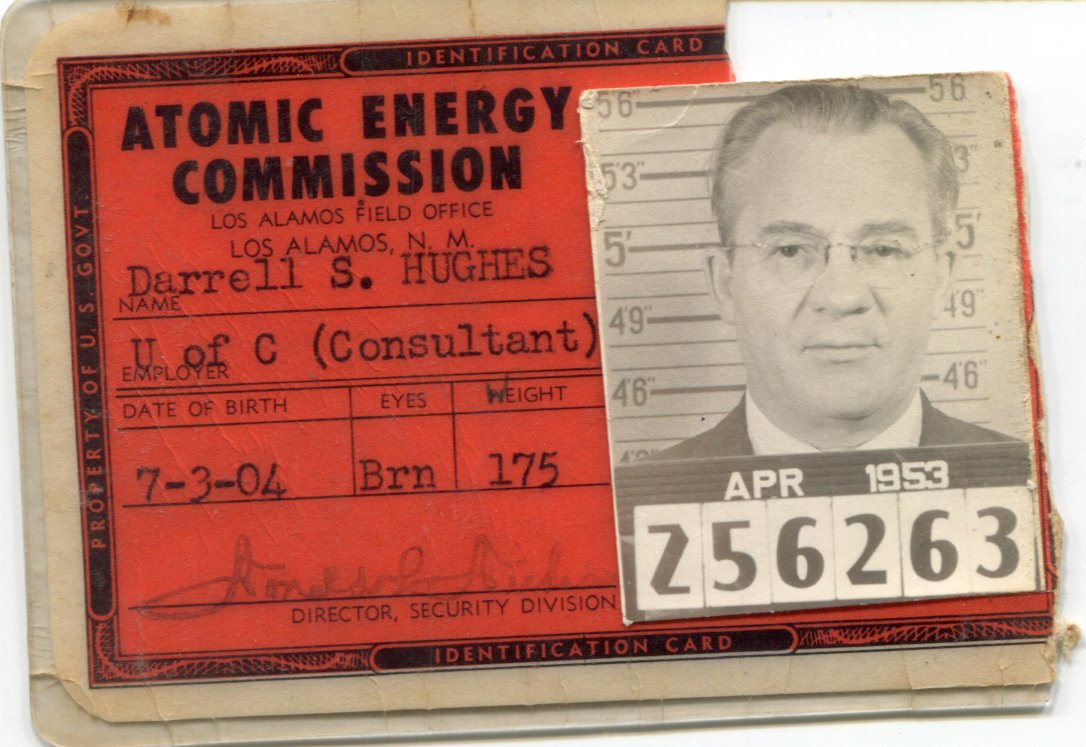
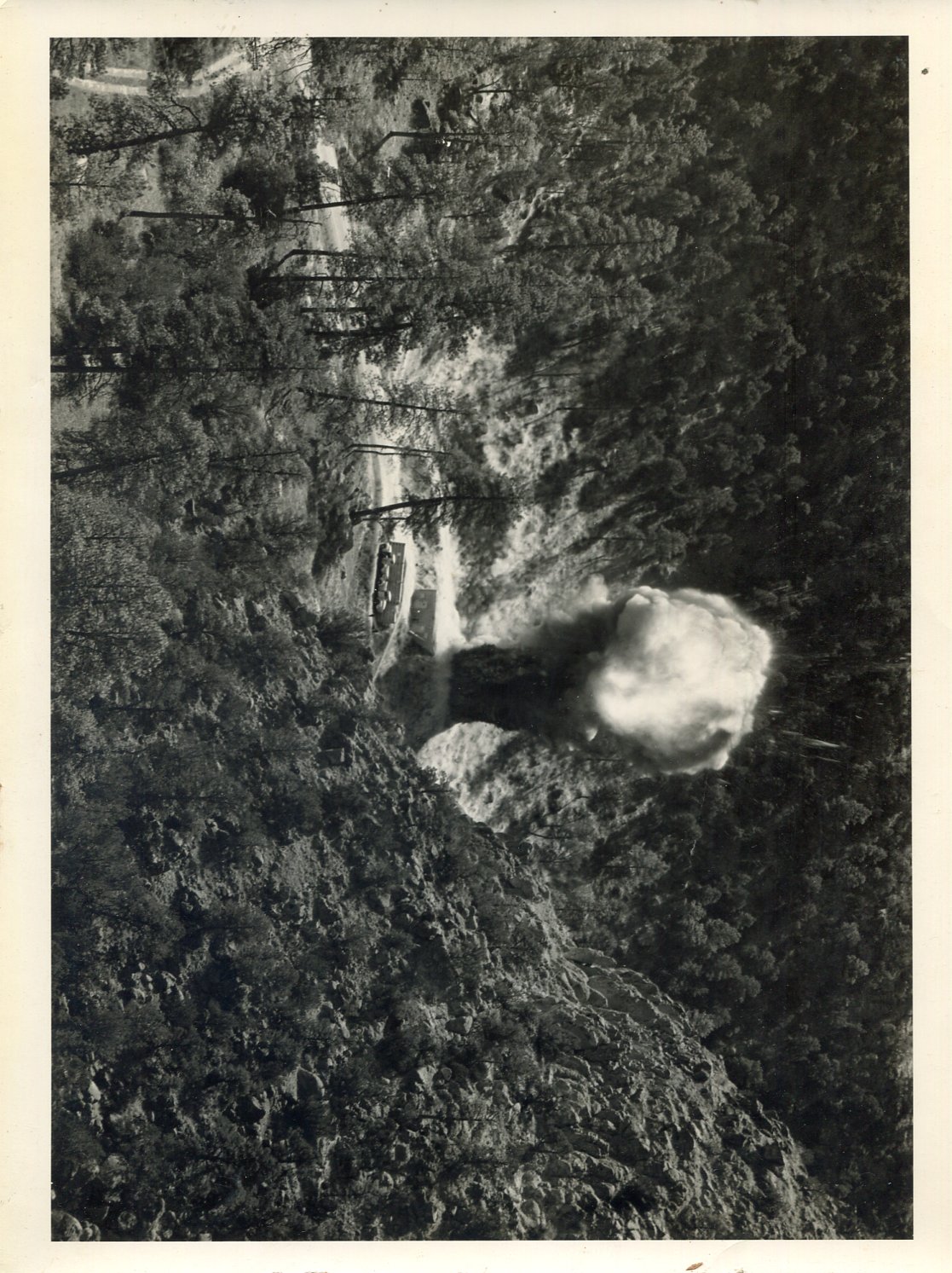
In addition to many invited papers on this work, Professor Hughes served as a Visiting Professor at the Centro de Investigacion de Estudios Avanzados del Instituto Politecnico Nacional, Mexico City, Mexico, June 5–August 10, 1964. In 1953, he became a consultant to Los Alamos National Laboratory in New Mexico, a position that continued until his death. During 1957–1958, he took a research leave to work full time at Los Alamos. The research he did there, was a continuation and extension of his work on the equation of state of various materials at elevated pressures and temperatures. This work required very sophisticated techniques of recording data, since the elevated pressures and temperatures were achieved by using large quantities of high explosives. Thus, the equipment was completely destroyed as soon as the experiment was completed, and there was no chance to check a reading.
Soon after the Computation Center was established on The University of Texas campus. Professor Hughes became one of its strongest supporters. He quickly became one of the most knowledgeable users of the computer among the members of the scientific community on campus, and he served on the Computer Advisory Committee for many years. Later on, in 1965, while serving as a consultant to this committee, he played a major role in the selection of the Control Data 6600 computer over its many competitors. This selection process sapped the full energy of the Computer Advisory Committee for a period of more than a year, and Dr. Hughes aided a minority of the members of the committee in convincing the majority to reverse themselves. This decision has long since proved to have been the correct one. The fact that The University of Texas has possibly the best equipped university computer center in the world is a tribute to Dr. Hughes' involvement in its development.
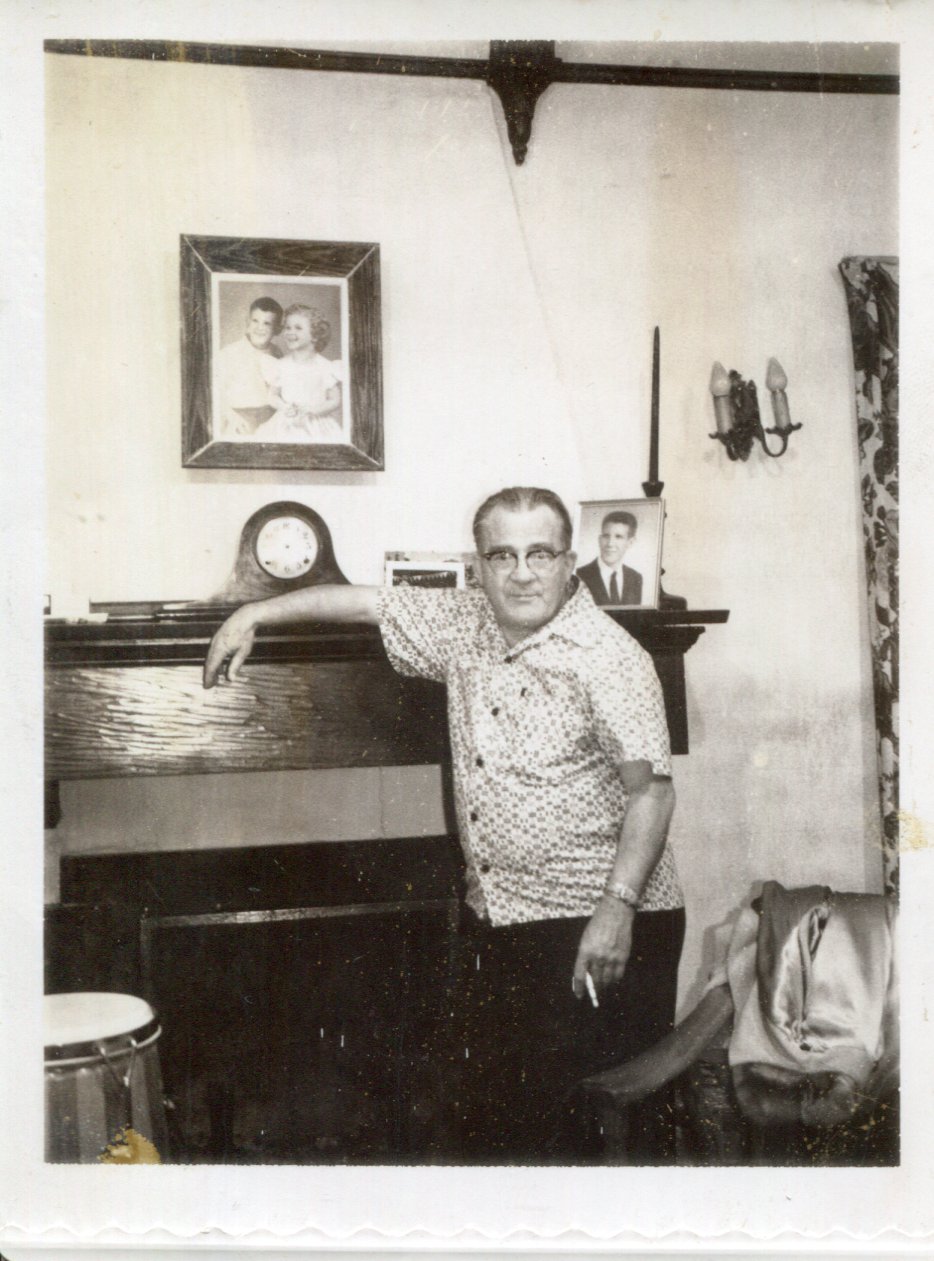
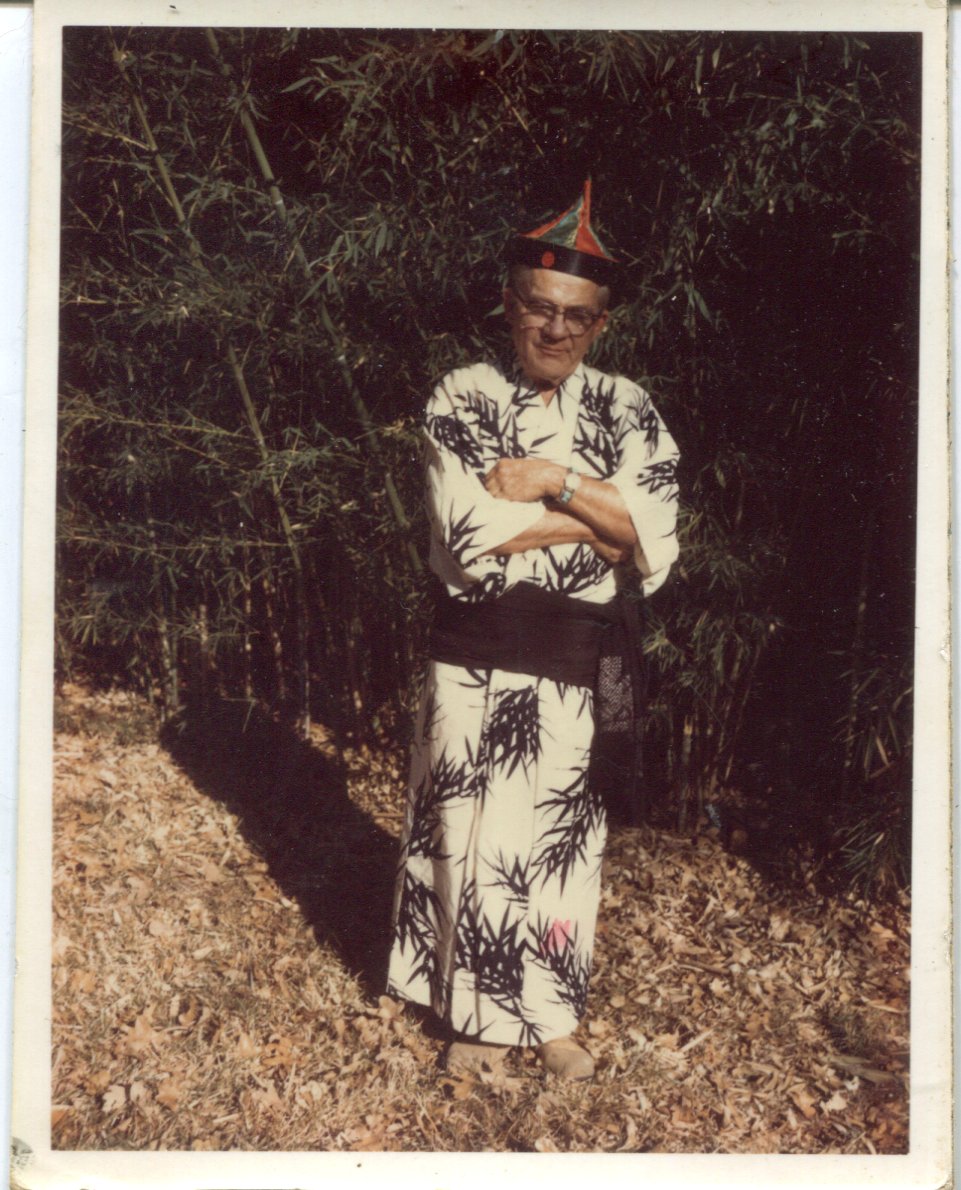
He was a member of the American Physical Society, a Fellow of the American Geological Society, and a member of the American Geophysical Society, the Society of Exploration Geophysicists, Society of Industrial and Applied Mathematicians, the Association for Computing Machinery, and the American Association of Physics Teachers. Professor Hughes had a vivid and dynamic personality; he was short in stature, but very strong physically and not easily tired. His most striking characteristic was his seemingly encyclopedic knowledge of a very wide range of subjects. He was not averse to using a little gamesmanship to extend his show of knowledge beyond the genuine limits. When caught up in an (admittedly rare) error of fact, he would change the subject without admitting the error. However, he showed greater respect for those people who would stand firm in their opinions than for those who avoided conflict. Unfortunately, he sometimes lost his patience and failed to show sufficient tact in dealing with other people. An ill-conceived question usually produced an explosive reply. Despite these qualities, Professor Hughes had a great interest in students and served very successfully for several years as faculty sponsor for Sigma Pi Sigma, the physics honor society. He usually established very close personal relationships with his graduate students and the resulting friendships lasted long after the students received their degrees.
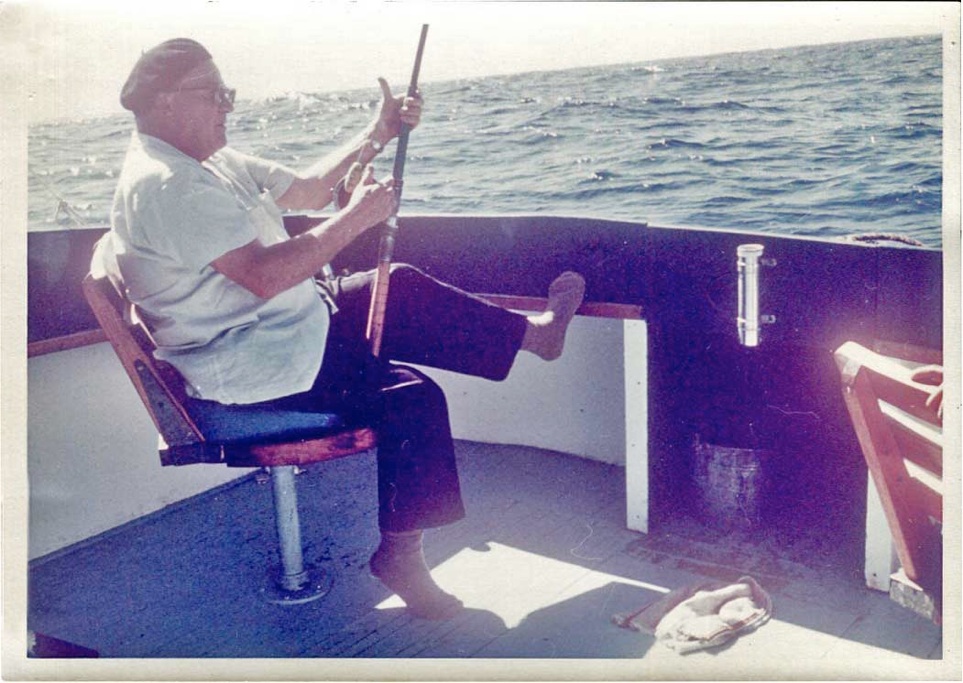
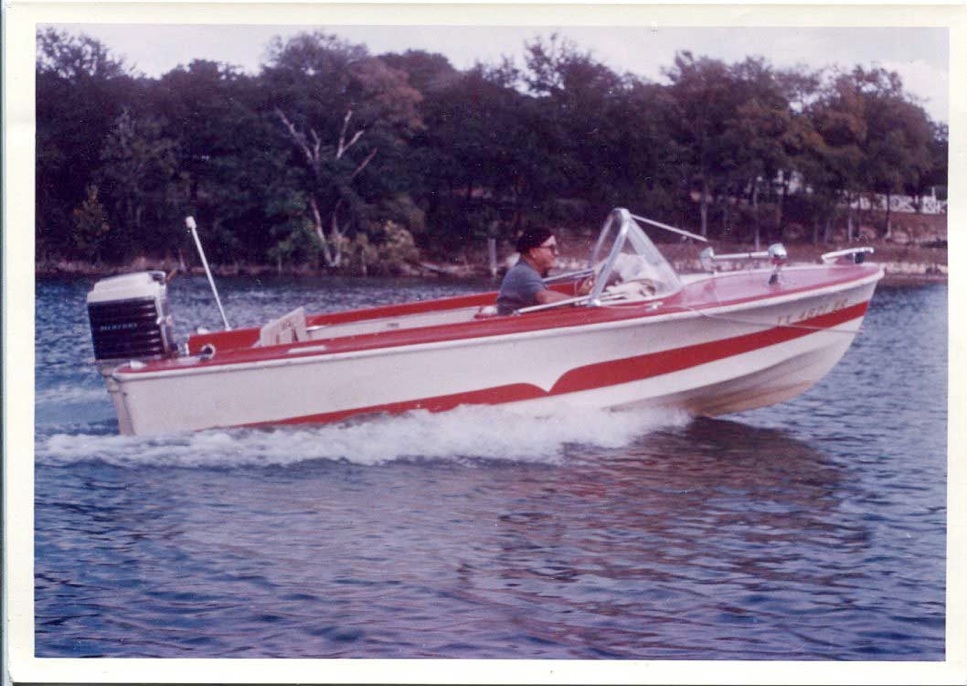
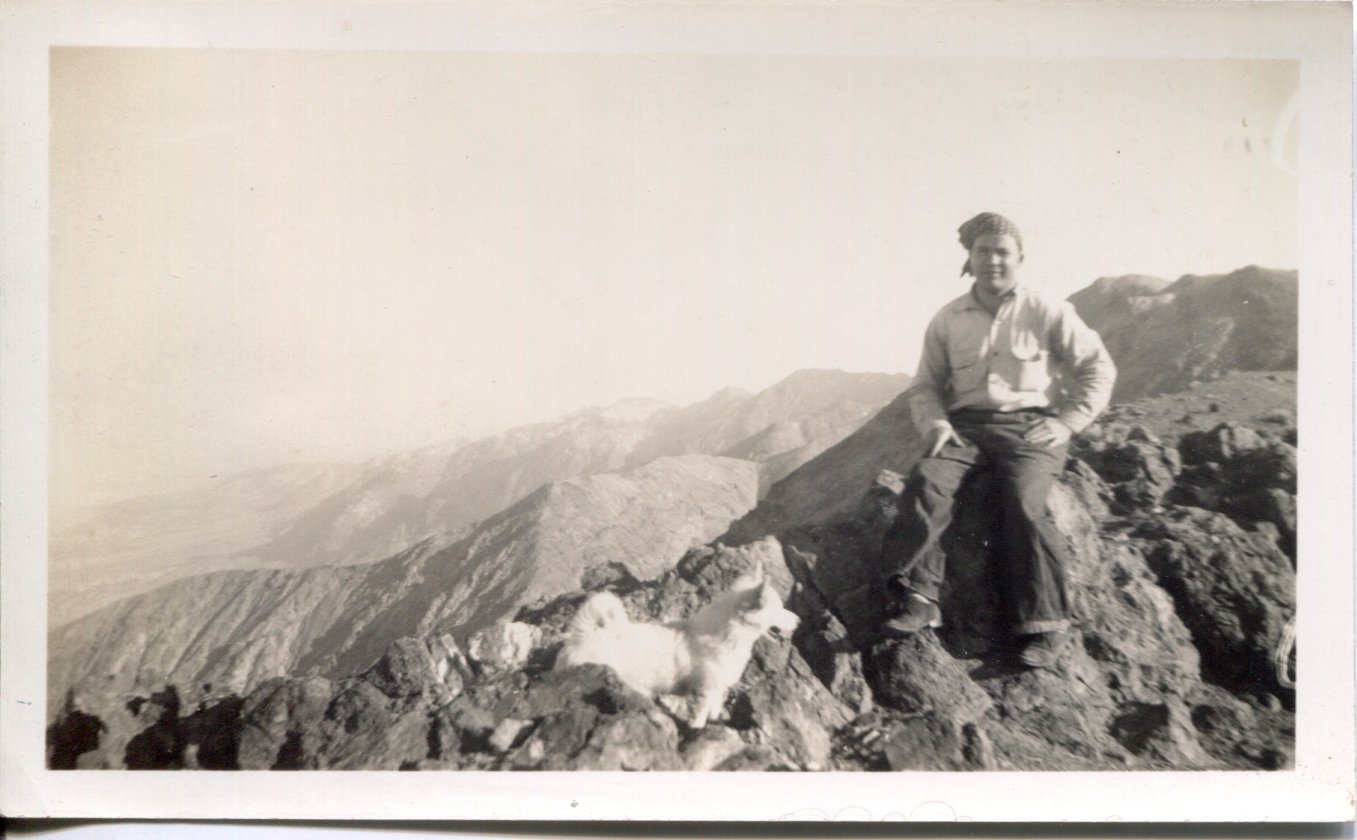
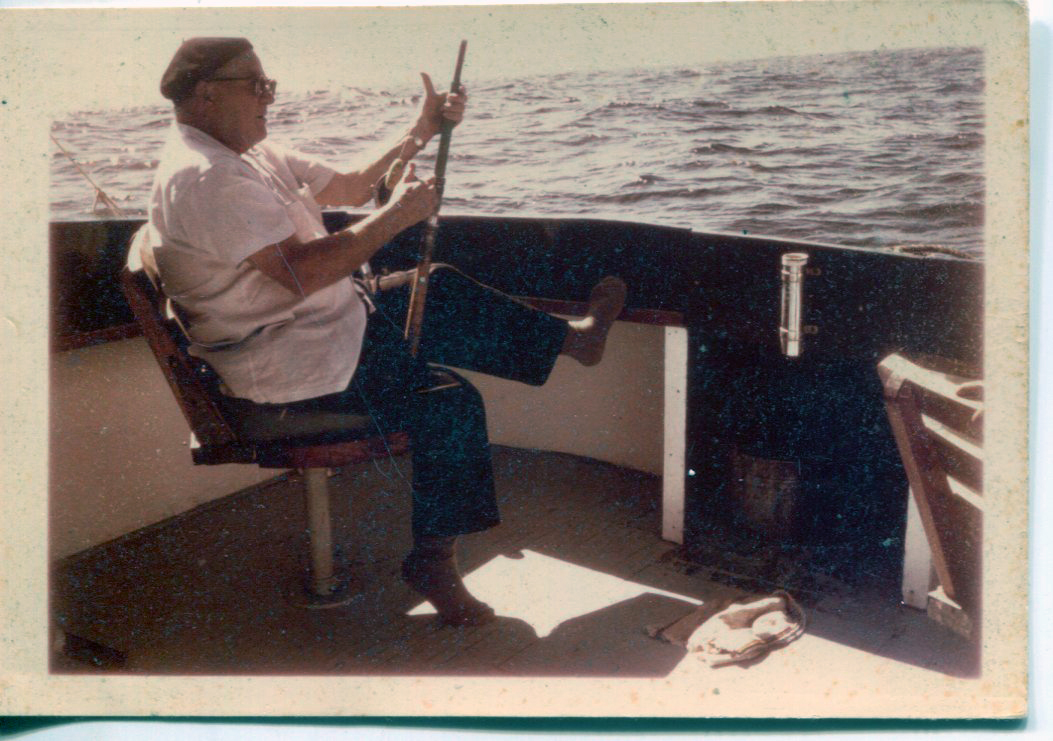
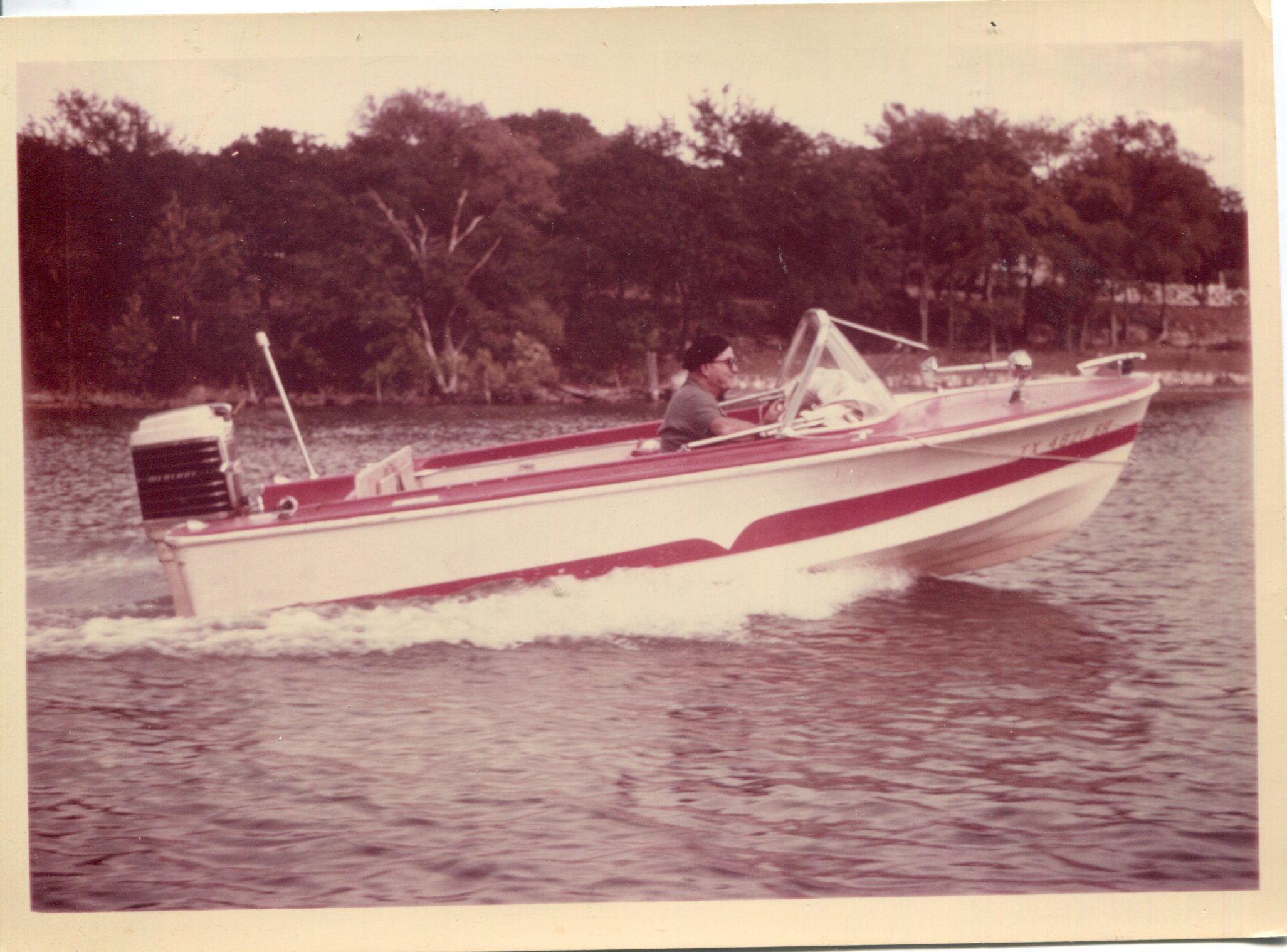
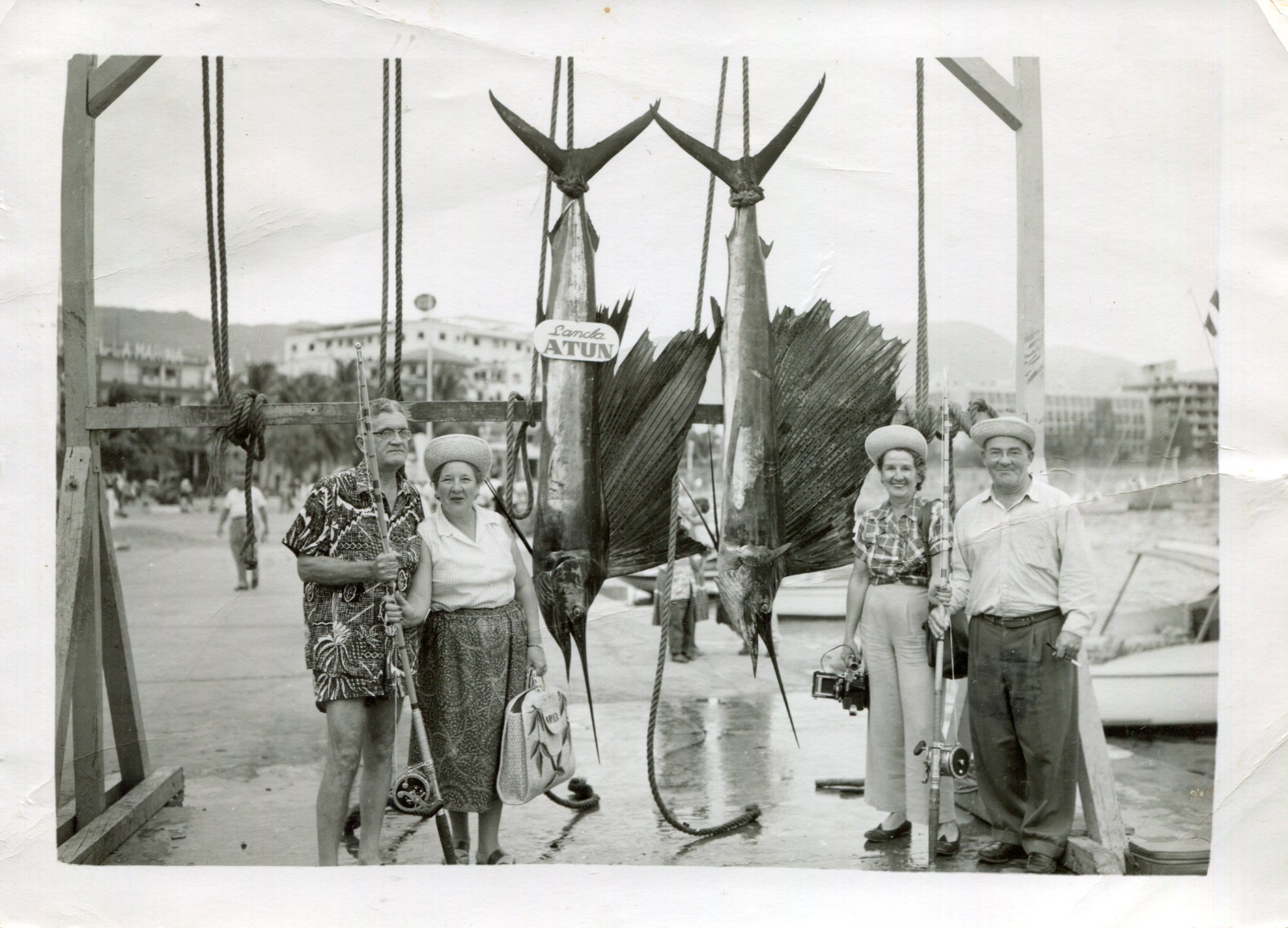
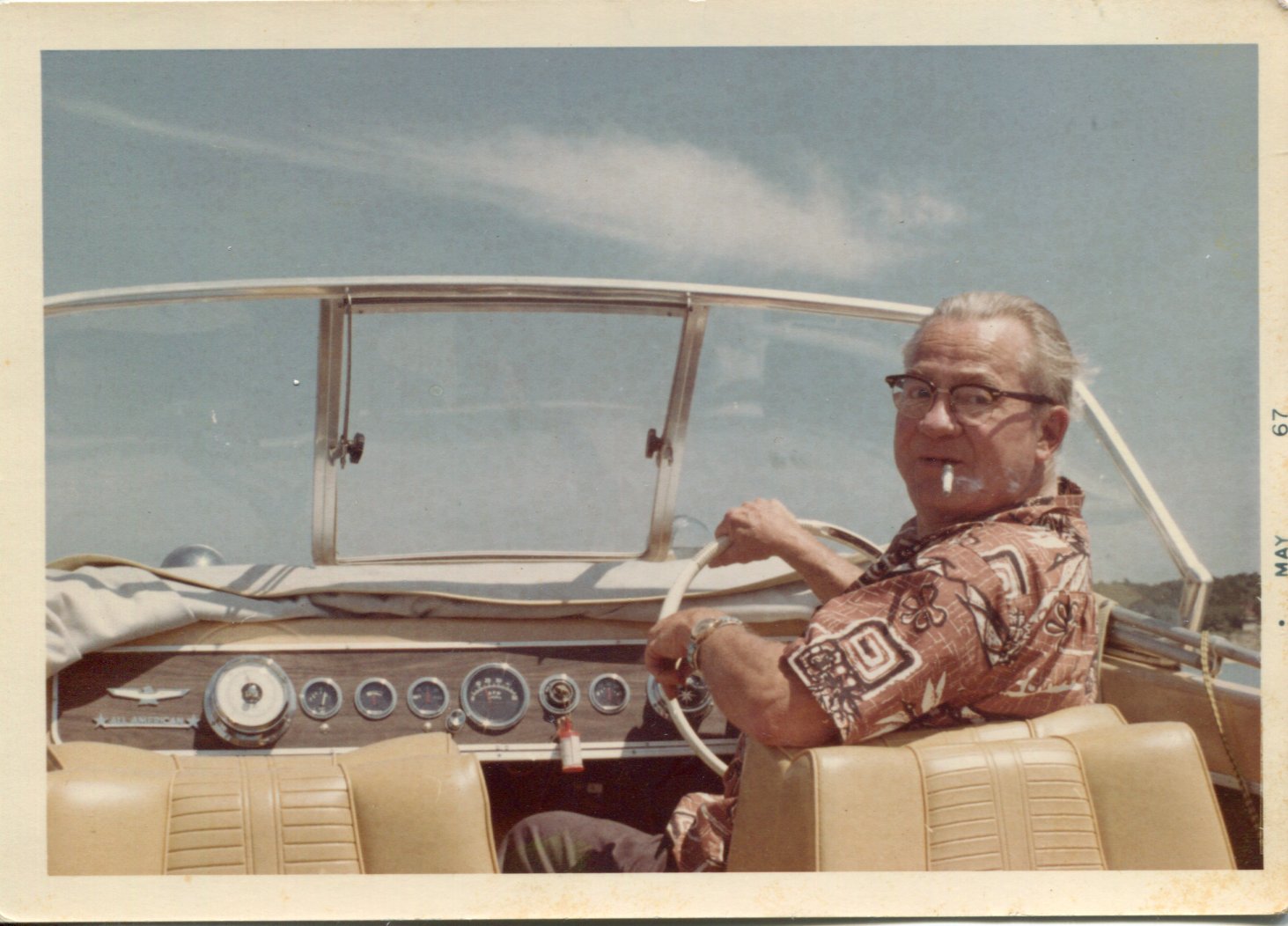
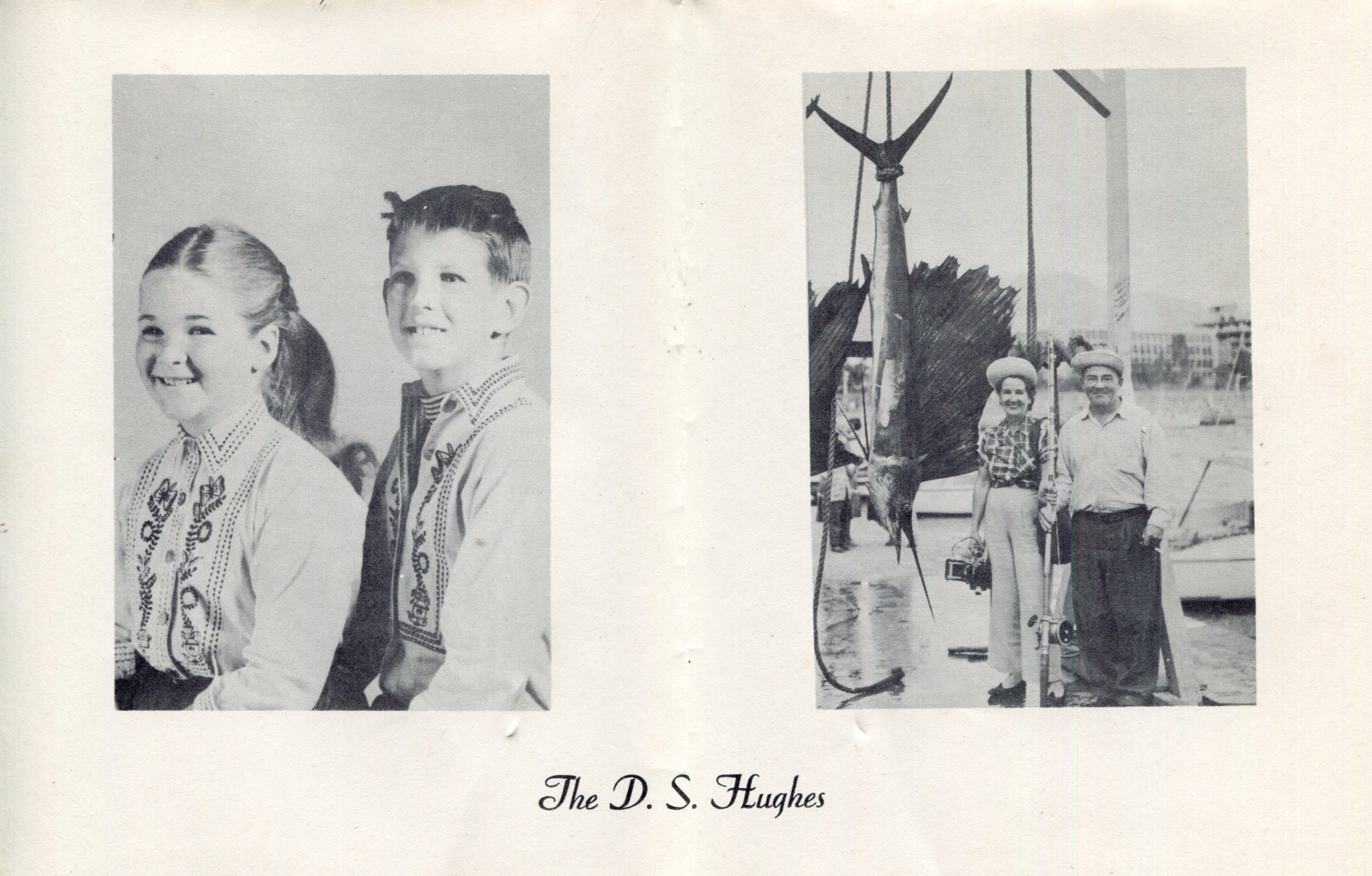
Professor Hughes enjoyed boating and deep-sea fishing very much. One of his favorite photographs of his later years was a picture of himself standing beside a large swordfish that he had caught near Mazatlan on the western coast of Mexico.

Information taken from memorial resolution prepared by a Special Committee consisting of Professors R. T. Gregory, C. W. Horton, Sr., Chairman, A. E. Lockenvitz and A. W. Nolle.
(Illustrated and augmented by Mel Oakes. Some pictures kindly provided by Leah Petri, Darrell and Leah Belle’s granddaughter)
Hughes Stories
“Hughes loved to teach his junior mechanics class at 8 a.m. on Tu-Th-Sat so he could give an exam on OU Weekend” –Richard Boner
“I also remember Dr. Hughes who was such a grump. The students steered clear of him to avoid his sharp tongue. However, when he was getting his cannon ready to fire into the specimens, he was all smiles and good will. We would then venture into his lab and visit and wait for the big bang. That was a good show. Later, after I came to the Bureau of Standards, Hughes appeared here to use our computer which was identical to the one the University of Texas had at the time, which was down, I think. He was terrorizing the computing staff for sure, since they were not doing his stuff fast enough. I ran into him there and he recognized me, but, of course, did not have any idea what my name was. He said "What are YOU doing here?" I said 'I work here!’" Being totally unimpressed, he replied, "More like draw your salary here!" The members of the computing staff and various bystanders were watching this open mouthed... What a blast from the past. I wouldn't have missed it.” –Ben A. Younglove, PhD 1961.
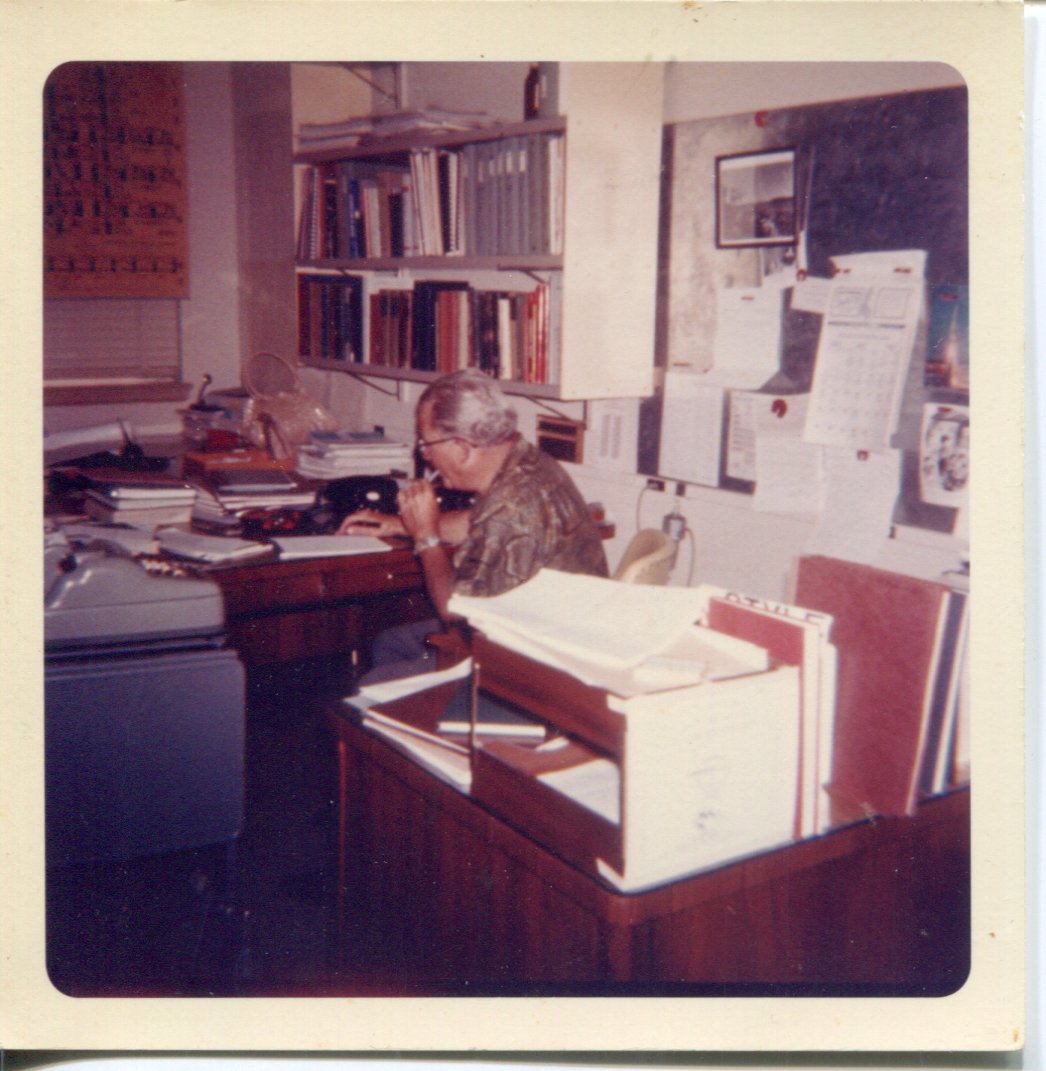
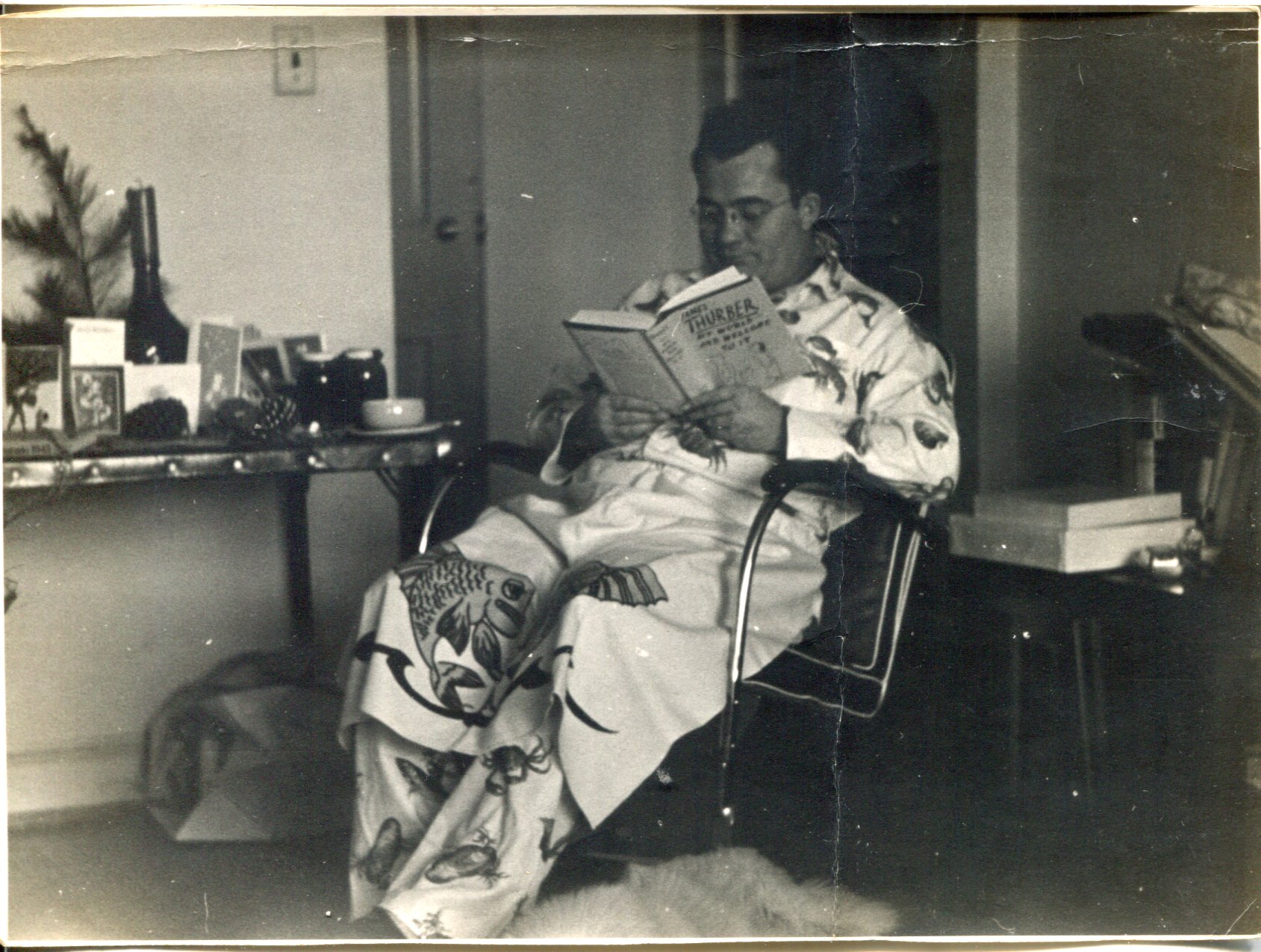
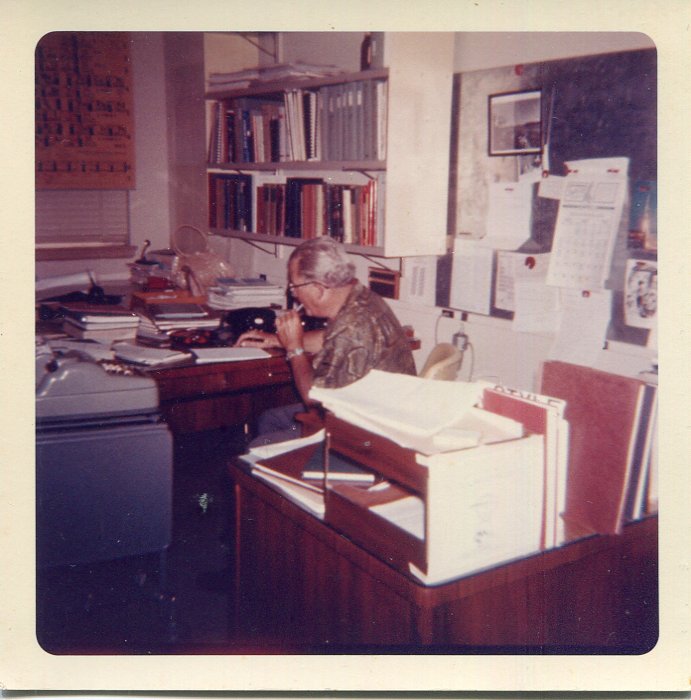
“The most colorful faculty member was Darrell Hughes. Always dressed in a Hawaiian shirt, he looked like Hemingway, save for the cigarette holder he held jauntily in his mouth. He was pugnacious and the rumor was that he had punched a person or two. Students were terrified of him. He was always grilling us in classes and telling us how stupid we were. He taught classical mechanics and, if I remember correctly, there were three in the sequence. Physics 335 for the undergraduate, Physics 365 for the beginning graduate student and Physics 385 for the PhD student. I remember once when a student tried to answer a question, he said, ‘Don’t give me any of that quantum mechanics crap.’ There was an international student who could not resist trying to answer questions that Hughes posed. Hughes would pound on him unmercifully, and the student would take two Maalox before class every day.”
“One class period, the 385 lecture seemed strange. First of all, I understood or at least thought I should understand, most of it. Secondly, he kept yelling at us that we didn’t even understand Physics 335 when usually he accused us of not knowing any Physics 365. Near the end of the lecture, I understood what was happening. The next day, he dropped into Hanson’s lab where I worked and was laughing. He told Hanson, “I gave the 365 lecture in 385 by mistake, and those students were either too dumb or too scared to say anything.' The latter was the case.”
“Faculty often dropped into Hanson’s lab on the ground floor of the old Physics Building. Charles Scherr and Hughes were frequent visitors during the noon hour while Hanson and his students were sitting around eating their sandwiches. Scherr and Hughes would pose problems for each other on the blackboard and dare the other to solve them. The clash of egos was a sight to see, particularly for a student.”
—David J. Cowan, BS 1958, MS 1960, PhD 1965. Emeritus Professor of Physics, Gettysburg College.
“ Hughes would argue loudly with his students and postdocs. Once, he walked in the lab and asked Teruo Nishitake, a postdoc, if he had written ‘that’ letter. When Teruo said, "No", Hughes yelled and demanded it be done now. Teruo left and soon returned with the letter. Hughes immediately took it to the office secretary and demanded she type and mail the letter immediately. She took the letter and a moment later said, ‘I can’t do that.’ Hughes boiled, ‘And why not?”, ‘It is in Japanese was her nervous reply.’”
—Les Deavers, Machinist for Professor Darrell S. Hughes. Later Les was Supervisor for Physics Machine Shop.
Mr. Brown, the janitor, put a Bible in the Physics library. It had blank pages for people to make comments. Darrell Hughes wrote: “Diverse weights are an abomination to the LORD, and dishonest scales are not good.”
Proverbs 20:23
—Eugene Ivash, UT Physics Professor
(For further information on the library bible see More...
His wife died in Africa of a stroke while on a tour, without him. He was never the same afterwards. He would work in his lab or office in the morning, teach perhaps, then off to home for the rest of the day playing opera or symphony music very loud. This info came from my phone calls to him.
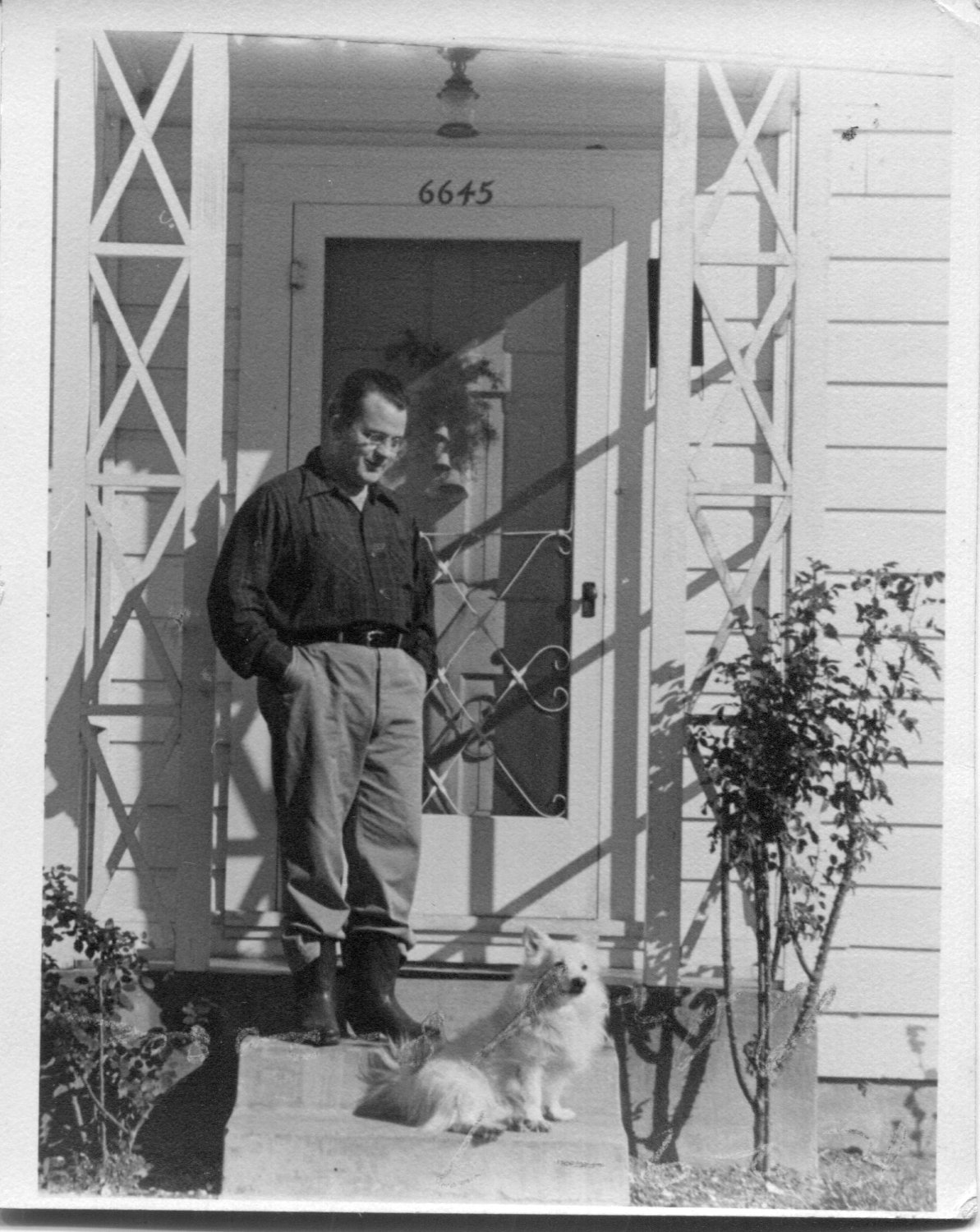
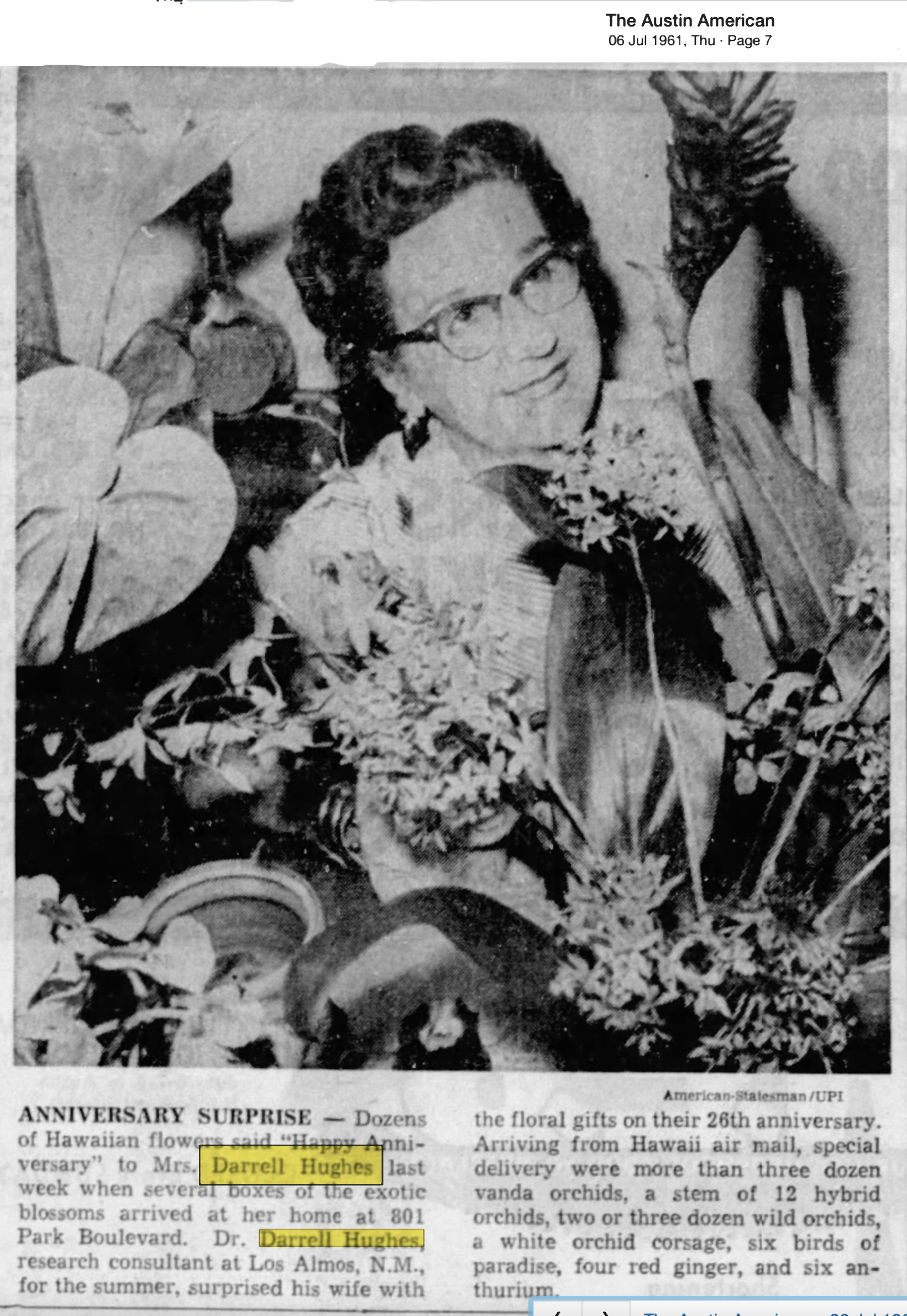
His home was just north of the campus at 801 Park Blvd, almost directly across from Harry Swinney's home now.
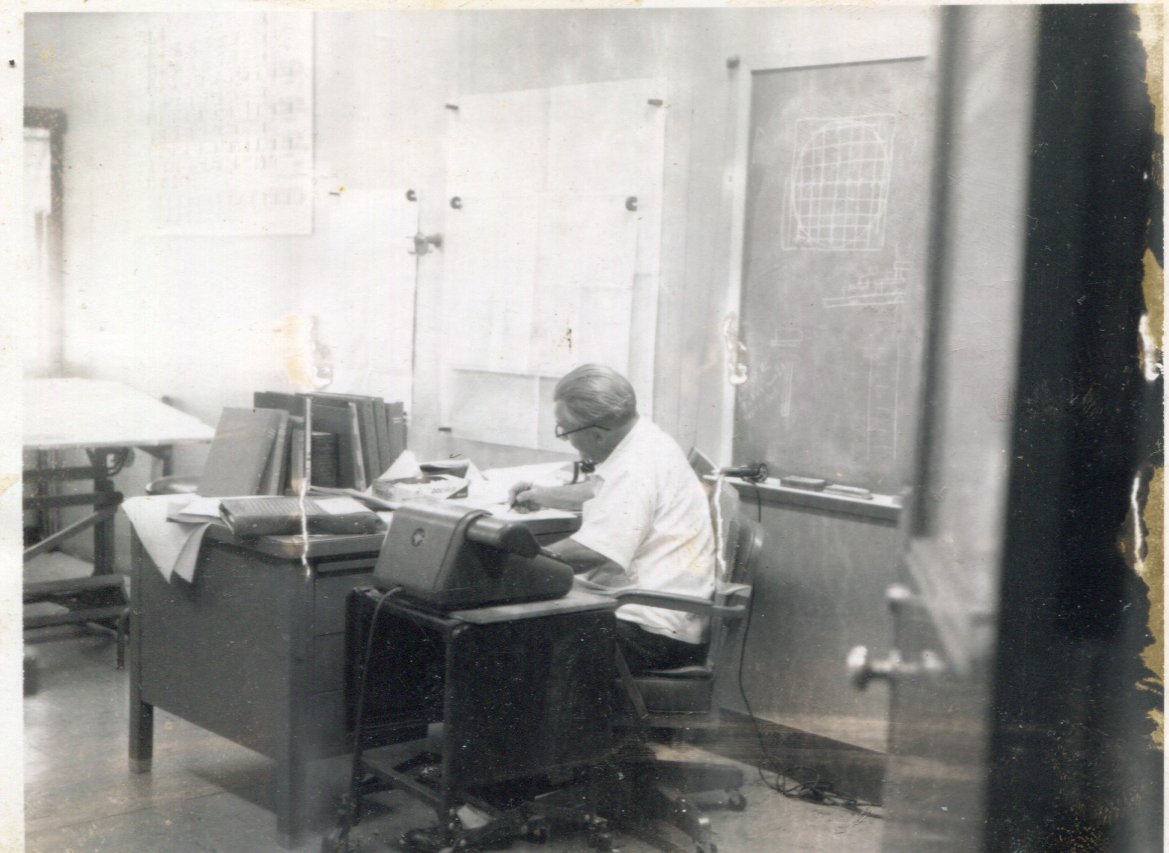
He did not want windows in his office. He had a machinist in the old building cover his window with an AL sheet and designed his office for RLM to be inside the walkway (but never used it, if my time history is correct).
In the old building, he would sometimes run up the stairs to confront whoever was using the elevator he wanted for his own use.
Had his typewriter modified to allow Greek letters.
He was a fierce graduate supervisor; there were few students but they worshiped him. One of my MA students switched to him after being in one of his graduate classes. That fellow's project steered away from Hughes's usual high pressure work.
His cannon work here involved a projectile aimed at the machine shop and slowed by a thick stack of newspapers. I have a piece of one that fractured at some point (perhaps not in flight). Everyone got out of the way before a firing. Most work was carried out at Los Alamos. Robert Brandt was the only machinist who could satisfy his demands and thus got all of his work.
He threw chalk and erasers at the students in his class, with good aim, if they could not answer a given question. Nevertheless, I discovered that the students who survived him and liked him were good students.
I liked him and respected him more than most of the faculty.
—James C. Thompson, UT Physics Professor
"Darrell was assigned a room for his class that he deemed unsuitable. I overheard his telephone conversation with Dorothy Lay who had the difficult job of making assignments across the campus and was considered the czar of classroom space. Hughes tried to make his case for a room change, however Dorothy resisted. Finally he yelled into the receiver, “I refuse to argue with a ‘clerk.’ Get me your boss.” Dorothy’s reply was “I am the boss.”
—Melvin Oakes, UT Physics Professor
“Darrell knew the Latin names for all the trees, and if you said there is a nice oak, he would tell you the Latin name for it. He was very outspoken, short and stocky, but outgoing and outspoken—quite a character”.
—Robert “Bob” Dedman, Darrell’s nephew
"Wilmer Hoyer and I were graders for Darrell Hughes' theoretical mechanics course; we agreed, after the fact, that this was no doubt one of our most outstanding learning experiences in graduate school."
—Harold Schmitt, Oak Ridge Scientist and University of Tennessee at Knoxville Professor
It was reported that Hughes had been a boxer. I am seeking confirmation.—Mel Oakes
Excerpted from Shock Waves in Condensed Matter-1983, edited by J. R. Asay, R. A. Graham and G. K. Struab, 1984
Thunder in the Mountains
John Waldon Taylor
University of California Los Alamos National Laboratory,
P.0. Box 1663
Los Alamos, NM 87545
This paper summarizes the pioneering work leading to the development of scientific studies of the physics of shot-compressed matter at Los Alamos and culminating In the publication of the article Compression of Solids by Strong Shock Waves,"by M. H. Rice, R. G. McQueen, and J. M. Walsh, Solid State Physics, Vol. VI, 1958. The work had its beginning during World War II when it became clear that development of a plutonium weapon would probably require the use of high explosives. It was immediately obvious to the staff that an entirely new level of sophistication in explosives technology would be required and that the equations-of-state of metals must be thoroughly understood. Following a suggestion by C. Critchfield, R. H. Goranson started a program to obtain equation-of-state data from shock~wave experiments. This program, begun late in 1944 and made possible only by the current and subsequent developments in explosive fabrication technology and electronic instrumentation, was continued after the war by Goranson and his successors. Nevertheless, the program remained relatively fallow until about 1950 when an influx of enthusiastic young staff were able to take advantage of a maturity of technical facilities. Centrally important to the new thrust were, (1) an optical diagnostics group which had developed a thorough familiarity with the technique in studies of shocked gases, (2) a charter to "work in various aspects of hydrodynamics in unusual areas," and (3) the overall supervision which, in consonance with general laboratory policy, looked favorably on research without restriction.
In the summer of 1952, J. M. Walsh with M. H. Rice and C. M. Fowler, developed the flash-gap technique that made possible rapid and ultimately essential mass production of shot assemblies. Their recognition of the potential of impedance-matching techniques enabled them to begin a highly efficient major experimental program. The investigations of R. G. Shreffler and W. E. Deal on explosively driven plates prompted the group, strengthened by R. G. McQueen and S. P. Marsh, to expand the work into the megabar region over the next few years. Meanwhile, a discrepancy between flash-gap data and older pin data prompted D. Bancroft, E. Peterson, and F. S. Minshall to investigate iron In detail and discover the 130-kbar phase transition. Also at that time, relaxed security restrictions made publication possible. Prominent in the early work was the involvement of D. S. Hughes from the University of Texas and the reinvention of the dc capacitor by M. H. Rice. This capacitor permitted improved velocity resolution over that of pins and required less assembly time.
1. INTRODUCTION On September 18, 1957, at approximately 10:00 p.m., I arrived at Los Alamos driving a rusty 1953 Rambler station wagon with all my worldly goods packed in the back end. This was the culmination of a three-day marathon drive from Ithaca, New York, which began the day after my doctoral orals and a very intense farewell party. I had accepted an offer to join Group GMX-6, located in Ancho Canyon in the explosive firing area about 15 miles from the center of town and two miles from Bandelier National Monument. As I drove north from Cline's Corners toward Santa Fe, I began to see lightning bolts outlining the distant mountains on a scale I had never deemed possible, and by the time I entered Santa Fe the peals of distant thunder had merged into a nearly continuous roar. I remember thinking then that nature seemed to be in harmony with the sort of activity I had decided to try as a career. At the time I arrived, the active research group in GMX-5 consisted of John M. (Mac) Walsh, the Group Leader; Bill Deal, his alternate; Bob McQueen; Stan Marsh; Jerry Wackerle (who had arrived in the spring from Kansas); Max Fowler (also having arrived as permanent staff in the spring); and Wray Garn, a Los Alamos veteran of the war years. Mel Rice was back at Iowa State finishing his PhD program. There was also a rather remarkable, pugnacious, but nonetheless lovable, consultant whose name was Darrell Hughes, but whom everyone called "Doc" with varying degrees of affection, fear, hatred, and respect. Up on the mesa at R-Site were Eric Peterson, Stan Minshall, Elizabeth Gittings (Marshall), and Stan Landeen. Russell Duff had by then become interested ln chemical reactions in gas shocks and had his own small group at TD-Site on the edge of the mesa.
In the summer of 1955, Professor Darrell S. (Doc) Hughes from the University of Texas at Austin came as a consultant. Hughes had worked for Shell Oil interpreting seismic exploration data in the 1930s, had been a consultant to Los Alamos since the war years, and had taught both Walsh and Deal when they were graduate students. He was interested in geophysics, guns, and everything about physics. Noting that Landeen and Houston were having only limited success with pins in obtaining rock Hugoniot data, he persuaded McQueen (easily) to obtain some data on dunnite, San Marcos Gobbro, and Braunite Gabbro. He also took a direct and forceful interest in the 6.5-in. gun and supervised having it rebored and the end faced to high precision at Watervliet arsenal. Further, he knew propellant experts, developed loading procedures, and designed the first control room facility for the gun. This occurred over a period of approximately two years. The group was so busy with other things that the gun kept falling to Second priority when "Doc" wasn't around.
Darrell Stephen Hughes Photo Album |
|
|---|---|

|
|
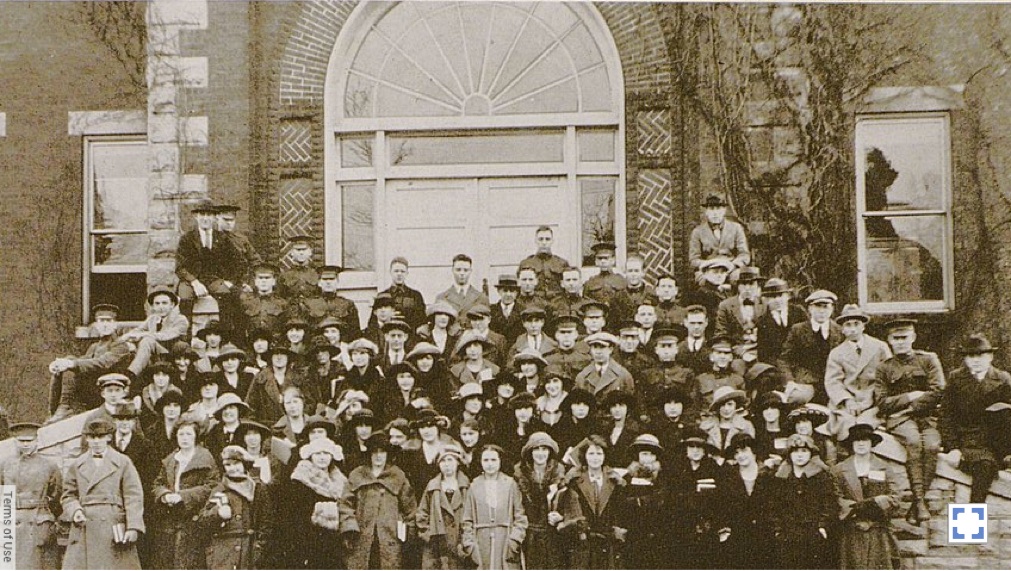
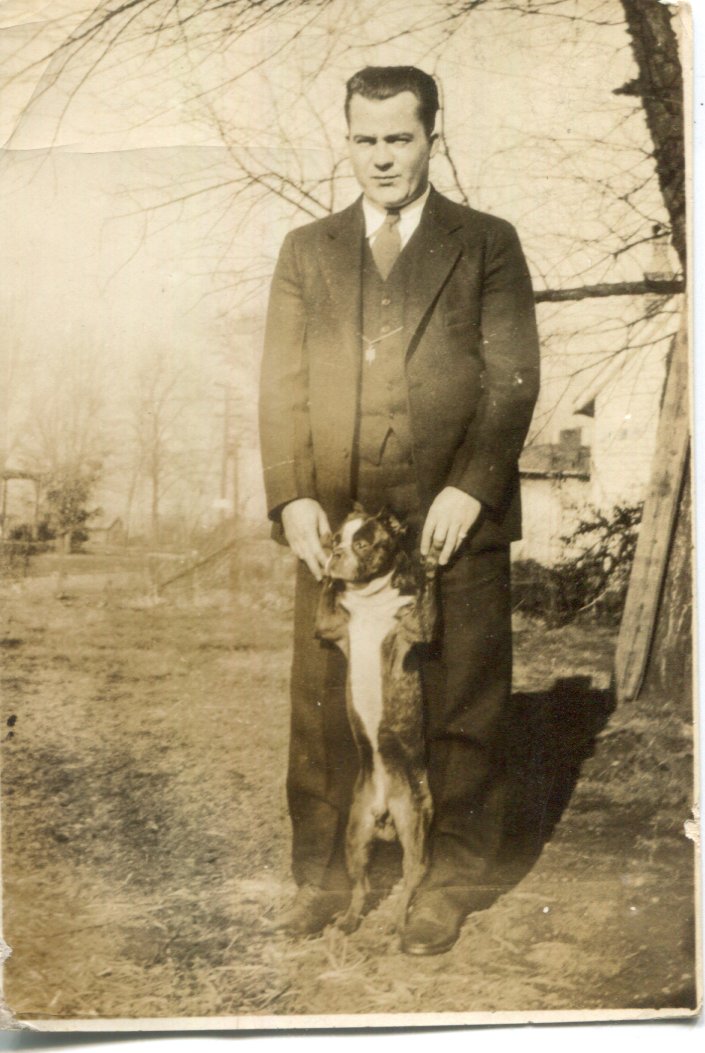
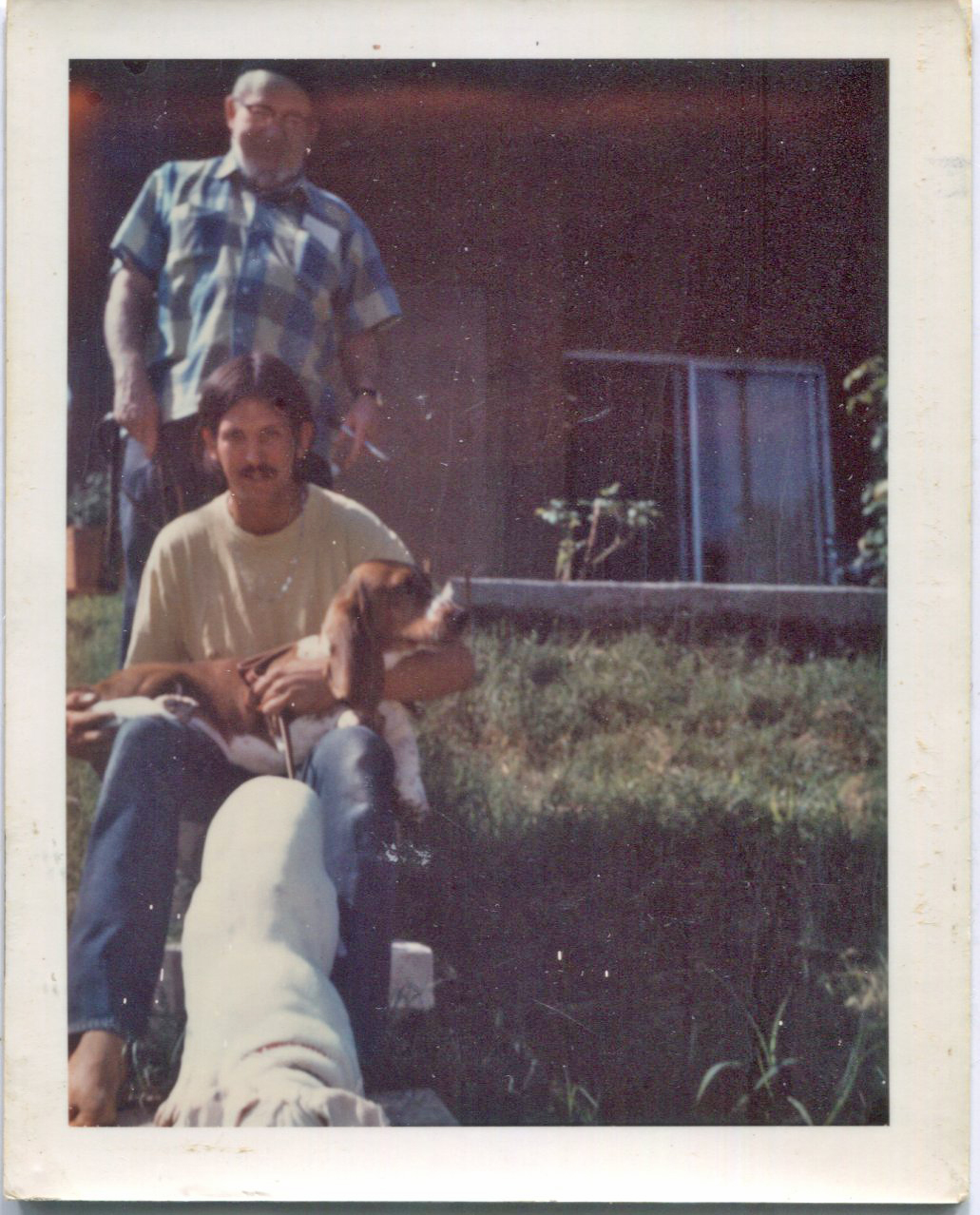
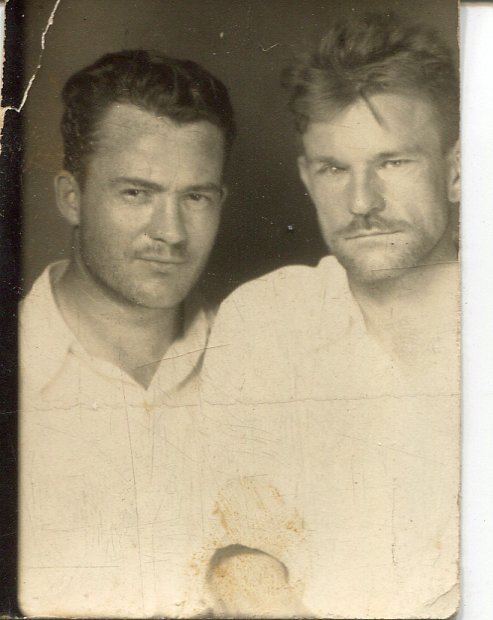
Maybe Darrell Stephen Hughes |
|
|
|

|
|
|
|
|
|

|
|

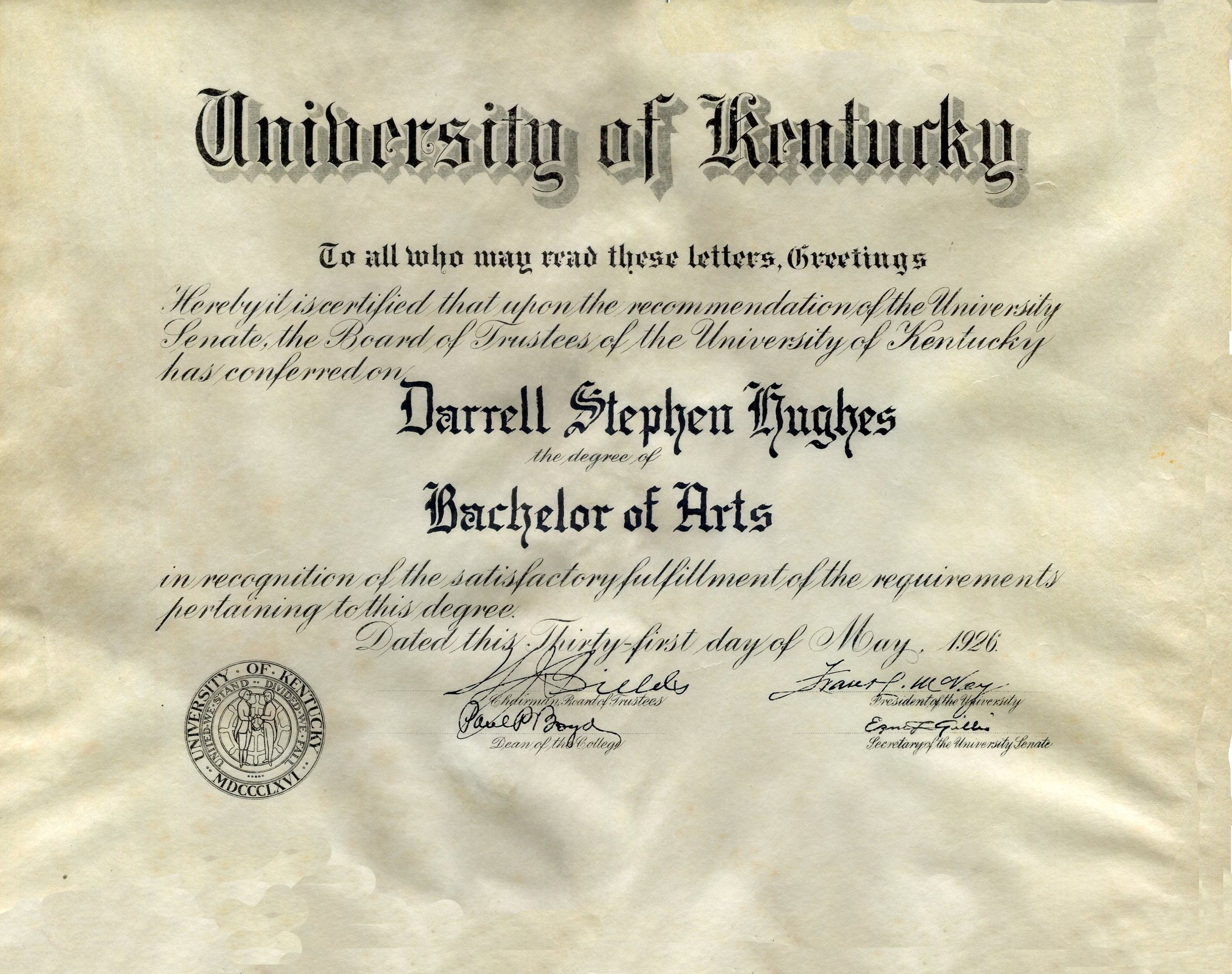
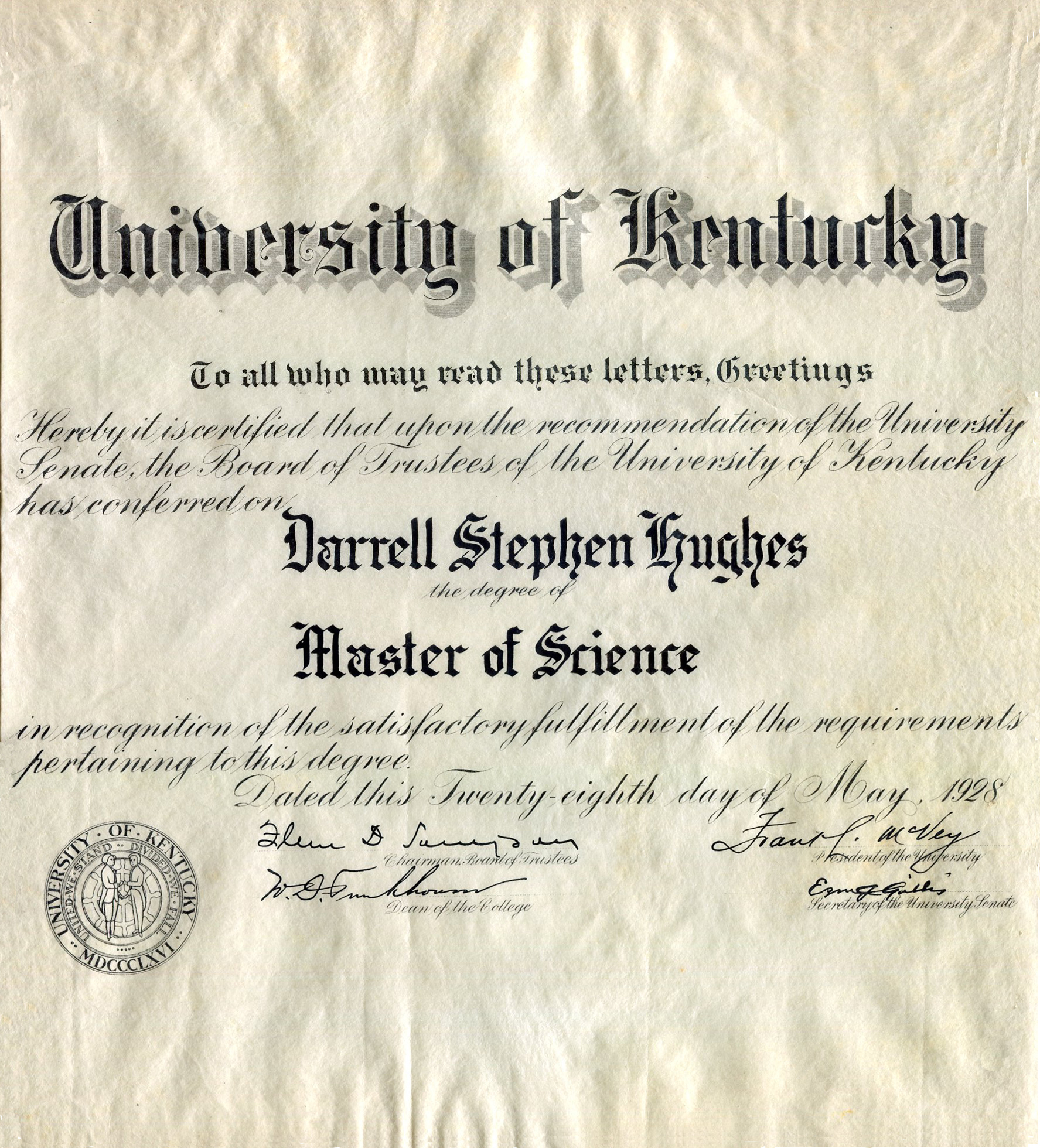
University of Chicago Physics Department, ca 1928. Front Row, L to R, J. A. Bearden, G. S. Monk, Frank C. Hoyt, A. J. Dempster, H. G. Gale, Arthur H. Compton (Nobel Prize in Physics 1927), Harvey B. Lemon, Carl Eckhardt, J. Barton Hoag M. Y. Colby (later UT professor), 3rd row, second from left, in light colored suit. To right of Colby might be John Schoff Millis, who became President of Case-Western Reserve. If this picture is from about 1928, then highly likely that another UT professor is in the picture, namely, Darrell S. Hughes. He entered in 1928 and worked for Carl Eckhardt who is also in picture. Comparing Hughes’ undergraduate photo from U. of Kentucky, Hughes is at extreme left on back row, a likely location for a new graduate student. Colby and Hughes used to reminisce together about their experiences at Chicago. |
|

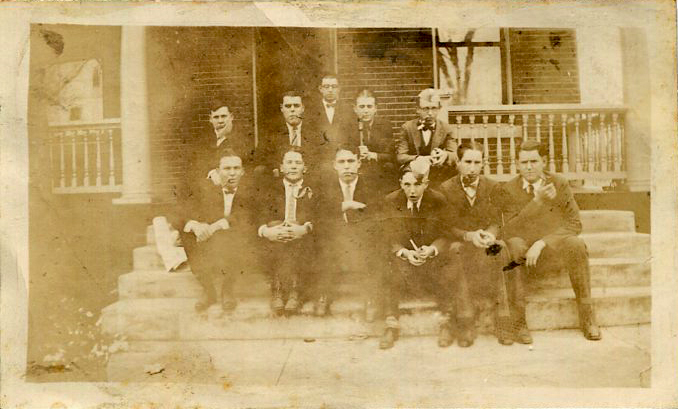
Darrell S. Hughes, left end of middle row. U. of Chicago This photo is on same paper and paper size as one below which belonged to Hughes also. The man 3rd from left in middle row is in the photo above. He is 3rd from left in second row. |
|
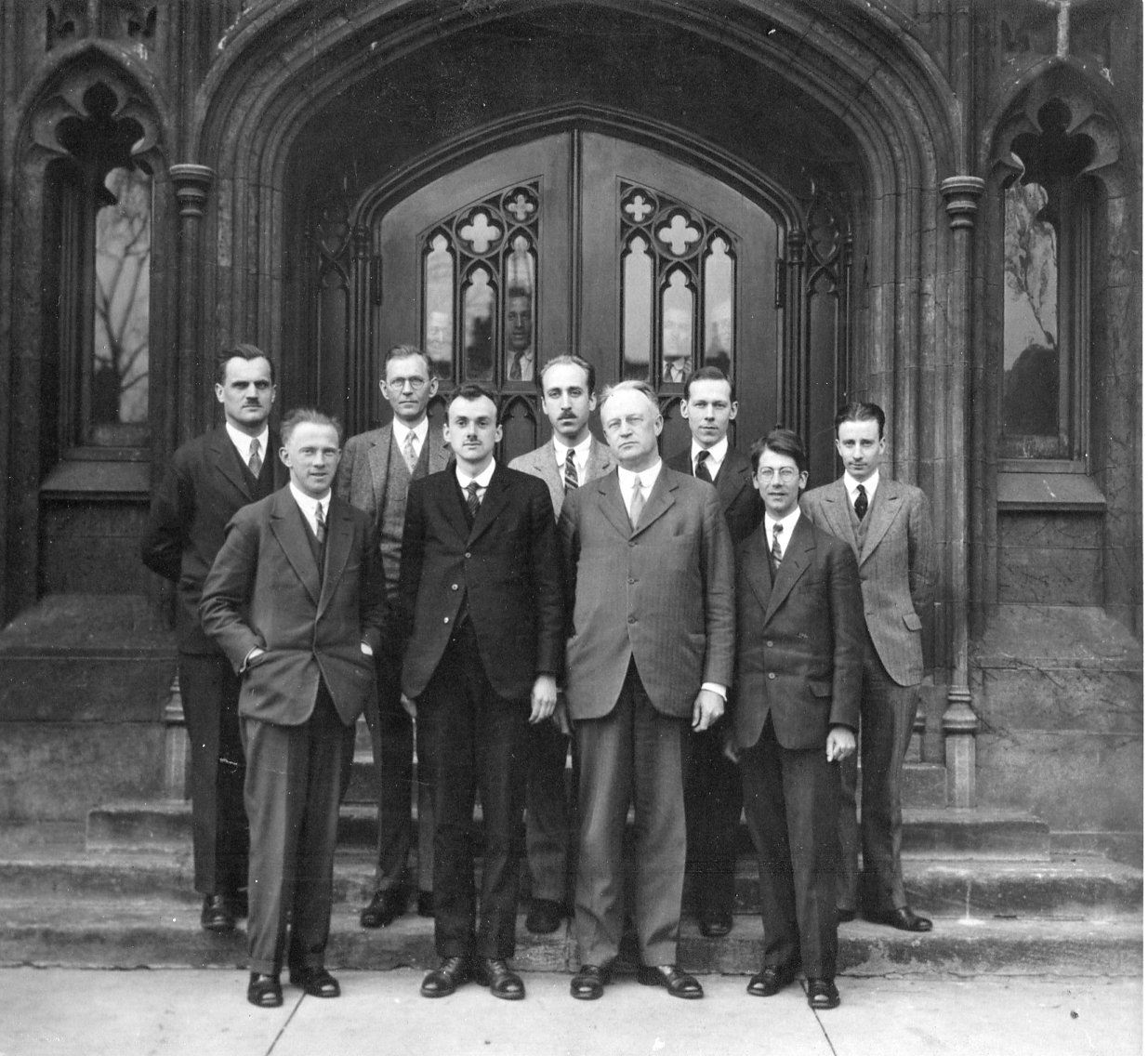
Front Row, L to R: Werner Heisenberg, P. A. M. Dirac, H. G. Gale, F. Hund |
|
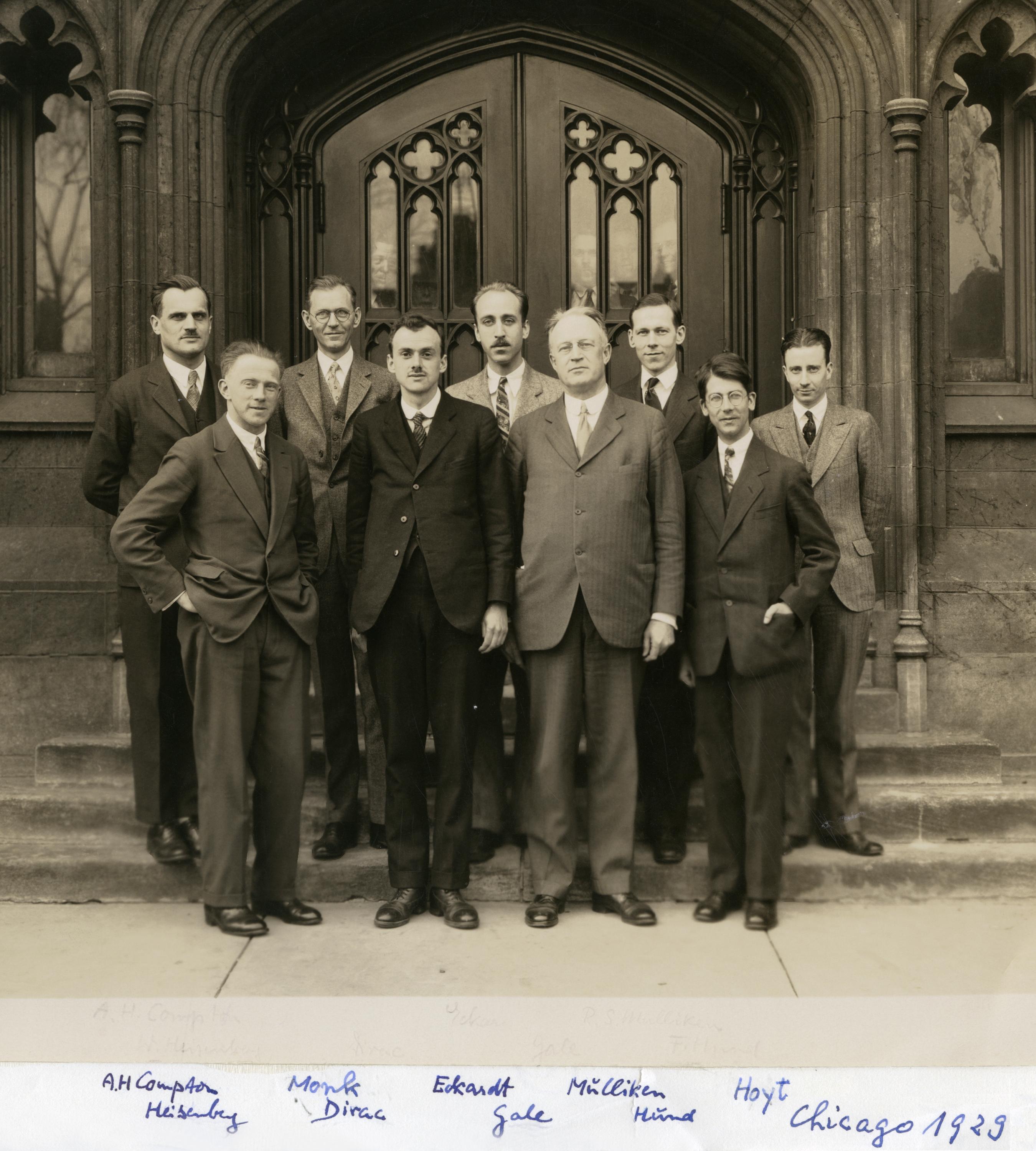
This is another version of the photo that is available on the web. It clearly was taken at the same time but there are obvious differences, especially in those peeking through the door. Front Row, L to R: Werner Heisenberg, P. A. M. Dirac, H. G. Gale, F. Hund |
|

Professor A. A. Michelson, 1852-1931, University of Chicago Physics Department. From Darrael Hughes photos. This is the Michelson from famous Michelson-Morley experiment which demonstrated the non-existence of the ether which was thought to carry electromagnetice waves.
|
|
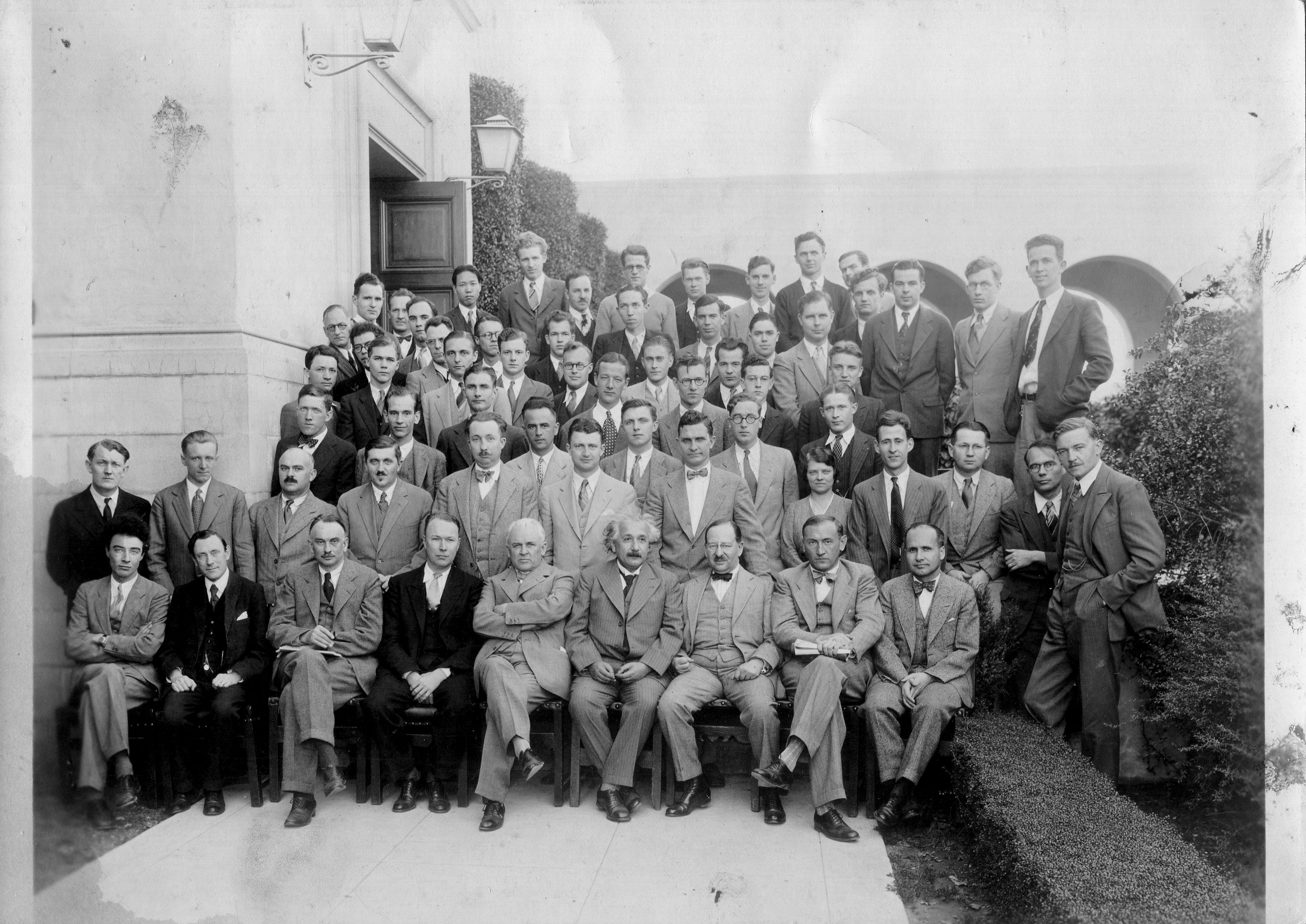
Group photo of the Caltech Department of Physics Faculty and Graduate Students. October 1931. Front row, left to right: J. Robert Oppenheimer, Harry Bateman, R.D. Tolman, William V. Houston, Robert A. Millikan, Albert Einstein, Paul Epstein, Fritz Zwicky, Earnest Watson. Charles Lauritsen (far left, second row), and Jesse DuMond (fourth from left, second row) Darrell Hughes. fourth row behind Paul Epstein (front row) Darrelll is in dark suit and has widow's peak. |
|
|
|
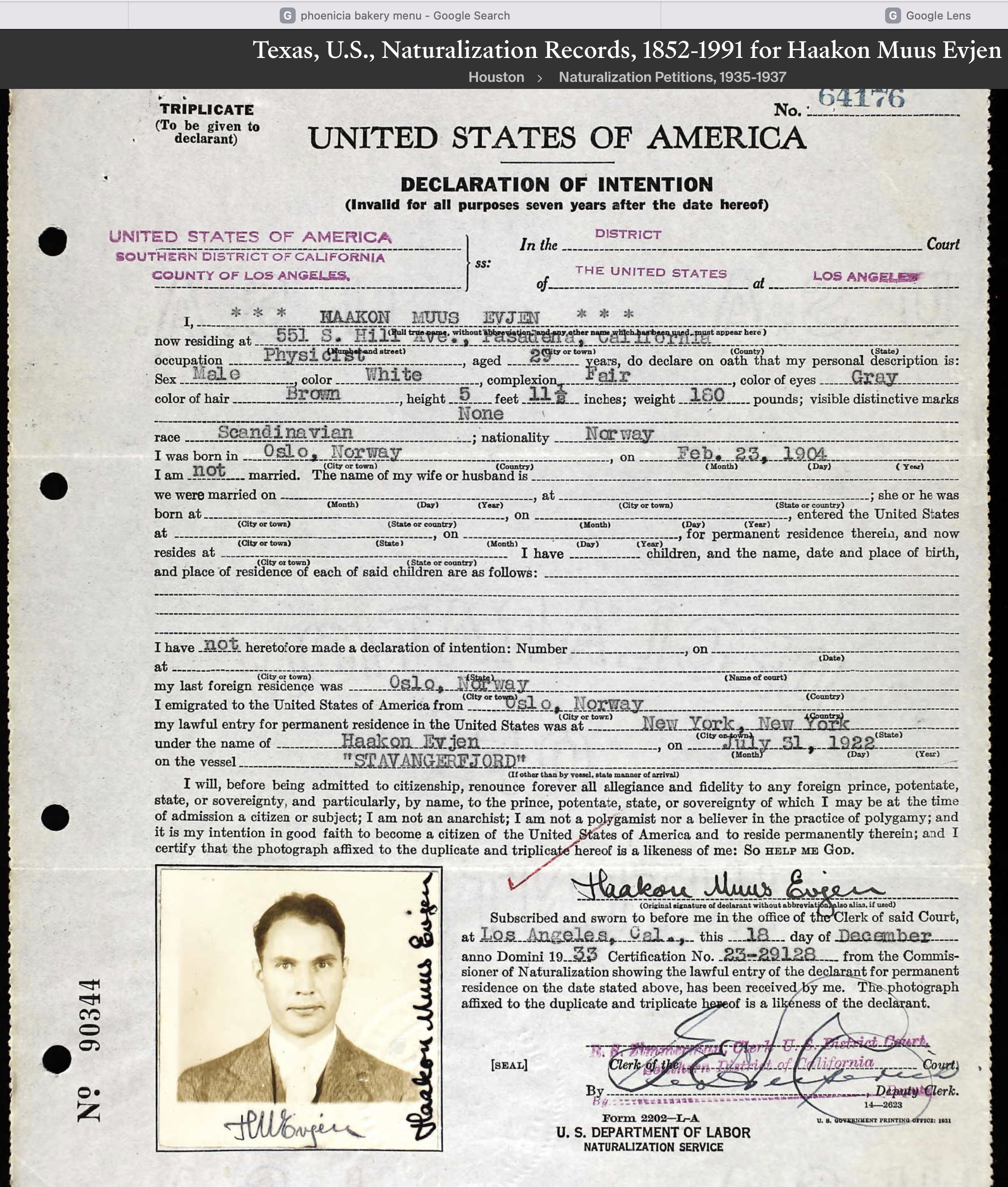
Naturalization papers of Haakon Muus Evjen, a fellowship holder at CalTech with whom Darrell Hughes collaborated with. He later worked for Shell Oil in Houston. He worked also for Fort Huachuca Electronics Proving Groound in Phoenix, AZ. He died in 1965 after suffering from multiple scelrosis for 25 years. He was born in Norway in 1904 to Jergen and Anna Muus Evjen. He had a brother, Knute Evjen, who was a geologist. . Haakon is buried in Mountain View Cmetery, Kingman, Mohave County, Arizona, United States of America. |
|

|
|
|
|

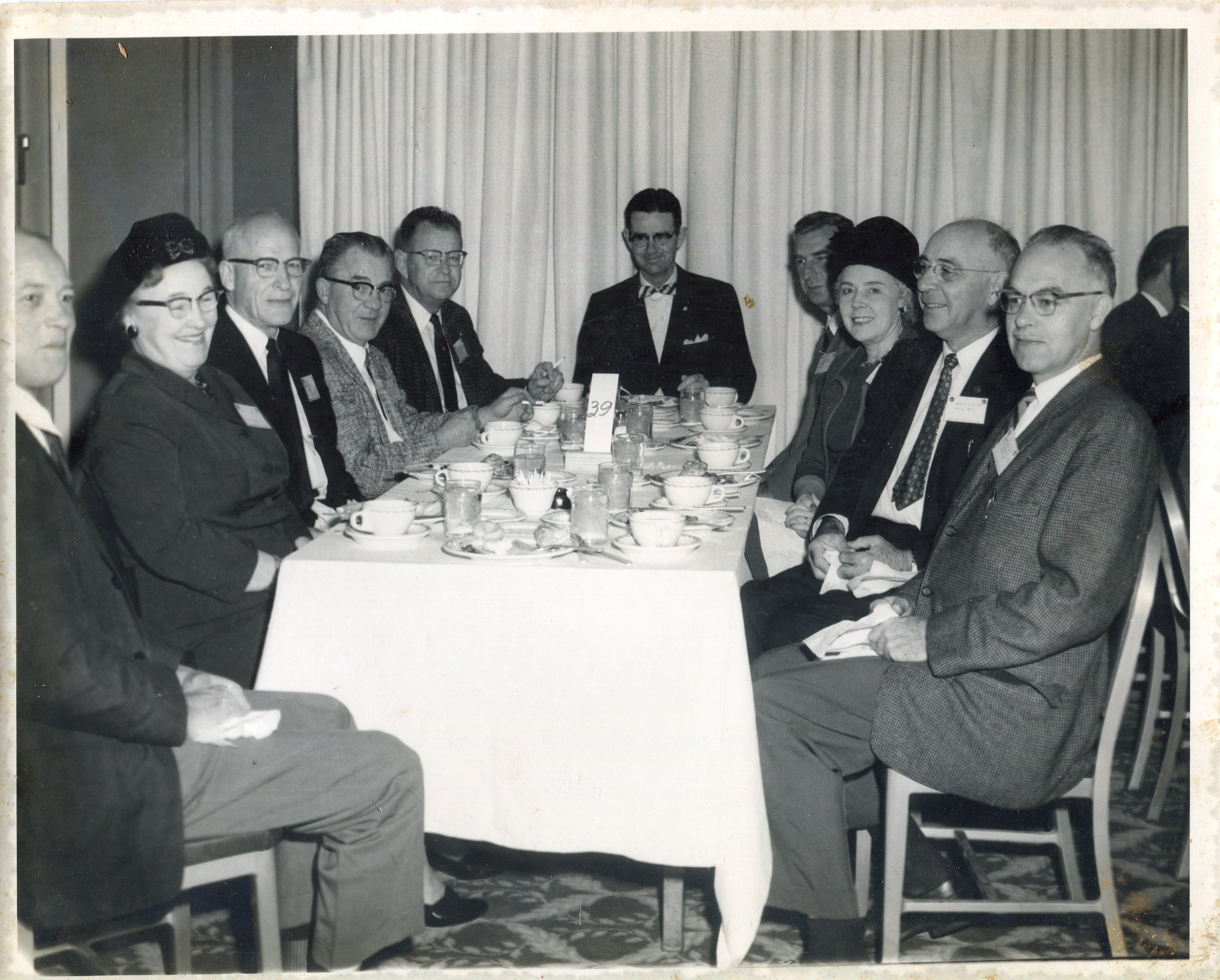
Society of Exploration Geophysicist, 28th Meeting, San Antonio, TX, Oct 13-16, 1958 |
|
|
|
|
|
|
|
|
|
|
|
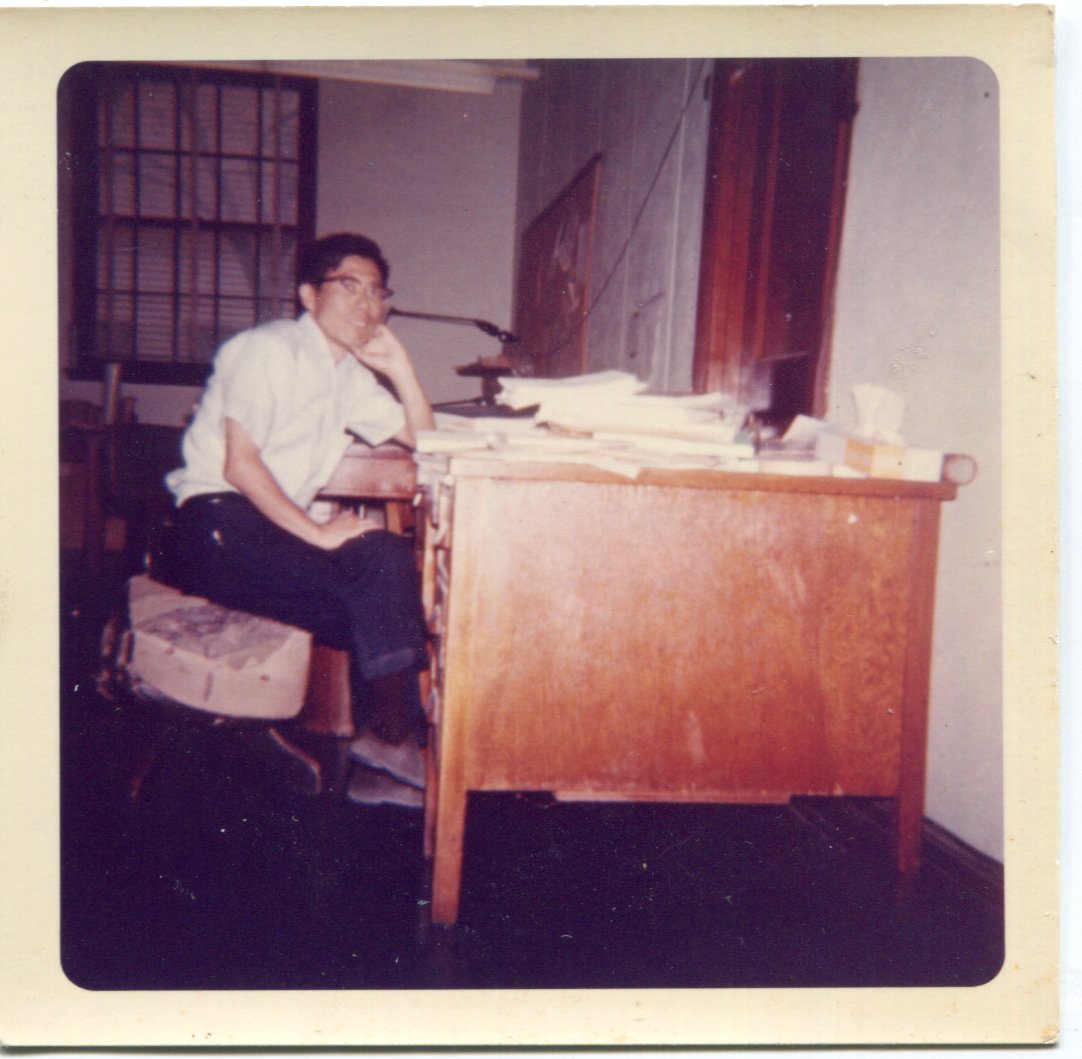
Dr. Teruo Nishitake, postdoctoral student of Hughes. Dr. Nishitake completed a BS in physics and studied geophysics at Kyoto University. His dissertation was related to research on physical properties of the earth’s interior. In 1959, he received a Fulbright Fellowship to study at the University of Texas in Austin. He became a professor at Ehime University and retired ca. 1992. He was honored with The Order of the Sacred Treasure, Gold Rays with Neck Ribbon.( Information kindly provided by Alumni Association. of Ehime University.)
|
|

Dr. Teruo Nishitake, postdoctoral student of Hughes. |
|
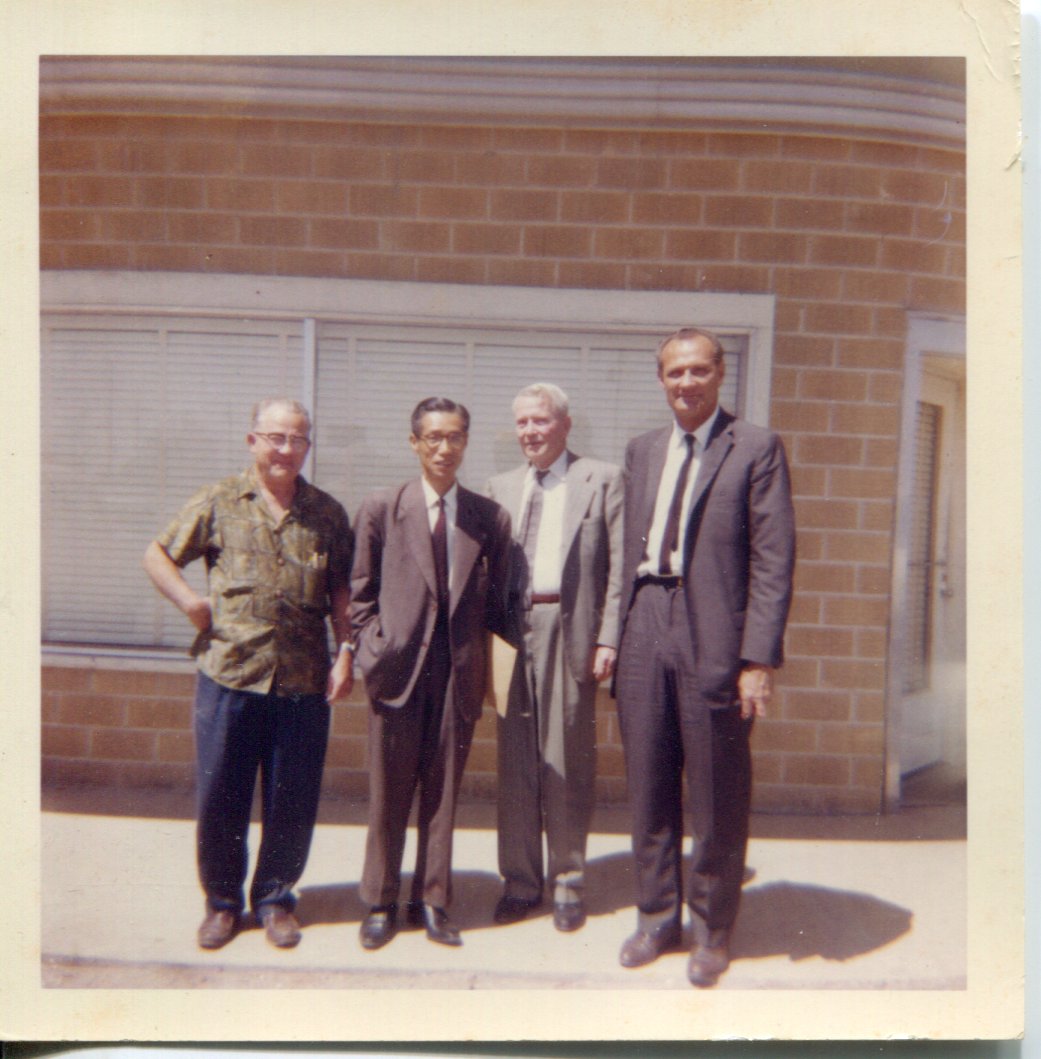
Darrell Hughes, Dr. Teruo Nishitake, unknown, unknown. |
|
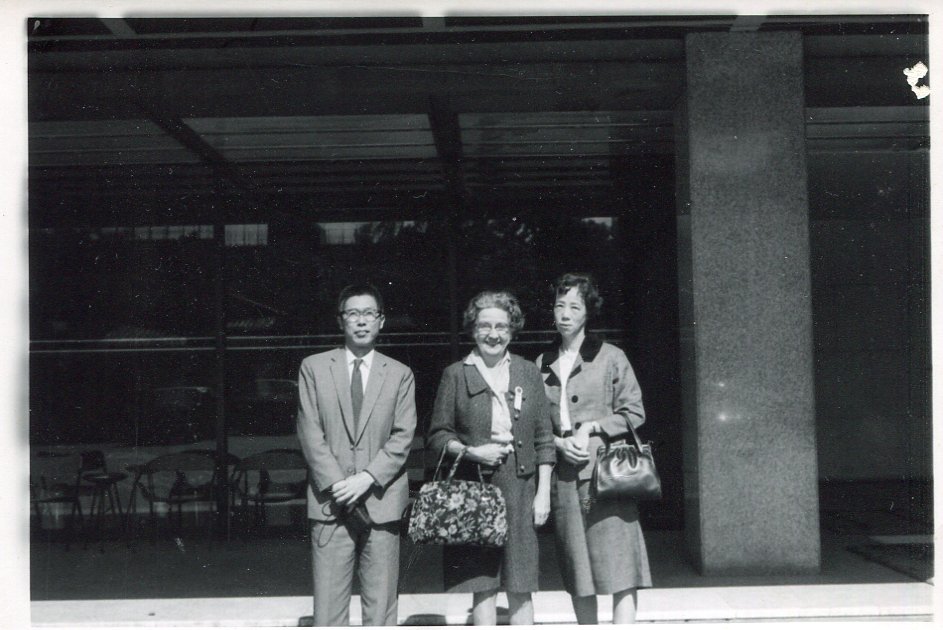
Dr. Teruo Nishitake, Leah Belle Hughes and Mrs. Nishitake |
|
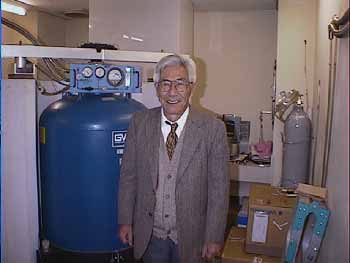
Prof. Teruo Nishitake visiting at the superconducting gravimeter room in Department of Geophysics, Kyoto University (Photo: Prof. S. Takemoto.) On the Campus of Ehime University in Matsuyama City, Ehime Pref., Prof. Nishitake constructed the following facility: Facility: Ultra-high Fluid Pressure Generating System (SHFP-40). Here are few of his papers. 第1部Elastic Properties of Rocks with Relation to the Earth’s Interior. Memoirs of the college of Science, Univ. of Kyoto, Series A, Vol.XXVIII, No.1, Article 4, 1956, 73~98. |
|

Facility: Ultra-high Fluid Pressure Generating System (SHFP-40) This facility was developed under the supervision of Professor Teruo Nishitake (currently Professor Emeritus) at Ehime University so that various high-pressure and high-temperature experiments can be performed in a fluid medium in the range of 4GPa and up to 1000°C. It boasts one of the world's largest capacities as a fluid pressure generators. The above facility was designed after reviewing the materials, shape, manufacturing accuracy, etc. for 2GPa equipment, which had been operated at Ehime University for a long time.
|
|
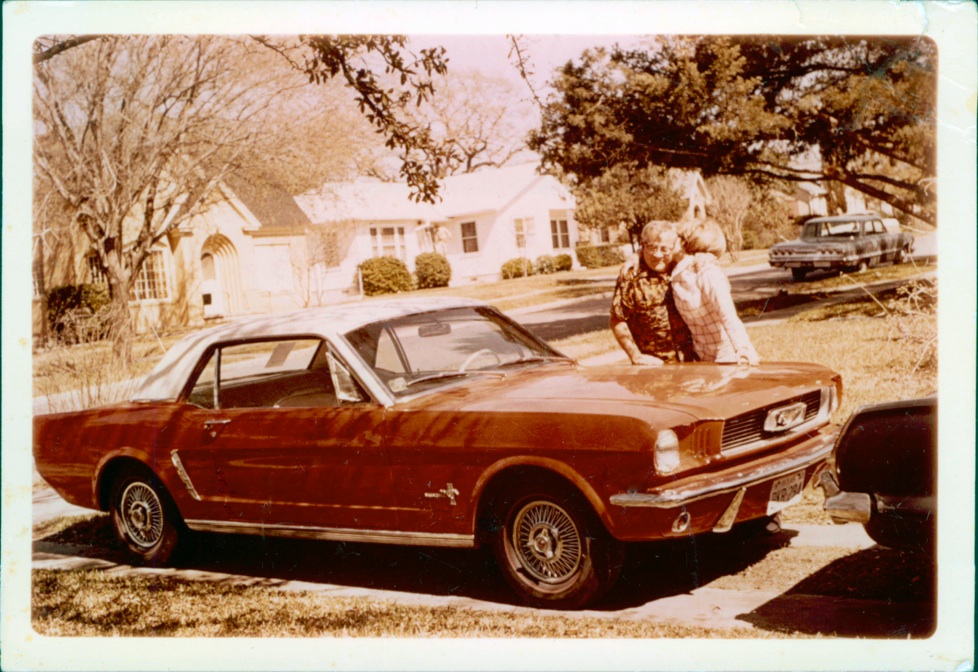
Darrell presenting a Mustang to his daughter, Brooks, on her 16th birthday. |
|
|
|

|
|
|
|
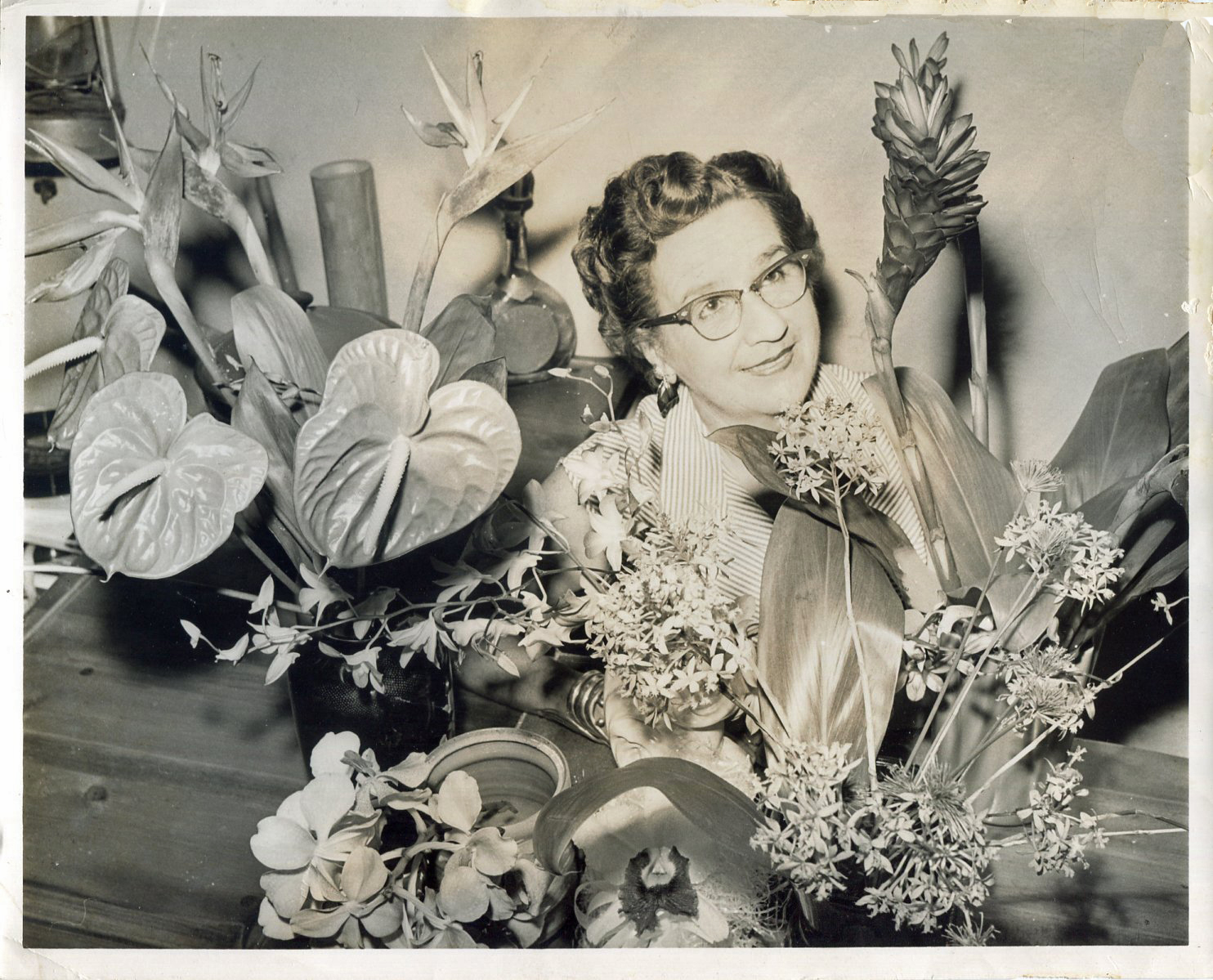
Original Photo of Orchids and Leah Belle Hughes
|
|
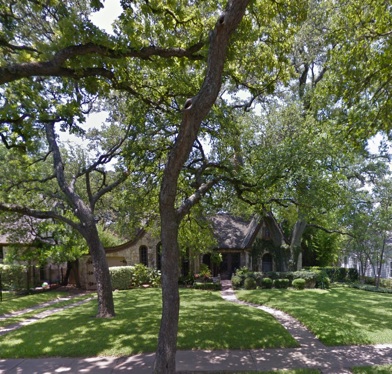
Hughes home today, 801 Park Boulevard, Austin, TX |
|
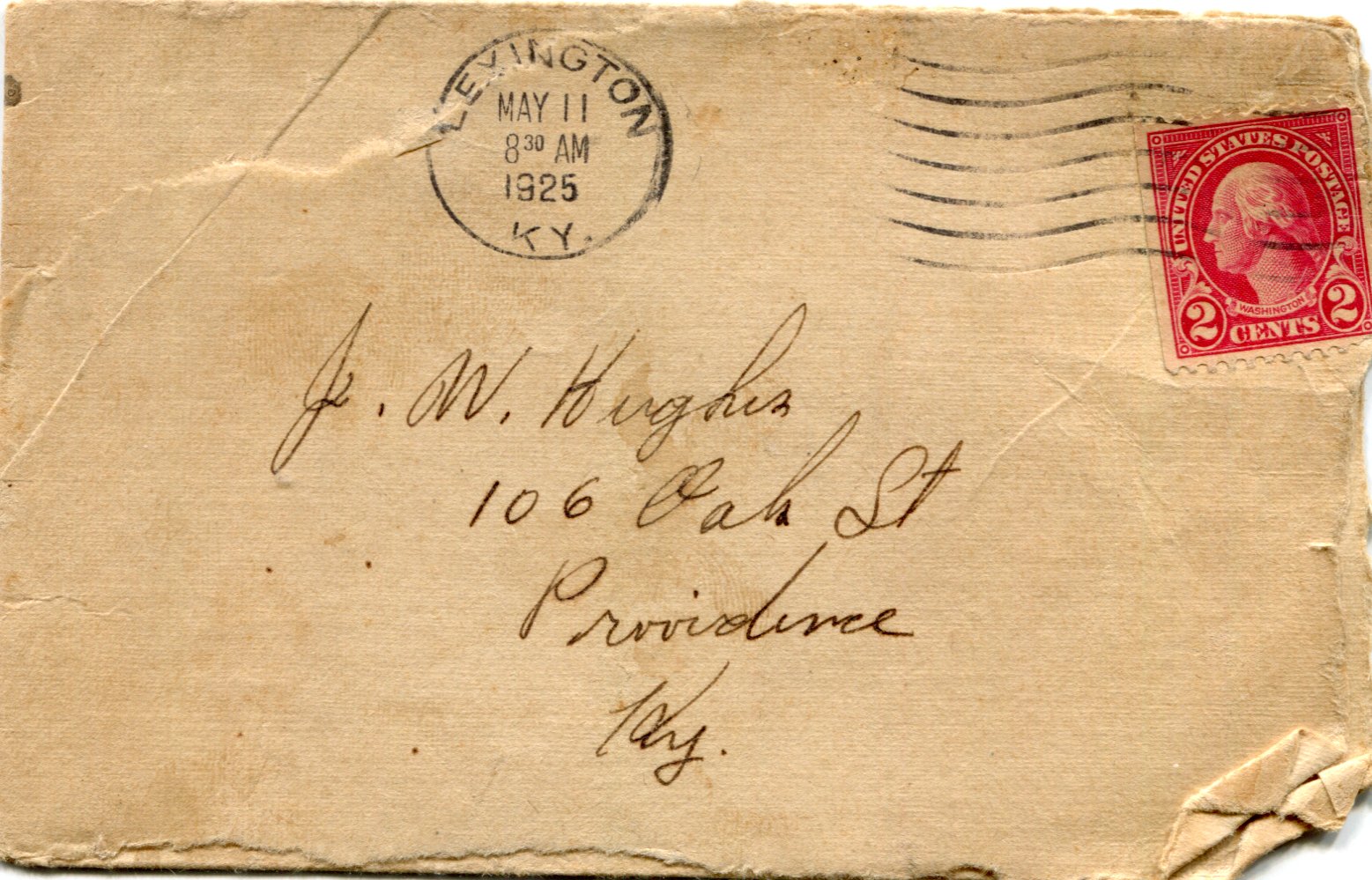
Obituary for Hughes' mother.
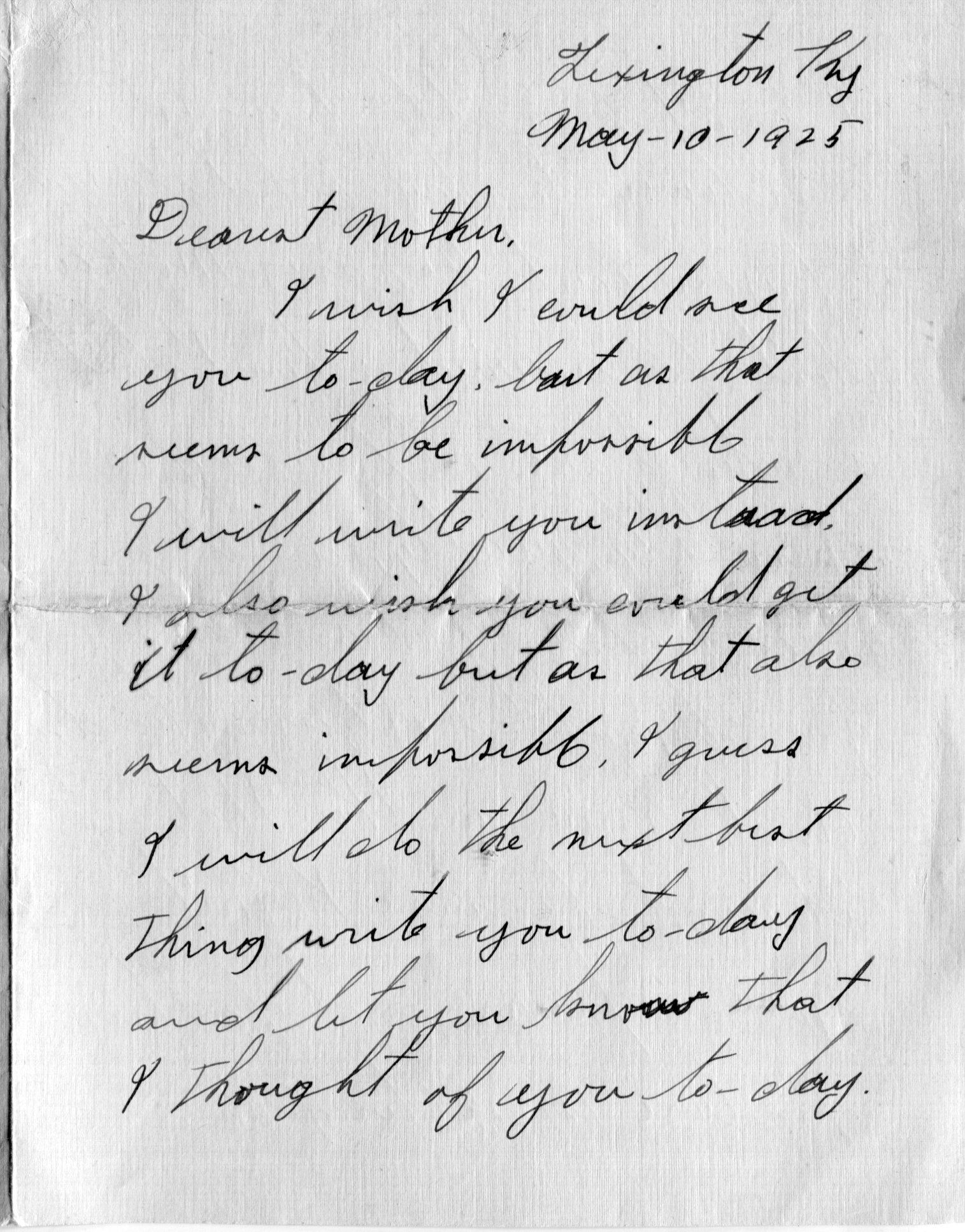
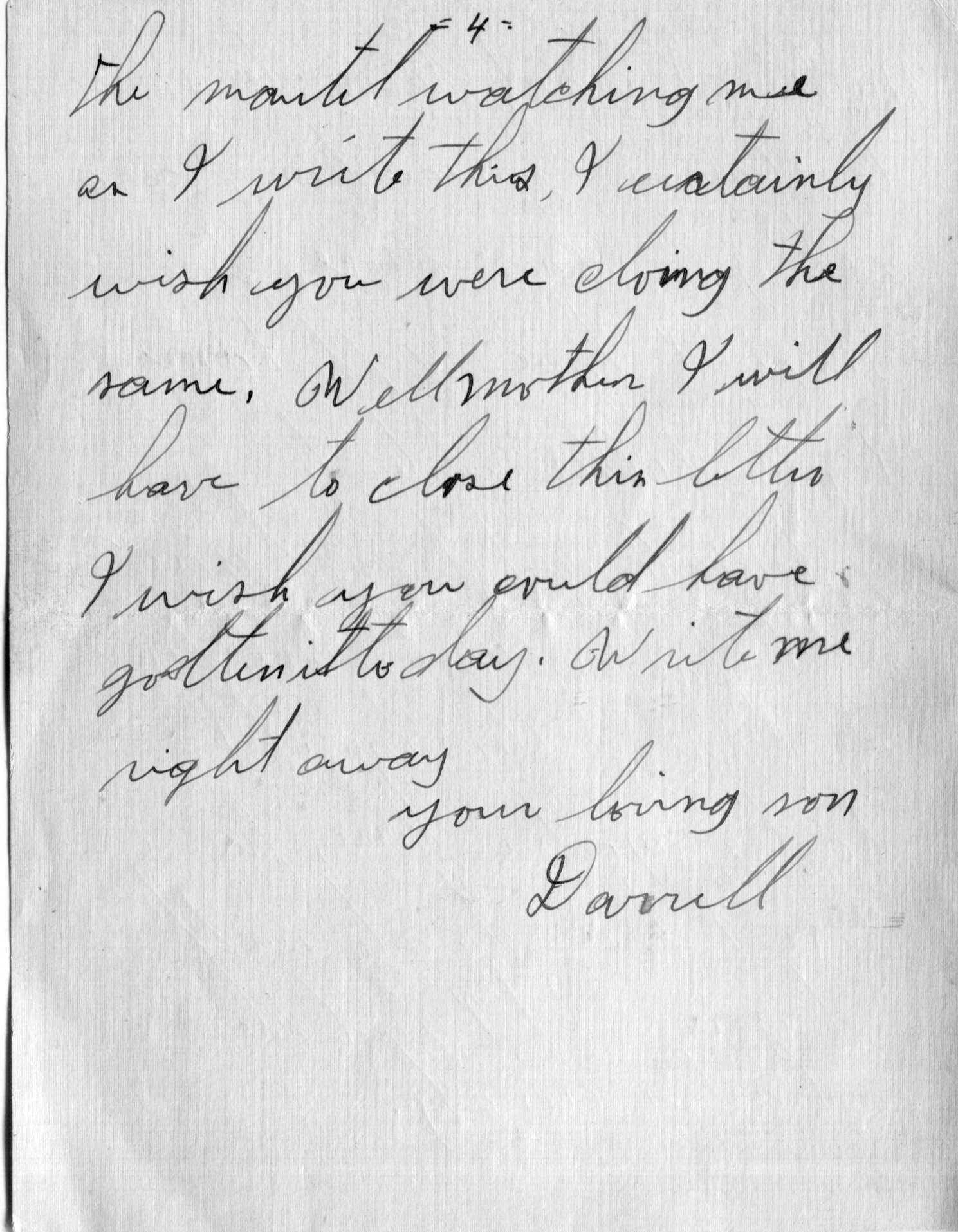
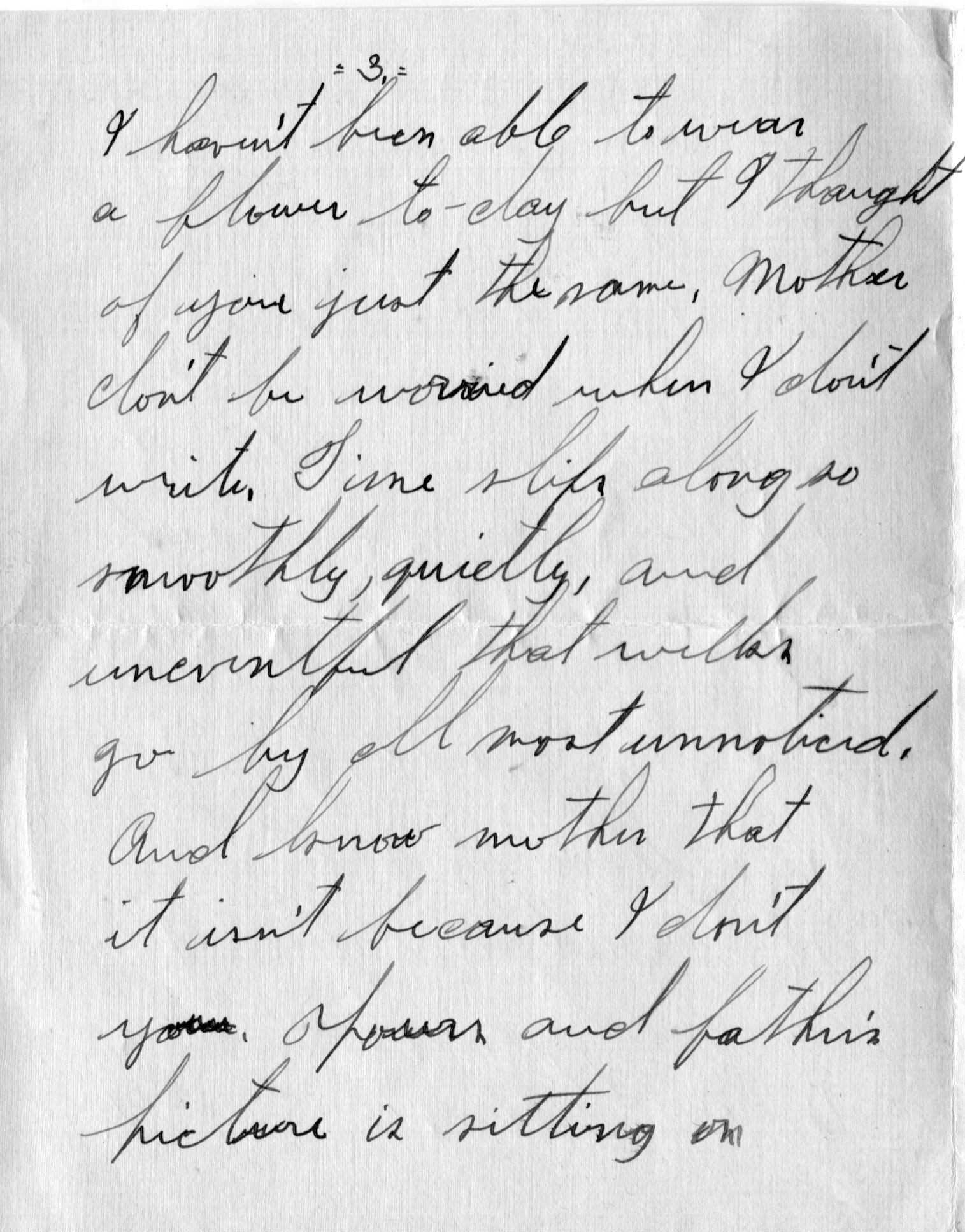
Mrs. James William Hughes, 71, of Providence, KY, died suddenly Saturday night while visiting in the home of her daughter, Mrs. W. M. Dedman,, and Dr. Dedman, in Gallatin, Tenn. She was a member of Providence First Baptist church and Eastern Star chapter. Mrs. Hughes, the former Mary BROOKS WALLACE, was the daughter of the late Mr. and Mrs. Stephen Wallace of Clay. She and Mr. Hughes were married January 27, 1902 in Dixon and they celebrated their golden wedding anniversary at their home here last year. They lived in Clay for ten years following their marriage and the remainder of the time in Providence. Surviving are the husband, formerly chief of police, who was elected police judge in the recent election; a son, Dr. Darrell S. Hughes, Austin, Tex., professor of physics in the University of Texas; the daughter, Mrs. Dedman; five grandchildren; a sister, Mrs. Pierce CURRY of Evansville; and a brother, Clusky Wallace of Evansville. The body was brought here for funeral services at 11 a.m. Monday in First Baptist Church, with the Rev. Benjamin Connaway officiating. Burial was in a Gallatin cemetery. Providence Journal-EnterpriseLeah Belle Smith Hughes Family
Leah Belle Smith was the daughter of Frank H. Smith and Belle Russell Smith. She attended the California Lutheran School of Nursing. She is in this school yearbook from 1930. Cal Lutheran School of Nursing Yearbook.
The California Hospital Medical Center, then known as the California Hospital School of Nursing, first began on June 11, 1898 at Dr. Walter Lindley’s private hospital on 6th Street in downtown Los Angeles. The hospital only accommodated up to eight patients, and four nursing students graduated from the school on June 10, 1899.
 At the turn of the century, the School of Nursing moved to the new five-bed California Hospital building on South Hope Street, which was considered one of the largest private hospitals in the country. In 1921, the management of California Hospital was transferred to the Lutheran Hospital Society of Southern California. In 1924, Mr. Adolph Larson, a building contractor and president of the California Hospital Board of Directors, built a new nurse’s home at 320 West 15th Street. lt housed 150 students and became known as “Larson Hall”. The building provided not only living quarters for the nursing students, it also had classroom and laboratory space. May 2, 1926 the new building was able to accommodate 35 patients, plus bassinettes for infants opened.

Leah Belle Hughes was very active with the Austin Symphony.
|
|||||||||||||||||||||||||||||||||||||||||||||||||||||||||||||||||||||||||||||||||||||||||||||||||||||||||||||||||||||||||||||||||||||||||||