
Preston Hampton Edwards |

(1843-1864)
Preston attended private and public schools in Darlington, and studied at Furman University, Greenville, SC, for two sessions, and three sessions at the University of Virginia, where, in June, 1900, he received simultaneously the degrees of BA and MA. The University of Virginia lists him in 1895–1997 and 1899–1900. The subjects in which advanced work was taken for the master’s degree were physics, mathematics, Latin and philosophy, and after this he took an experimental courses in physics and chemistry during two summer terms at the University of Chicago. He taught two years in small schools in South Carolina, and served for two years as an instructor in physics at Miller Manual Labor School in Virginia, and from 1902–1908 as Professor of Physics at Allahabad Christian College, Allahabad, India (picture below). Picture of the college also below.


Returning to America, he studied at Johns Hopkins University from February 1908, to January 1910, taking physics, with applied electricity as First Subordinate and mathematics as Second Subordinate. He attended lectures under Professors Ames, Wood, Whitehead and Cohen, Doctors Anderson and Pfund, and also under Professor Bloomfield. During the session of 1908–1909 he was a Fellow in Physics, and during the rest of his stay was Fellow by Courtesy. His dissertation in 1911 was entitled A Method for the Qualitative Analysis of Musical Tone. The thesis was supervised by Professor Ames and Dr. Anderson and later published in the Physical Review, 32, No. 1, 1911. A diary from his days at the University of Virginia is below. (Supplied by his son George Griffith Edwards).

 After completing his dissertation, he returned to India. He was there from March 1910 to December 1916 and from November 1918 to January 1920. In 1913, he was listed as an associate member of the American Physical Society in Allahabad Christian College. He grew up a Southern Baptist in Darlington, S.C. He wanted to “roam around the world,” Edwards’ son said, “an opportunity the Baptists weren’t offering at the time. So, he hooked up with the Presbyterians and traveled to India, where he met and married Mabel E. Griffith, of Utica, N.Y.” They were married June 11, 1912, in Allahabad, Bengal, India.. Mabel was born December 17, 1881, in Westernville, New York. She was educated at Smith College, 1903, Carnegie Library Training School, 1904 and YWCA Training School, 1908. She went to India in 1910 to work at the Ewing Christian College. Three of the couple’s four children (Howard Berryman(1913–89, b. Landour), mechanical engineer (later aerospace), George Griffith (1918–2000, b. Baltimore), chemical engineer, Ernest Preston (1919, b. Landour), ornithologist and professor of biology, Ruth Cary (1915-1916, Allahabad) were born in India. Ruth died there at fourteen months. Ernest Edwards described his mother as quiet and unassuming, and believed she never completely got over losing her daughter and having to leave her buried so far away.
In August 1917, Edwards took a one year position with the National Bureau of Standards in Washington, DC, “to do scientific investigation, partly in connection with war problems.” Records show Preston and Mabel arriving Vancouver aboard the Empress of Japan on January 31, 1917. He returned to India in November 1918.
 They returned from India September 24, 1920 and spent further time at Johns Hopkins. A report of his activity there is contained in a Johns Hopkins University Circular “Important advances have been made by Dr. Preston H. Edwards, Johnston Scholar in Psychology, toward the perfecting of a practical acoumeter—an instrument very much needed both for research and clinical work on auditory functions. In the course of this work, Dr. Edwards has developed an instrument for the measurement of pitch changes in the human voice and other tone sources. This instrument will shortly be available for research purposes and will be employed next year in research to be begun here with the collaboration of Professor Miller of the Greek Department, on the pitch and rhythm of speech.”
While in India, Preston somehow found time to publish another paper, A Simple Apparatus for Testing Pitch Control, Physical Review, 18, p. 120, 1921. His work at Johns Hopkins was used in the research of Professor Otto Ortmann, Psychological Laboratory of the Peabody Conservatory of Music. In his book, The Physical Basis Of Piano Touch And Tone, published in 1925, he wrote, "In order to verify the fundamental variations shown in the results obtained for the vibration of the piano string, a few photographs were made, for which an improved form of vibrating reflector, invented by Preston Edwards, was used. This consists essentially of a small mirror mounted on a tuned rod and placed before the mouth of a resonator. The torsional vibration resulting serves the purpose of greatly magnifying the vibration, so that a beam of light, when reflected from the vibrating mirror, makes a considerable excursion, the amplitude of which may be further increased by increasing the distance of the recording surface from the mirror. When properly adjusted, this device is very sensitive, and will show minute variations in intensity."
In 1919, Preston published a paper entitled, "Simplified Musical Notation: The Elements of Musical Notation on a Simplified System" Allababad: The Scientific Instrument Co. Agents. Price 10 Annas. Grandson Dr. Berryman Edwards contributed the paper which can be seen here: Simplified Musical Notation
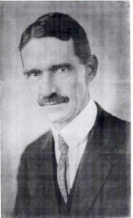 In 1921, Preston accepted a job at the University of Texas. His son, Ernest, believes (regents’ minutes confirm) they stayed there two terms before accepting an appointment at Winthrop College in South Carolina for four years and then Gettysburg College (PA) for a year. He next joined Sweet Briar College where he taught from 1927 until his retirement in 1943. Mabel was a librarian. He died May 21, 1969, Hampton, VA, USA.
There is a possible early connection with UT physics. During his graduate years at Johns Hopkins, 1908–1911, he would have surely met UT faculty member, Mary Lulu Bailey. She was on leave from UT from 1908–1910. She was not a degree candidate. They took many of the same courses. Both were single and older than average, Lulu being 39 and Preston 33. I speculate that a correspondence continued for a number of years. As 1920 approached, Lulu became ill and had to take a leave of absence for the year. It is likely that she suggested Preston as a temporary replacement, particularly since she was teaching the service courses. Lulu died in February of 1921. This would explain how Preston, in India, could have been recruited.
Picture below: Mabel, Preston, Howard, Griffith, and Ernest Edwards.

One further connection with UT: His son, Ernest Preston Edwards, an ornithologist and retired Dorys M. Duberg Professor of Ecology Emeritus at Sweet Briar College in Virginia, had a book published by the University of Texas Press: A Field Guide to the Birds of Mexico and Adjacent Areas : Belize, Guatemala, and El Salvador.
Acknowledgment: Much information in this entry generously provided by Ernest Preston Edwards, Howard Berryman Edwards, Anne Edwards (wife of Griffith Edwards) and Dr. Berry Edwards, son of Howard Berryman Edwards..
More Information About the Edwards Family
Sadly, Ernest Preston Edwards died in September 27, 2011. He had a very distinguished career and was held in high affection by all who knew him. Below is a memorial statement from The Auk, published by the American Ornithological Society.
 Ernest P. (Buck) Edwards, an Elective Member of the AOU since 1954, died a day after his 92nd birthday in Lynchburg, Virginia. He taught ornithology, ecology, and field natural history at Sweet Briar College (SBC), his boyhood home, from 1965 until his retirement in 1990. His interest in the avifauna of Mexico began when he and Stephen W. Eaton (fellow graduate students at Cornell) made a summer trip there in 1946 to study birds. Buck's account of some of their adventures in Nuevo León and Tamaulipas can be found in Moments of Discovery: Natural History Narratives from Mexico and Central America (2010, University Press of Florida), edited by Kevin Winker. Following frequent annual trips to Mexico, Buck wrote and published A Field Guide to the Birds of Mexico (1972), the third edition of which is still in print (1998, University of Texas Press).
Buck was born in Allahabad, India, on 25 September 1919, the son of Presbyterian missionaries Preston Hampton and Mabel Griffith Edwards. He grew up at SBC, where his father was a physics professor and his mother a librarian. After attending Lynchburg College, Buck transferred to the University of Virginia, where he and his older brother, George Griffith Edwards, shared a room with bunk beds on the Lawn, a particular honor at Mr. Jefferson's University, before graduating Phi Beta Kappa in 1940. He began his graduate work at the Laboratory of Ornithology at Cornell University in the summer of 1940 and immersed himself in ornithology courses taught by Arthur A. Allen and Peter Paul Kellogg. World War II intervened, and Buck served in the US Army until 1946, when he resumed his studies at Cornell; he received his PhD in the fall of 1949.
Following a teaching position at the University of Kentucky, he worked as a civilian with the U.S. Army Chemical Corps in Frederick, Maryland, where he met his wife, Mabel Thacher. After they married and before coming to SBC, he taught at Hanover College, served as associate director of the Houston Museum of Natural History, and taught for five years at the University of the Pacific in California. At SBC he was best known as the “bird man,” but his interest extended to the college's hardwood forests, where he established permanent research plots and a network of nature sanctuaries. He and Mabel knew every fern, orchid, and wildflower on SBC's 3,250 acres, and they were a distinctive pair as they rambled the forest trails. Buck, taller than six-foot-four, always wore a fedora and carried binoculars around his neck. Mabel, white-haired and diminutive, wore blouses embroidered with wild flowers and birds. Together they used their botanical knowledge to produce an exhaustive, annotated list of the vascular plants growing at SBC. The forest plots, sanctuaries, and plant list are valuable educational and research assets for the biology department and will serve as a legacy from Buck and Mabel for future generations of students.
Buck's enchantment with Mexico and its birds continued from 1946 to the end of his life. In 1955, in an effort to share his knowledge and experience, he wrote and published Finding Birds in Mexico, a book of a new genre designed to provide the traveling bird watcher with information on destinations, what birds might be found there, and where to look for them. He divided the country into regions reflecting the diverse topography of Mexico, describing the climate, vegetation, topography, and bird life of each. In 1972, having spent, in aggregate, nearly four years in the field in 31 of Mexico's 32 states, territories, and districts, he produced A Field Guide to the Birds of Mexico. For the first time, bird students had a field guide with color plates depicting nearly 500 species found south of the border. These groundbreaking books were self published and successfully marketed by the Edwards team (Buck and Mabel) over the years and in successive editions. In his retirement, Buck continued to write and publish: Checklist of the Birds of Belize and the Mexican Yucatan (2004), Birds of the Shenandoah National Park, Blue Ridge Parkway, and Great Smoky Mountains National Park (2006, McDonald and Woodward Publishing), and The Hummingbirds of North and Middle America (2008).
An image of this gentle and courtly southern gentlemen related by his nephew Preston from a recent trip to the Yucatan captures so well the professor and “bird man”: in the forest, the tall and slender Edwards standing alongside his Mayan counterpart, the two intently working out the identification of a bird high in the canopy.
Buck was preceded in death by his wife Mabel in 1996. He is survived by his niece, Anne Cary Edwards, and nephews Dr. H. Berryman Edwards, Jr., Dr. Preston H. Edwards, and Dr. Benjamin G. Edwards.

Mable Griffith Edward's History, Written by Her

 Mother Edwards—Smith College, Round Robin, 1950
This is a short history written by Mabel Emma Griffith Edwards, Preston Hampton Edward's wife.
(Her graduation picture from Smith College is shown at left—Mel Oakes)
I joined the group in the Round Robin on graduation in 1903. Spent fall and winter of 1903–1904 in Library School in Pittsburgh. While there, my father died in spring of 1904. (George Griffith is shown at right.—Mel Oakes) After graduation there, I took a position in the Reid Memorial Library in Passaic, N. J. Our work was largely among the foreigners; we had books in about twelve languages there. The children’s room was a bright and popular spot. I lived at the YWCA where, for part of my stay, Elizabeth (Viles) McBride was General Secretary.
A few years later, I resigned to got to Chicago for YWCA work taking training there which was, in a measure, a preparation for Foreign Mission work. I became Secretary of the YWCA in Sunbury, PA, for a short time.
In summer of 1910, I was accepted as a missionary to India, by the Board of F. M. of the Presbyterian Church, USA, and sailed from NY in the fall. On the boat to England, there were three of us going out for the first time. After a few days in London, we boarded an Anchor Line boat at Liverpool. There we found other missionaries who were not new, and learned a little about the language we would have to learn, the customs and habits of the people among whom we were to live. It was a rather leisurely trip through the Mediterranean, Suez Canal, Red Sea, Gulf of Arabia on to Bombay. Our only landing en route was for a day at Port Said.
At the dock in Bombay, Elizabeth came to meet me—she was now Mrs. McBride and had one small daughter. The two of us were to go to the North India Mission (what was then the United Provinces) , we went first to the Annual meeting of the missionaries of that District, and were there about a week. We were assigned to Allahabad after we spent some time getting a start learning the language. For that, we were sent to one of the small stations, where we had regular lessons, kept house, and so practiced our Hindustani on the servants, who seldom showed in any way that we ever made mistakes! In the hottest weather we went to Himalayas and continued our language study there.
In July, I went down to the Girls’ School in Allahabad, and started teaching (in English).

 To go back a bit—at Christmas time, or just before—Dr and Mrs. Ewing at Allahabad Christian College, had a house party “for the younger set”! This was a most unusual occasion for India, but for a few days, the American men teaching at the college gave several of us spinsters a very pleasant time. The aftermath of this party spread over several years. The results were that the four of us who went to Indian in the fall of 1910 married men who were serving out there—not all at the College.
The great event of the year 1911 was the Durbar at Delhi, where in the city of the ancient rulers of India, their modern rulers, King George and Queen Mary, were crowned with all the splendor and pageantry that royalty, and the Orientals who love color, could crowd into the day. It was the most colorful and exciting event that I have ever seen. We had fairly good seats, and sat in the broiling sun from 11:00 AM to 2:30 PM but survived the ordeal. It was like something out of a fairy tale.
I was married to Preston Edwards in June 1912. Preston had come out earlier to help Dr. Ewing at an early stage in the history of the college. He had been home and secured his PhD at Johns Hopkins, and returned to India in the summer of 1910.
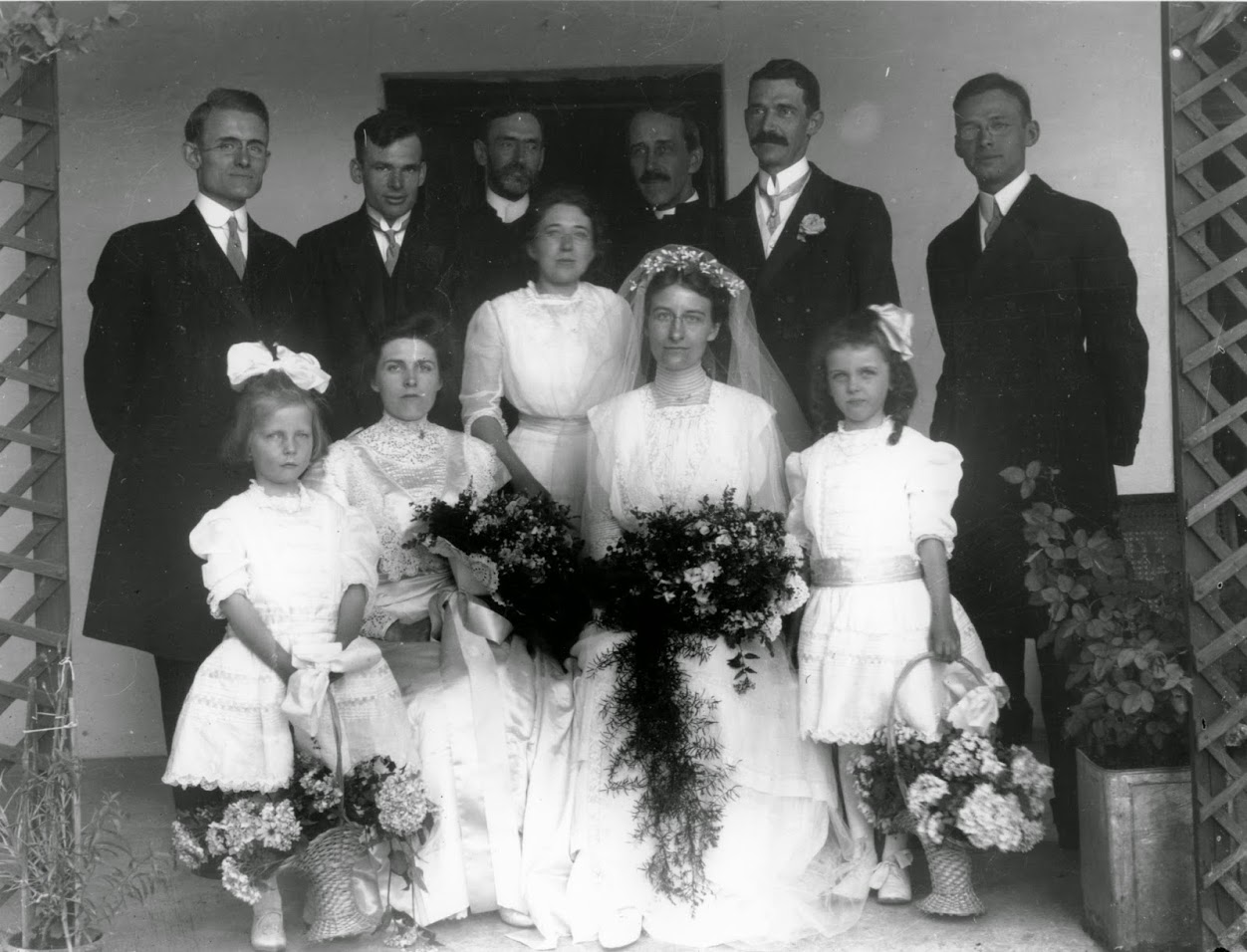
The bride is Mabel. Preston is second from right on back row. Dr. Arthur Ewing is at left end of back row.
Our wedding trip was taken back in the Himalaya Mountains, toward the source of the Ganges. Most of it on foot with the towering snow-capped peaks always in view. We heard no English spoken after our first day out. We, of course, saw many Pilgrims, as the source (Gangotri) is a very sacred spot for the Hindus.( Below is Preston on the trip.—Mel Oakes)

We lived at the college until our furlough home in the winter of 1917. Howard was born in Landor (where we spent part of the hot weather) in August 1913. Ruth was born in Allahabad in October 1915. She left us in December of 1917, just as we were about to leave for the U. S. (Below are photos of Howard and his proud parents—Mel Oakes)


Because there was a war on, no women were allowed through the Mediterranean, so we came home via the Pacific. We met extremes of weather—left Ceylon at Christmas in great heat. Arrived at Hong Kong in the coldest weather they had experienced for years. At Shanghai, the same cold weather. Storms all the way across the Pacific, and a not-too-serious collision with another boat as we neared Vancouver, made the trip one not to be forgotten. As we landed, we heard that the US had entered the war. Through Canada there were great snow drifts which, at one place, held the train at one spot for a whole day. The snow and cold were new sensations for son Howard. We visited relatives in N. Y. State and in South Carolina, returning to Washington to live for a time. Preston was engaged in war work at the Bureau of Standards.
 We were called back to India for a time until a new President of the college might be found. Our son, Griffith, born in Baltimore was just three months old when we started the long trip back via at the Pacific again. He was six months old when, after many experiences and some danger, we finally reached Madras in India. As we landed we received the news that the Armistice had been signed. Howard and Griffith are shown at right.
 Son, Ernest Preston, was born in India, and was a year old as we came into N.Y. harbor—this time to stay. At left are Ernest, Howard and Griffith. We lived a year near Baltimore where the two younger boys learned English, and Preston took some refresher courses at John Hopkins. This was followed by four years at Winthrop College in Rock Hill, SC. From there to Gettysburg College, then Sweet Briar (S. B.) in 1927.
On arrival in S. B., my surprise was great to find that our old friend Miss Czarnomska was teaching English at S. B. Our boys have grown up here except for the high school years spent in their father’s home town of Darlington, SC. They all graduated from the University of Virginia (as did their father). Griffith had two years at Annapolis, then had to leave on account of his eyes. He completed his course in chemical engineering at the University. Howard is a mechanical engineer, employed at the NACA/NASA. at Langley Field, near Norfolk, VA. He married an Amherst girl, and they have our eldest grandson now 16 months old. After Griffith’s graduation from college he was at Edgeworth Arsenal for a time then, as war came on, he went into the Navy. He took training as a radar specialist. His service was on an APA (Attack Transport) boat in the Pacific. At the end of the war, he was a Senior Lt. He returned home, met and married a Sweet Briar graduate, and lives in Amherst. He is an Engineer at the Calco plant of the American Cyanamid Corp. His son is Preston Hill and is 13 months old.
Ernest went to Cornell after graduating with Phi Beta Kappa honors from the University of Virginia. He took his MA then was called into the army. He took training as a pilot but was too tall to actually fly, so taught for a time, then took officer training. He was sent to Edgewood and was engaged in the high secret work carried on there. We found out later that it was biological warfare. One of the “bugs” caught him, and he had undulant fever for some time. After his discharge, he returned to Cornell and won his PhD in ornithology. He has been teaching this year at the University of Kentucky. He has made several trips to Mexico to study bird life there and will go again this summer.
Preston was retired from S. B. several years ago, but during the war, taught winter and summer, giving the Navy recruits training in physics. His longest terms were at the University of North Carolina and at Virginia Polytechnic Institute. Then, years before last and part of last year, he substituted at S. B. He has really retired now, and at present we are both well and busy building a new home.
Written spring of 1950
Mabel had scientist and engineers on her side of the family also: Here is a brief biography of her half-brothe, Dr. Ernnest Stacy Griffith, written by his son Stephen, a lawyer.
Dr. Ernest Stacy Griffith ("Doc," or big Ernest, ironically, since he ultimately was much shorter than "little" Ernest, Preston's youngest son): "Dad taught at Princeton, Syracuse, Harvard and American universities. He was a Fulbright lecturer at Oxford University and a visiting professor at a number of schools after he retired from A.U. including International Christian University in Japan. He was director of the Legislative Reference Service of the Library of Congress from 1942-1959 before becoming the founding dean of the School of International Service at American University, now the largest foreign service school in the United States. He was Phi Beta Kappa. He was a Rhodes Scholar out of Hamilton College in Clinton NY and a student of Merton College, Oxford. One factor in his selection as a Rhodes Scholar, he believes, was his founding in 1915 of a club in Clinton for boys 9-12, the Pioneers of America, which was the forerunner of the Cub Scouts of America. In the first three months the Pioneers had organized 100 troops in six states with an oath, a sign (the present two-fingered Cub scout sign) and a motto; the program was suspended during World War I because all the adult leaders were in the military; after the war the Boy Scouts of America was granted permission to use the Pioneer ideas and upon this foundation built the Cub Scout program. He was warden of the Settlement House in Liverpool to earn money while he earned his D Phil from Oxford. He wrote many books starting with his published Oxford thesis Modern Development of City Government. His best known works were Congress: Its Contemporary Role and The American System of Government, the latter of which was translated into many languages and used by the USIS as the basic primer on American government. He was vice president of the American Political Science Association, president of the National Academy of Economics and Political Science, and first recipient of the Jame Madison Award of the National Academy of Public Administration. At one time he held records for fastest ascent in the English Lake District and greatest number of peaks and miles walked in 24 hours in the Adirondacks. He was the son of George Griffith, superintendent of schools for Oneida County, and Elizabeth Griffith, a high school classics teacher. He married Margaret Dyckman Davenport, the daughter of Frederick and Edith Davenport, while Dr. Davenport was a professor at Hamilton College and before he was a member of the US House of Representatives. Dad and mother had five children: Margaret (Margo) Griffith Earley, Alison Griffith Tennyson, Lawrence S.C. Griffith, Julia Griffith Abernethy and Stephen Griffith; all are deceased except for the sons." (Provided by Stephen who is a retired lawyer in Portland, OR. Dr. Lawrence Griffith was a professor of cardiology at Hopkins.)
More information on Howard Berryman Edwards family provided by his son in 2021, Dr. Berry Edwards.
"My father, Howard Berryman Edwards worked ~40 years at NACA/NASA which was the setting of the movie and book "Hidden Figures". I worked there one summer and learned Fortran on the IBM 360 depicted in the movie. The book is excellent non-fiction account of the African-American "computers" as well as racism in my home town of Hampton, the oldest continuous English-speaking settlement in the New World, founded 1610. I, too, lived on Mr. Jefferson's Lawn (#10 East) my fourth year as an undergraduate in Engineering. My uncles shared #4. Both my father and I were members of Tau Beta PI (the engineering version of Phi Beta Kappa) and the Theta Tau professional fraternity as well as The Raven Society. I played saxophone in band and was first chair in the All-Virginia band 2 or 3 years. I still play daily. A couple weeks ago I played Taps on my Boy Scout bugle for military honors for the 400th time since 2011 at Tahoma National Cemetery with a VFW Honor Guard. My sister Anne Cary got her MS in engineering at UVa. She sings and plays guitar. My daughter Lauren Claire Edwards, yet another member of Phi Beta Kappa, is working on her PhD in psychology and just published her first research paper as first-named author. In her high school orchestra, she played the violin that belonged to Preston."
Below are some photos and interesting documents between Preston and the college administration in India:
Preston Hampton Edwards Photos and Documents |
|
|---|---|

|
|

|
|

Preston Hampton Edwards Instrument is a sarangi, late C19, North India,. A sarangi is a bowed stringed instrument with a skin-covered resonator. The typical sarangi is made by hand, usually from a single block of wood. The four playing strings on this instrument are made of goat gut, and the seventeen sympathetic strings are made of steel. The sarangi is used throughout India and has some regional variations, but it is a particularly important part of the Hindustani music of North India. |
|

Preston Hampton Edwards in orchestra before going to India. He is play the cello. In front of the piano with moustache. |
|

Preston Hampton Edwards, cellist, Sweet Briar College 1933 |
|

Preston Hampton Edwards, physics faculty, Sweet Briar College, 1933 |
|

Preston Hampton Edwards, physics faculty, Sweet Briar College, 1935 |
|

Preston Hampton Edwards, physics faculty, Sweet Briar College, 1937 |
|

Preston Hampton Edwards, physics faculty, Sweet Briar College, 1942 |
|

Preston Hampton Edwards, physics faculty, Sweet Briar College, 1943 |
|
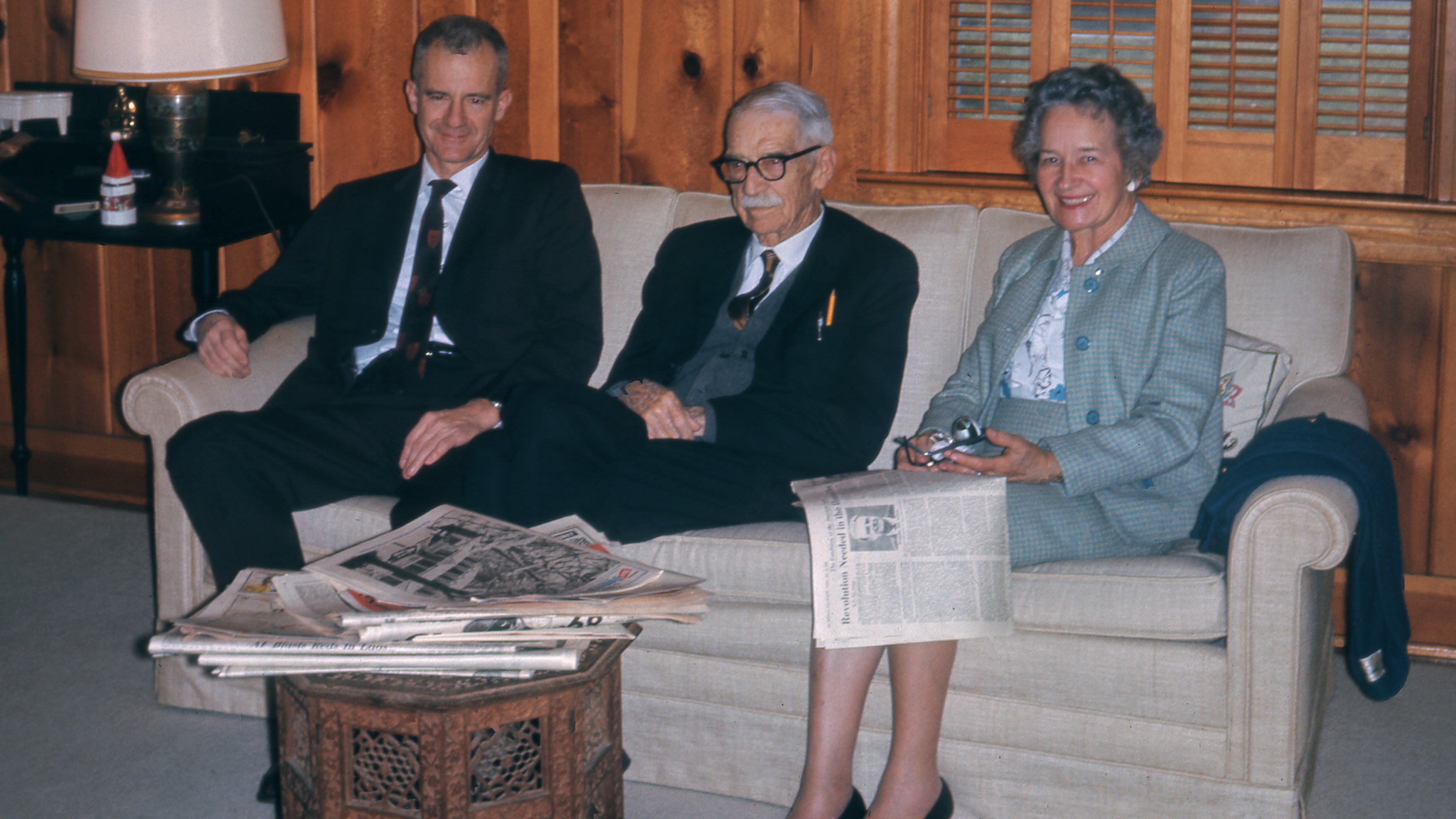
Howard Berryman Edwards, Preston Hampton and Lillian Carter (wife of Senator Walter Harrison Carter), 1968. |
|

Lilian L. Edwards, Preston Hampton and Lillian Robertson Carter (wife of Senator Walter Harrison Carter), 1968. |
|

Anne Cary Edwards, Lillian Robertson Carter, Howard Berryman Edwards, Preston Hampton Edwards 1968. |
|

Walter H Carter, Anne Cary Edwards, Preston Hampton Edwards, Lillian Robertson Livesay Edwards (daughter of Lillian Carter), Lillian Robertson Carter. |
|
RECEIVED: Physics Department Personal Labor Report of P. H. Edwards. There is very little variety from year to year in the reports of one whose work is largely according to a fixed routine, so my last year's report would serve with very few changes for this year. |
|
The Jamna School, Allahabad. I have also dropped back into my position of Honorary Secretary of the Christian Literature Society's branch in Allahabad, which means little more than having a weekly conference with Mr. Mukerji, who does practically all the work of secretary,- and attending a few meetings; I am glad, however, to have this touch with the literature work. Other interests which have involved some attendance of meetings, correspondence, and more or less work, are the Allahabad University, the Provincial Text-Book Committee, the United Provinces Missionary Council, the Missionary Education Union, the United Hymn Book Committee, and various minor committees. I spent about six weeks of the vacation in Laudaur with my family, doing at the same time light work in the Language School. The health of the whole family has been good, and we have been rejoiced recently by the addition of a third boy, whom I have not yet seen. I close another year with deep thanksgiving that God has given me a broader and deeper vision, I believe, of His will than ever before.
Signed
|
|
RECEIVED Note from P. H. Edwards You might turn Janvier's note over to Dr. Reed for file on FILING DEPT. July 16, 1917. I am enclosing a note from Janvier* which will show you his attitude on the subject of the man for Chemistry. Is the Board yet on the track of anyone who would fit the conditions? I wrote to W. W. Ewing, who was for awhile at Fatehgarh, but he was doubtful about going back to India, and would prefer school work to college if he did go. You saw the cablegram I had sent to Dr. Janvier, I believe, and the letter I wrote to Mr. Day. The cable, of course, didn't represent the case in its proper proportions, but my letter should have reached him a few days later and explained things more fully. I have written again the subject to Janvier, Weld and others, adding little to what I wrote in the first place except to emphasize the pull of my own country on me, and the fact that I have never been in at all close touch with the constituency at home of the Northern Presbyterian Mission, none too close indeed with the Mission on the field, but I have not emphasized this last. I think perhaps I left one misapprehension with you, when I spoke of engaging in layman's work at home; I did not mean anything like official connection with the Layman's Missionary Movement, but simply to take some position in my own line of work, and do whatever I can, as a layman, to forward the cause of missions, among other causes. I am now arranging to take up such work, for one year, and I hope that with the help of this year's experience I may be led to a wise decision for the farther future. Yours very sincerely, Preston H. Edwards |
|
transcription I am afraid I have been negligent about informing the for one year to do scientific investigation, partly in connection with war problems, beginning the 9th of August. Letters may be addressed to me there or at my street address, 3511-30th In order that you may know, if you wish, the present status of the question of my return to India, I am sending a copy of the resolutions passed by the College Council with regard to my cablegram and letter which you saw, and my reply to those resolutions. I hope I shall see you when you are here for the Missionary Sincerely, Preston H. Edwards |
|
STAMP My dear Janvier:- Transcription I want you to say to the College Council for me that I deeply appreciate 3. I quite realize the weight of the fact that I was a party to the arrangement 4. It is probable, or at least possible, that if I decide to return, I should want to Thanking you all for your kind words, and for the spirit of considerateness Yours affectionately, (Signed) Preston H. Edwards. |
|
FILING DEPT. 2. His failure to return would not only involve serious decline of 3. Naturally we feel most of all the need for him in our own institution. |
|
Personal Labour Report of Page 1. |
|
Page 2. |
|
Mother Edwards—Smith College Round Robin 1950 I joined the group in the Round Robin on graduation in 1903. Spent fall & winter of 1903–1904 in Library School in Pittsburgh. While there, my father died in spring of 1904. After graduation there, I took a position in the Reid Memorial Library in Passaic, N. J. Our work was largely among the foreigners; we had books in about twelve languages there. The children’s room was a bright and popular spot. I lived at the YWCA where, for part of my stay, Elizabeth (Viles) McBride was General Secretary. A few years later, I resigned to got to Chicago for YWCA work taking training there which was, in a measure, a preparation for Foreign Mission work. I became Secretary of the YWCA IN Sunbury, PA, for a short time. In summer of 1910, I was accepted as a missionary to India, by the Board of F. M. of the Presbyterian Church, USA, and sailed from NY in the fall. On the boat to England, there were three of us going out for the first time. After a few days in London, we boarded an Anchor Line boat at Liverpool. There we found other missionaries who were not new, and learned a little about the language we would have to learn, the customs and habits of the people among whom we were to live. It was a rather leisurely trip through the Mediterranean, Suez Canal, Red Sea, Gulf of Arabia on to Bombay. Our only landing en route was for a day at Port Said. At the dock in Bombay, Elizabeth came to meet me—she was now Mrs. McBride and had one small daughter. The two of us were to go to the North India Mission (what was then the United Provinces) went first to the Annual meeting of the missionaries of that District, and were there about a week. We were assigned to Allahabad, after we spent some time getting a start learning the language. For that, we were sent to one of the small stations, where we had regular lessons, kept house, and so practiced our Hindustani on the servants, who seldom showed in any way that we ever made mistakes! In the hottest weather we went to Himalayas and continued our language study there. In July I went down to the Girls’ School in Allahabad, and started teaching (in English). To go back a bit—at Christmas time, for just before—Dr and Mrs. Ewing at Allahabad Christian College, had a house party “for the younger set”! This was a most unusual occasion for India, but for a few days, the American men teaching at the college gave several of us spinsters a very pleasant time. The aftermath of this party spread over several years was that the four of us who went to Indian in the fall of 1910 married men who were serving out there—not all at the College. The great event of the year 1911 was the Durbar at Delhi, where in the city of the ancient rulers of India, their modern rulers, King George and Queen Mary, were crowned with all the splendor and pageantry that royalty, and the Orientals who love color, could crowd into the day. It was the most colorful and exciting event that I have ever seen. We had fairly good seats, and sat in the broiling sun from 11:00 AM to 2:30 PM but survived the ordeal. It was like something out of a fairy tale. I was married to Preston Edwards in June 1912. Preston had come out earlier to help Dr. Ewing at an early stage in the history of the college. He had been home and secured his PhD at Johns Hopkins, and returned to India in the summer of 1910. Our wedding trip was taken back in the Himalaya Mountains, toward the source of the Ganges. Most of it on foot with the towering snow-capped peaks always in view. We heard no English spoken after our first day out. We, of course, saw many Pilgrims, as the source (Gangotri) is a very sacred spot for the Hindus. We lived at the college until our furlough home in the winter of 1917. Howard was born in Landor (where we spent part of the hot weather) in August 1913. ruth was born in Allahabad in October 1915. She left us in December of 1917, just as we were about to leave for the U. S. Because there was a war on, no women were allowed through the Mediterranean, so we came home via the Pacific. We met extremes of weather—left Ceylon at Christmas in great heat. Arrived at Hong Kong in the coldest weather they had experienced for years. At Shanghai, the same cold weather. Storms all the way across the Pacific, and a not-too-serious collision with another boat as we neared Vancouver, made the trip one not to be forgotten. As we landed, we heard that the US had entered the war. Through Canada there were great snow drifts which, at one place, held the train at one spot for a whole day. The snow and cold were new sensations for son Howard. We visited relatives in N. Y. State and in South Carolina, returning to Washington to live for a time. Preston was engaged in war work at the Bureau of Standards. We were called back to India for a time until a new President of the college might be found. Our son, Griffith, born in Baltimore was just three months old when we started the long trip back via at the Pacific again. He was six months old when, after many experiences and some danger, we finally reached Madras in India. As we landed we received the news that the Armistice had been signed. Son Ernest Preston was born in India, and was a year old as we came into N.Y. harbor—this time to stay. We lived a year near Baltimore where the two younger boys learned English, and Preston took some refresher courses at John Hopkins. This was followed by four years at Winthrop College in Rock Hill, SC. From there to Gettysburg College, then Sweet Briar in 1927. On arrival in S. B., my surprise was great to find that our old friend Miss Czarnomska was teaching English at S. B. Our boys have grown up here except for the high school years spent in their father’s home town of Darlington, SC. They all graduated from the University of Virginia (as did their father). Griffith had two years at Annapolis, then had to leave on account of his eyes. He completed his course in chemical engineering at the University. Howard is a mechanical engineer, employed at the W.N.C.A. at Langley Field, near Norfolk, VA. He married an Amherst girl, and they have our eldest grandson now 16 months old. After Griffith’s graduation from college he was at Edgeworth Arsenal for a time then, as war came on, he went into the Navy. He took training as a radar specialist. His service was on an APA (Attack Transport) boat in the Pacific. At the end of the war, he was a Senior Lt. He returned home, met and married a Sweet Briar graduate, and lives in Amherst. He is an Engineer at the Calco plant of the American Cyanamid Corp. His son is Preston Hill and is 13 months old. Ernest went to Cornell after graduating with Phi Beta Kappa honors from the University of Virginia. He took his MA then was called into the army. He took training as a pilot but was too tall to actually fly, so taught for a time, then took officer training. He was sent to Edgewood and was engaged in the high secret work carried on there. We found out later that it was biological warfare. One of the “bugs” caught him, and he had undulant fever for some time. After his discharge, he returned to Cornell and won his PhD in ornithology. He has been teaching this year at the University of Kentucky. He has made several trips to Mexico to study bird life there and will go again this summer. Preston was retired from S. B. several years ago, but during the war, taught winter and summer, giving the Navy recruits training in physics. His longest terms were at the University of North Carolina and at Virginia Polytechnic Institute. Then, years before last and part of last year, he substituted at S. B. He has really retired now, and at present we are both well and busy building a new home. Written spring of 1950 |
