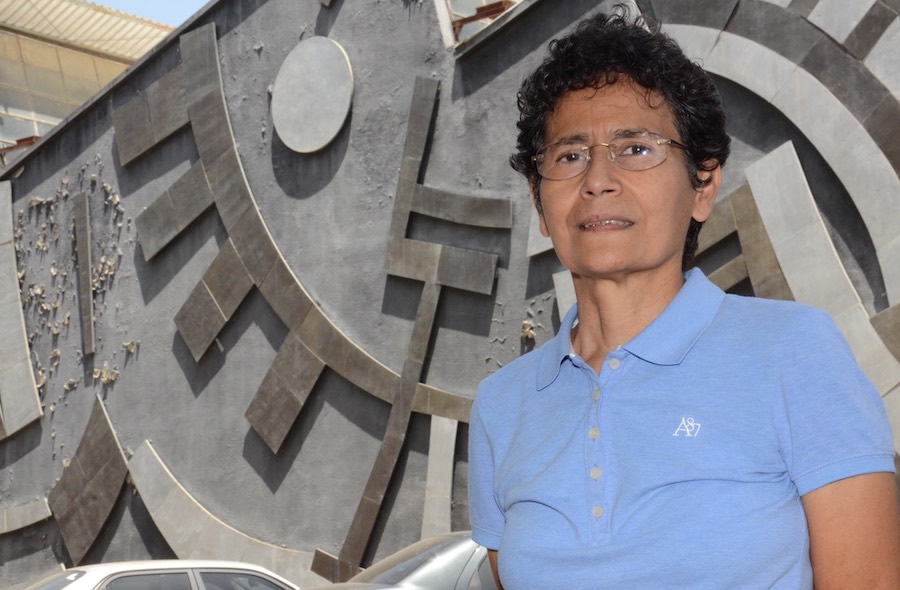
Anamaria Font |
Anamaria Font was born to José Ramón Font and Isabel Villarroel in 1959. José, an accountant, worked for the Oil Ministry. Following his marriage to Isabel, they moved to Anaco, Venezuela, in the eastern part of the country where there was an oil boom and where Anamaria was born. Later the family moved to Puerto la Cruz, a city on the Caribbean Sea.
Anamaria grew up in Puerto la Cruz with her two younger sisters, Isabel and Magdalena. Her half-brother, Omar, lived for a while with the family. In Puerto la Cruz the family lived in a housing settlement of the Sinclair Oil Company, thanks to her father being an employee of the Oil Ministry. Her parents divorced and her mother remarried. Anamaria has a half-sister, Mariana, from that marriage. José died in 2007. Her mother remained in Caracas. All of the daughters left the country.
Education
Anamaria writes of her education:
"I went to the primary school that was also part of the settlement. It was a wonderful school, with huge playgrounds, well kept facilities (maintenance done by the company who also provided school materials). I started secondary school in 1970 at a public high school. At the time there were student protests and classes were often interrupted, so in the middle of the second year my parents transferred me to a quieter private school where I stayed until the fourth year.
"In July 1974, we moved to Margarita Island, and I did my final high school year in a public school. The chemistry and physics lectures included regular lab sessions. The math lessons were also very good. I went to undergraduate school at Universidad Simón Bolívar (USB) in Caracas, from 1975 to 1980. My major was physics. I had excellent professors, many from abroad. For my undergraduate thesis, I worked with Rodolfo Gambini and Antonio Trias on solving the Bhabha-Corben equations of motion for radiating spinning particles. After finishing my undergraduate studies, I wanted to do a PhD in the US. While preparing applications I started a MSc at USB where I was also instructor. Meanwhile, I also applied for a fellowship from the Research Council in Venezuela. One of the places I applied was UT which my professor Alfredo Sánchez, a UT PhD, had recommended. Somehow, this was the place I wanted to go.
"Even before being accepted, in the spring 1981, I decided to go to Austin to take a summer course in English. While there, I learned that I was admitted and was also awarded a fellowship. I did very well in the obligatory courses. Before the qualifying exam, I asked Prof. Gleeson to be my advisor. The plan was to work on high temperature quantum field theory (QFT). To begin, I had to study 2-dimensional QFTs. Along the way, I got interested in higher dimensions and ended up doing the qualifying in anomalies in higher dimensions. This was a topic related to strings that was gaining much attention those days. I started to study string theory like many other people in the department. Every week, I met with Prof. Gleeson for discussions and progress reports. My dissertation, defended on May 1987, was entitled 'Four dimensional supergravity theories arising from superstrings.' It was mostly based on work done with Cliff Burgess and Fernando Quevedo. I spent six wonderful years at UT."
Anamaria recalls some fond memories of her time in Austin:
"* The kindness of Prof. W. Millett. He taught me electrodynamics I and then let me have a desk in his lab in the basement of the RLM building.
* Becoming a T.A. and being an instructor in Professor Robert Little's Physical Science courses. This really helped me improve my teaching abilities.
* Many happy hours with my fellow LatinAmerican students."
After graduating from UT, Anamaria applied for post-docs and got offers from University of Rochester, the Abdus Salam International Centre for Theoretical Physics (ICTP) in Italy and Laboratoire d’Annecy de Physique des Particules (LAPP) in France, where she went. She spent two very productive years in Annecy, working mostly with Fernando Quevedo, Luis Ibáñez and Hans-Peter Nilles who were at CERN. From Annecy to Geneva was a short ride, and she went there once a week. In September 1989, Anamaria returned to Caracas to take a position at the Physics Department of Universidad Central de Venezuela.
Research and Professional Career
Anamaria describes her research, "I have kept working on string theory. From 1987 to 1995 my interests were on phenomenological implications of string models, as well as on mirror and duality symmetries. In a paper with Luis Ibáñez, Dieter Lüst and Fernando Quevedo, we introduced the key concept of S-duality that played an important role in the understanding of dualities among string theories. In 1995, I went back to UT for a sabbatical year. This time I joined Professor Weinberg's Theory Group to work with Philip Candelas with whom I had already collaborated. At that time, the so-called second string revolution got under way. I was very lucky to be able to learn the new developments, such as D-branes, as they were happening.
"In the following years my research focused on models with open strings and D-branes. In 2003, I went to Madrid for a sabbatical and ended up staying at the Instituto de Física Teórica UAM/CSIC until 2007. During those years my work mostly centered on flux compactifications and moduli stabilization in string constructions. Back in Caracas, my attention shifted to the analysis of grand unification models constructed in the framework of F-theory compactifications.
" I retired from Universidad Central de Venezuela (UCV) in December 2017, but I am still doing research. Recently I have worked on toroidal heterotic compactifications and on swampland conjectures.
" Of course, a very important part of my work at UCV was teaching. I enjoyed it and always tried to do my best. I didn't spare any efforts in helping the students understand and apply the concepts. Not as often as desired, I also acted as thesis supervisor. I had one Ph.D. student, two M.Sc. students and five undergraduates."
Honors and Awards
During her career, Anamaria received the following awards and fellowships:
- Elected Member to Academia de Ciencias de América Latina (ACAL), April 2016.
- Fellowship from the Max Planck Society, January-July 2015.
- Fellowship from the Alexander von Humboldt Foundation, October-December 2014.
- Elected Member to The World Academy of Science (TWAS), October 2013.
- Senior Associateship to International Centre for Theoretical Physics-Trieste, January 2012-December 2017.
- Fellowship from the Alexander von Humboldt Foundation, September 2000-March 2001.
- ICTP Prize in High Energy Physics [shared with Dr. F. Quevedo], July 1998.
- Lorenzo Mendoza Fleury-Polar Foundation Prize, May 1991.
- Junior Associateship to International Centre for Theoretical Physics-Trieste, December 1990-December 1998.
- Scholarship from Conicit-Venezuela, September 1981- July 1986.
Personal Information
In December 2017, Anamaria married Stefan Theisen in December 2017. They had been together since 2001. They now live in Potsdam. Stefan is also a physicist.
Below is an interview Tony Feder of Anamaria which appeared in Physics Today, July 10, 2018.
Q&A: Anamaría Font on the deterioration of science in Venezuela
By her early 30s, Anamaría Font was a tenured professor, owned an apartment in Caracas, and was teaching and pursuing research in string theory. “I could travel, I could get support, I could get grants to buy computers,” says Font. That was in the late 1980s. “This is unthinkable now. Everything has changed. All of those opportunities have disappeared.”
In the past few years, Venezuela’s economy has nosedived. The oil-rich country has gone from being the wealthiest per capita in Latin America to experiencing the deepest financial recession anywhere in decades. Hyperinflation has made food, medical supplies, and other basic needs unavailable or unaffordable. People who once lived comfortably are now scavenging the streets. And Venezuelans are leaving the country in droves—in the first part of this year, an estimated 5000 departed each day.
Siberian-born journalist Anatoly Kurmanaev wrote in the Wall Street Journal on 26 May 2018 that Venezuela’s collapse “has been far worse than the chaos” he experienced in the post-Soviet meltdown. For most ordinary Venezuelans he knows, the “foreordained victory” of Nicolás Maduro’s reelection to the presidency on 20 May 2018 snuffed out the last glimmer of hope that their lives can improve through democratic and peaceful means. What’s left is exile or further misery.”
For now, at least, Font is staying in the country where she was born and has spent most of her life. But she retired last year, earlier than she’d ever intended. And she is looking for new opportunities. “We are going through a lot of hardship. We sacrifice time, health, and energy. What for? And how long can we do it?”
PT: Where did you go to college?
FONT: Simón Bolívar University. At the time it was new, and it was the best the country could offer. Many professors were foreigners. The libraries were good, the labs were good. The students were good. I liked biology, chemistry, science, mathematics. I was talking to people at the university, and the people in physics were very nice. They were trying to attract new students, and they got me.
After I graduated, I went to graduate school at the University of Texas at Austin. Compared with other students, my level of preparation was high.
PT: Did you like Austin?
FONT: One reason I liked it a lot was because there were so many Latin American students there in physics. It was very lively—Fernando Quevedo [now head of the Abdus Salam International Centre for Theoretical Physics in Trieste, Italy] and Cliff Burgess were there. There were many good people. The relativity group was good. Also, Steven Weinberg had arrived there a year before, and John Wheeler was there. Weinberg was active in inviting people who worked at the frontiers, in the hot topics of the time.
PT: What did you do after graduate school?
FONT: I went to France for a postdoc, and after two years there I went back to Caracas. My PhD was paid by a fellowship from the Venezuelan government, and the condition was that I had to return and work in academia. I felt it was my obligation to go back, and I wanted to go back. I had a very good offer from the Universidad Central [Central University of Venezuela], salaries were fine, working conditions were decent.
At the beginning I had to teach a lot. I don’t know how I managed to teach and do research. I had to go somewhere else to use what was at the time email—it was called BITNET. I lived one hour away from the university and used public transportation. But I was very productive. I got tenure after about two years. I also got a prize from the Polar Foundation in Caracas. That helped economically. With part of the prize, a loan from the university, and my savings, I bought an apartment.
PT: What did you like about working in Venezuela?
FONT: When I started my career, the country was scientifically strong and getting stronger. Like me, many people had returned after having government fellowships abroad, and research at the universities and other institutions was improving—it was getting to a very good level. Salaries were competitive, even with the United States and other places.
I am in the faculty of science, which includes biology, chemistry, mathematics, and computer sciences. My main research subject is the application of string theory to the construction of models of fundamental interactions. I look at string compactifications and their duality symmetries and analyze phenomenological implications of string models.
Overall there are many women on the faculty; there were and still are. Ever since I was in university, I always wanted to have an academic life here. But now, the young people who finish their undergraduate or graduate studies don’t want to take up positions at Venezuelan universities.
PT: Can you still work productively in Venezuela?
FONT: No. In 2016 I was still working, finishing projects, starting new ones. But since July or August of last year, conditions have gotten much worse. Internet is very poor. We have shortages of paper and ink. In my department, eight people resigned in the past year. Compared with two or three years ago, about a third of the students have left, and no new ones have been coming. This is no longer a place to do research.
These days, I don’t do much in Caracas except go back and forth between home and the university. If I want to go to the movies or to the theater, it would be expensive for me with my salary. Everything is changing, even as we speak. Prices are going up and up. And security is poor. I don’t stay in the office until late, as I used to. It’s not safe. I go home before dark.
I myself took the decision to retire. Some years ago, I thought this was absurd; I would never retire when I was still young and productive. But then I realized it’s hard with my salary to feed myself or to have a decent quality of life. It’s no longer possible to pay for medical costs or to travel. I realized that if I want to do research, I will have to go somewhere else.
There are also shortages of medicine. I have suffered that myself. I had to have a biopsy, and there were no needles. I had to wait until needles arrived. I am at an age now where I could have health problems, and if you need special medical attention or facilities, these things are hard to find. When you are worried about surviving, taking care of your family, your health, you cannot concentrate on work. There are still people who do it. I try.
PT: Do you still do research?
FONT: Yes. It’s what keeps me going.
PT: What contributes most to the problems in Venezuela?
FONT: Several economic and political actions, or lack thereof, contribute. The country is continuously printing money and not removing exchange controls, which ends up hampering industry and fueling the black market and corruption. The government has installed an assembly with supra-constitutional powers that can issue arbitrary decrees contrary to existing laws.
And the state-owned oil company is not producing enough to keep the country going. The sanctions by the US and Europe further limit the government’s access to funds. They are imposed on some government officials or government companies. They are not directed at the people, but they make the government’s handling of the economy more erratic, more irresponsible, and we feel the effects. I don’t know what the international community could do to help. They could do concrete things like send medications or food, but then the Venezuelan government has to allow for that, and it doesn’t.
The situation has been getting worse and worse since about 2012. But it’s been really bad for about a year. That’s when prices got completely out of control. I honestly don’t know how to improve the situation, how things can change. That is part of the uncertainty that makes life so hard.
PT: What are your plans?
FONT: I don’t know. Since I am now retired, I don’t have to teach. I may go somewhere else, where I can get a scholarship for a few months, and then return to Caracas. I retired to have a Plan B, to have more freedom. I am not planning to apply for jobs, but maybe I can continue to get support in Spain, Germany, and Trieste for short times. Since 2015, every time I have gone abroad I got my tickets paid and help with expenses. What I manage to save, I can use the next time I travel, or for my expenses, my savings, my future.
And I would like to teach again. I was teaching until the end of January, and I had very good students. I think of these young, promising students, and now there are many courses that don’t have professors. Or they have professors who don’t have experience. People who graduated recently, even people who have only an undergraduate degree, teach advanced courses because the faculty have left or retired. But there are still very good, motivated students. I want to be a professor for these students.
PT: Is that why you stay in Venezuela?
FONT: I still feel Caracas is my home. I have my house, my books, and my mother is here. To start again would take a lot of energy, and I am not sure I have it. But maybe I will have to put myself to the test.
Anamaria Font Photo and Document Album |
|
|---|---|

|
|

|
|

|

University of Texas, 1987 |

|
|

Anamaria Font and Urjit A Yajnik (Professor, Indian Institute of Technology, Bombay, India, PhD, U. Texas 1986))
|
|
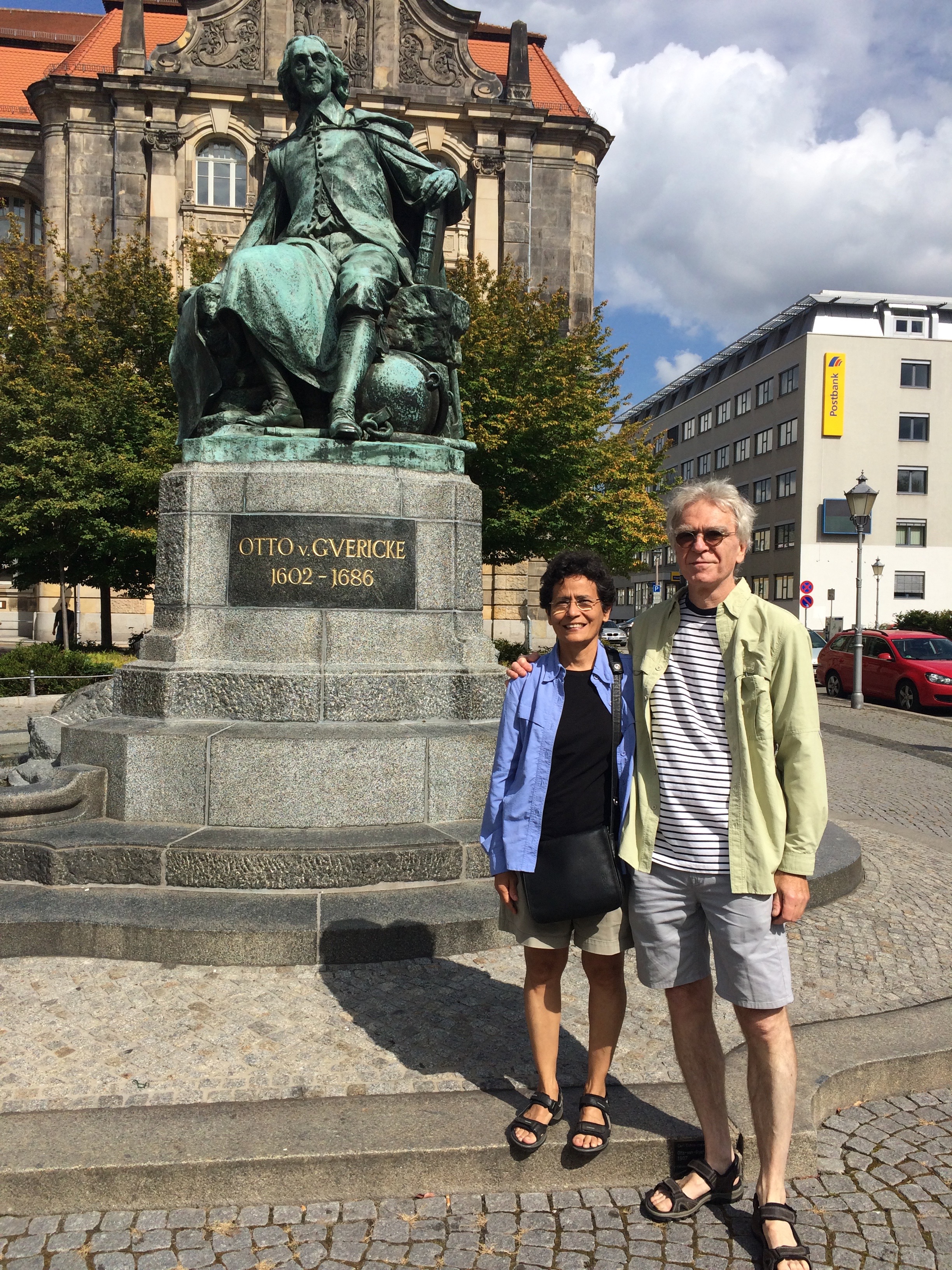
Anamaria Font and Stefan Theisen (Professor Max Planck Institute for Gravitation Physics-Albert Einstein Institute, Postdam, Germany.) Bronze statue of Otto Von Guericke sitting on a stone bench leaning with his left arm on a book and keeping a plan of Magdeburg in his left hand. Just to the right of his feet and part of the statue are the Magdeburg hemispheres, which he used in 1654 to demonstrate the force of the atmosphere. Magdeburg, Saxony-Anhalt, Germany |
|

|
|

ICTP in 2016 Back: Left to Right: Senarath "Shanta" De Alwis (postdoc of Steven Weinberg, now professor at U. of Colorado), Philip Candelas (Emeritus Professor, U. Oxford), Fernando Quevedo (1986 PhD graduate supervised by Steven Weinberg, now at U. of Cambridge), Cliff Burgess (UT graduate, now at McMaster U. and Perimeter Institute, PhD supervised by Steven Weinberg) |
|