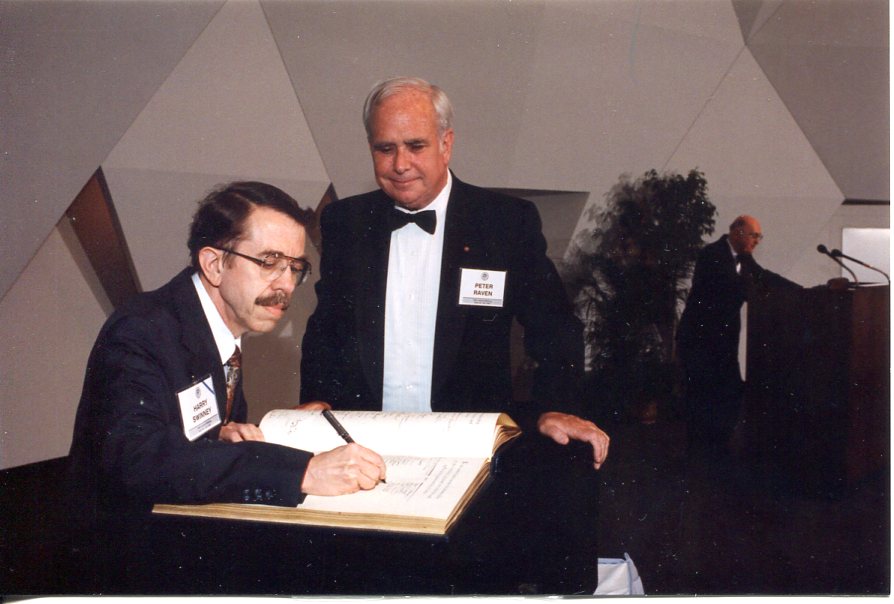
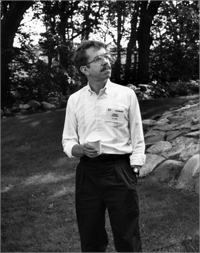
Harry L. Swinney signing at his election to the National Academy of Sciences, 1993 |
Harry Leonard Swinney
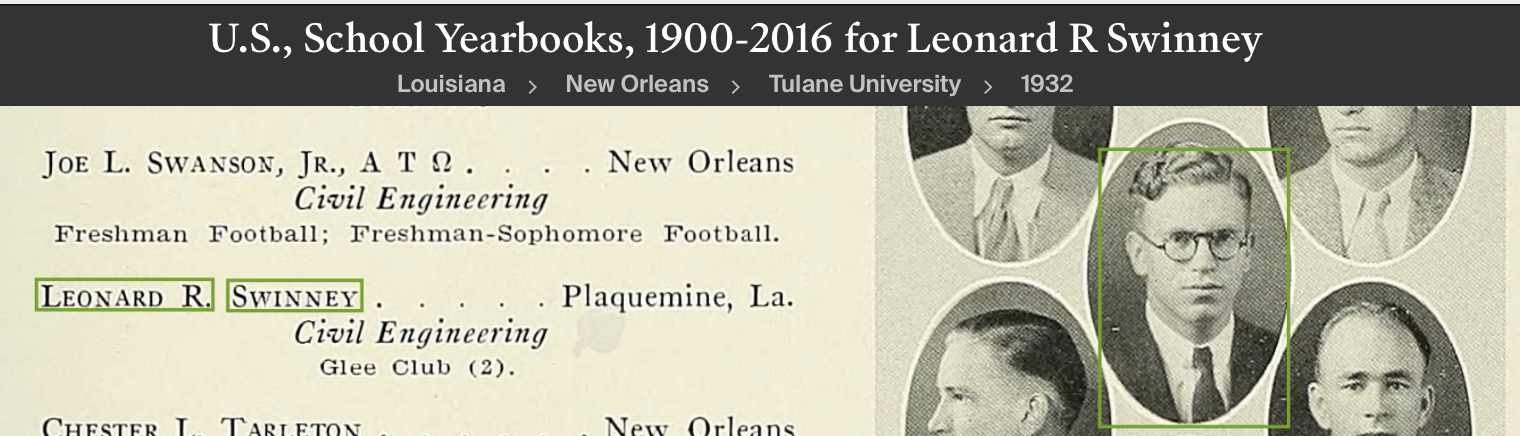
Harry Leonard Swinney was born in Opelousas, Louisiana, on April 10, 1939, to Leonard R. Swinney and Ethel Bertheaud Swinney. Harry was the older of their two sons which included Robert S. Swinney. Harry's mother, Ethel, born in Louisiana, graduated from Southwestern Louisiana Institute (now University of Louisiana). Ethel was a teacher and nutritionist. Harry's father, Leonard, born in New York, had graduated in Civil Engineering from Tulane University in 1935. He worked for his father's civil engineering firm in Baton Rouge, LA. After World War II, the family moved to Austin while Leonard attended Austin Presbyterian Theological Seminary. Following graduation from seminary, Rev. Swinny pastored churches in Texas and Louisana.
Education and Personal Life:
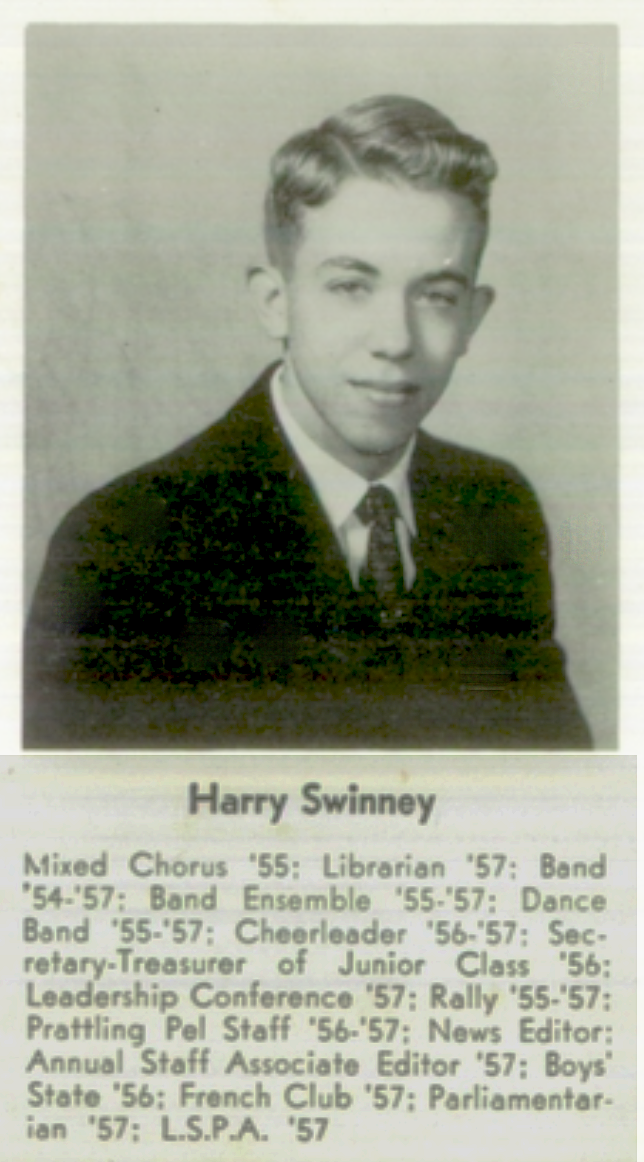
Swinney attended elementary school in Austin, Texas. In 1957, he graduated from Homer High School in Homer, Louisiana where he was active with the school yearbook, band, chorus, etc. Following graduation, he entered Southwestern at Memphis, TN (now Rhodes College) where he earned a B. S. with honors in physics in 1961. At Rhodes he was inspired by his physics professor and research mentor, Professor Jack H. Taylor. Harry followed Professor Taylor's path and entered graduate school at Johns Hopkins University. In 1968, Harry was awarded a Ph.D. in physics; his dissertation was entitled, " The Spectrum of Light Scattered by Carbon-Dioxide in the Critical Region." His advisor was Professor Herman Z. Cummins. He remained at Johns Hopkins as a Research Associate in Physics (1968-1970) and Visiting Assistant Professor of Physics (1970-1971).
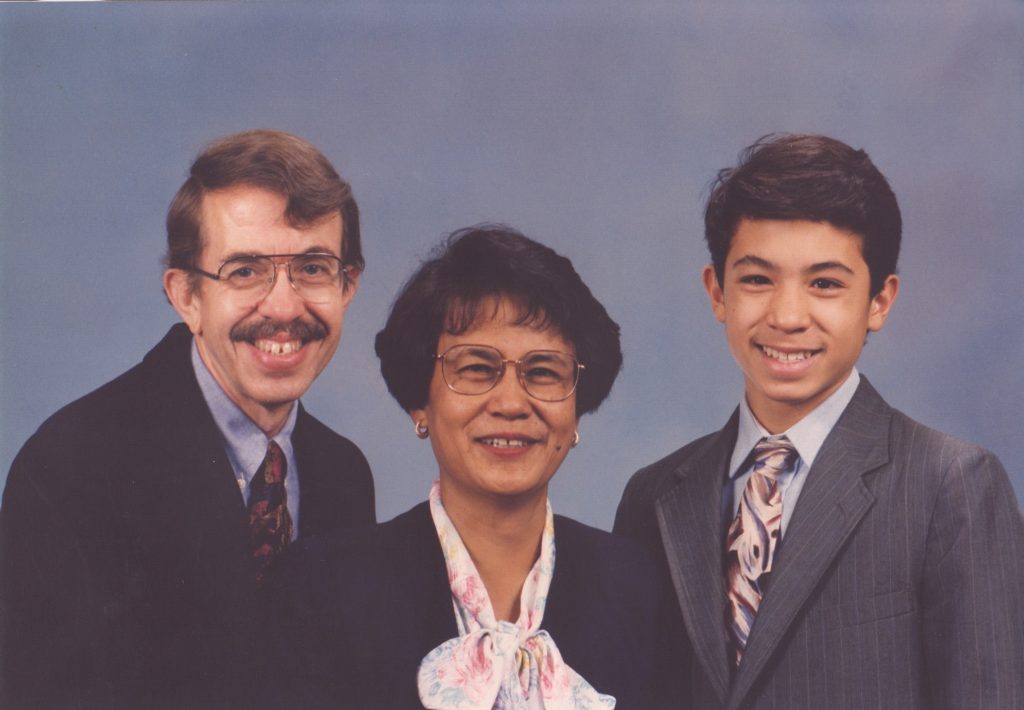
During his time at Hopkins, Harry married Gloria T. Luyas in 1967. Gloria Luyas – was the top student in her sixth grade class in the Phillipines. That ranking made her eligible for a scholarship to Silliman High School – and set her on a path of lifelong learning. After high school, she entered Silliman University, graduating with a B.S. in nursing in 1963. A few years later, Gloria was serving as an exchange nurse at the University of Maryland Hospital in Baltimore, when Harry, then a graduate student at Johns Hopkins University, sat next to her at church one Sunday morning. They were married in 1967, and Gloria went on to earn a PhD at University of Texas in medical anthropology. Her dissertation was entitled, "The Biocultural Context of Low-income Mexican American Women with Type II Non-Insulin Dependent Diabetes and Its Implications for Health Care Delivery." She later joined the faculty of the School of Nursing at The University of Texas at Austin. They had a son Brent Luyas Swinney in 1978. Sadly, Brent died of brain cancer in 1995. Harry and Gloria established a scholarship in Brent's honor at Sillman University. The scholarships are award to students in science, engineering, nursing, information technology, mathematics, or related sciences fields. Tragically Gloria passed away in 1997. Harry established the Gloria Luyas Swinney Memorial Scholarship at Sillman in her memory.
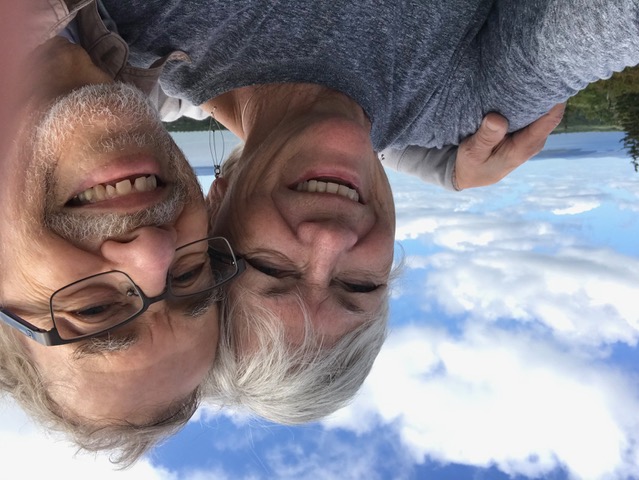
Harry Swinney married Lizabeth Marie "Beth" Kelley on August 12, 2000. Beth grew up in Bloomington, Indiana, and became a nurse and public health educator for the state of Indiana. She moved to Austin in 1996 to develop public health curricula for the Texas Department of Health. Harry and Beth like to say, "We met in Honduras in 1999 on a mission trip, and that is not far from the truth. Although we had met each other briefly at the pre-trip meetings, it was the hours-long bus-rides through the mountainous Honduran countryside that really brought us together."
Career
Swinney served as an assistant professor of physics at New York University from 1971 to 1973). From 1873 to 1978, Harry was associate professor and then professor at the City College of the City University of New York. In 1977, Swinney was made a Fellow of the American Physical Society. In 1978, the University of Texas Physics Department recruited Swinney. He was awarded the Trull Centennial Professor of Physics in 1984 and the Sid W. Richardson Foundation Regents Chair of Physics in 1990. In 1985, he became founding Director of the new Center for Nonlinear Dynamics, a position he held until his retirement.
Honors
Swinney is a member of the National Academy of Sciences (1992) and a fellow of the American Physical Society (1977), the American Academy of Arts and Sciences (1991), the American Association for the Advancement of Science (1999), and the Society for Industrial and Applied Mathematics (2009). In 1995, Harry was awarded the American Physical Society Fluid Dynamics Prize, the citation read, "In recognition of his definitive characterizing of the onset of turbulence, his pioneering investigations of chaotic advection and fluid dynamics in rotating flows, and his discoveries and insights concerning pattern formation in chemical dynamics using novel experimental techniques. Professor Swinney's efforts were the first to bridge the gap between nonlinear dynamical systems theory and laboratory investigations of flow phenomena. His ability to bring together different fields of science to explore new ground with rigor, dedication, and enthusiasm is truly remarkable."
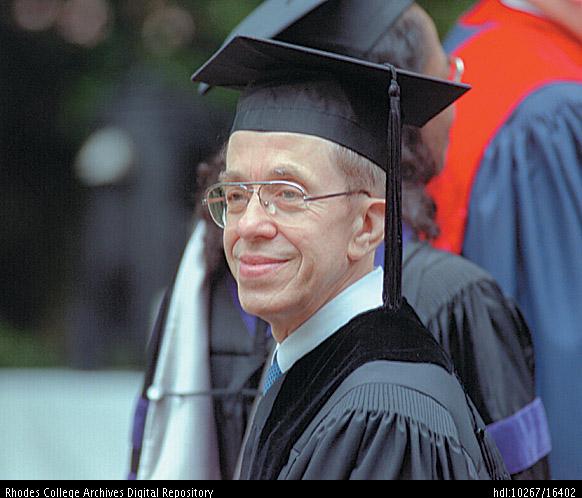
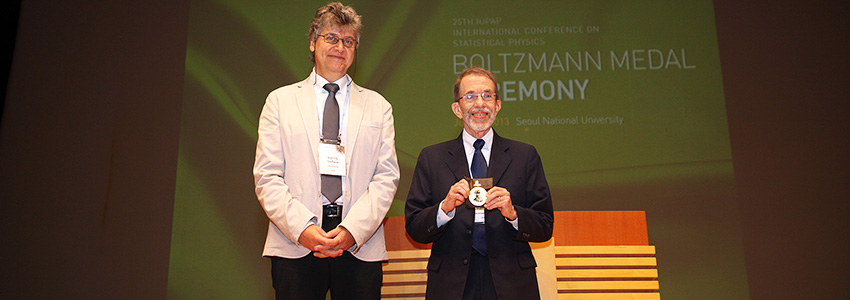
In 2007, the Society for Industrial and Applied Mathematics awarded Swinney the Jürgen Moser Prize, in recognition of "an individual who has made distinguished contributions to nonlinear science." In 2021, he received the European Geosciences Union Richardson Medal for "for his pioneering experiments on deterministic chaos and highly original laboratory models of geophysical flows."In 2013, he received the Boltzmann Medal ( of the Commission on Statistical Physics of the International Union of Pure and Applied Physics "for his ingenious and challenging experiments which have had a large impact on many areas of statistical physics." He was a Guggenheim Fellow (1983–84) and he was inducted into The Johns Hopkins University Society of Scholars (1984). He was awarded honorary doctoral degrees by Rhodes College (2002), The Hebrew University of Jerusalem (2008), and the University of Buenos Aires (2010).
Research contributions
Swinney conducted research on instabilities, chaos, and pattern formation in diverse systems, including fluid, chemical, and granular media. Swinney together with his students, postdocs, and other collaborators have:
- determined the decay rate of order parameter fluctuations for fluids near the critical point
- observed a transition to chaos—deterministic yet nonperiodic behavior—in experiments on a fluid flow
- characterized chaos from time series data by computing the largest Lyapunov exponent (rate of loss of predictability) and the mutual information (general dependence of two variables)
- discovered multiple transitions to different patterns of fluid flow between concentric independently rotating cylinders
- designed a laboratory experiment that yielded a stable vortex for conditions mimicking those on Jupiter. This result provides a plausible explanation of the stability of Jupiter’s Great Red Spot, which was first observed by Robert Hooke in 1664.
- observed the emergence of a spatial pattern in a chemical system, as predicted in 1952 by Alan Turning
- determined the scaling of power dissipated in strongly turbulent flow between concentric rotating cylinders
- observed anomalous diffusion and Lévy flights in a fluid flow
- discovered localized structures, dubbed “oscillons”, in an oscillating granular layer; oscillons were subsequently found in many dynamical systems. The granular experiments also investigated various extended spatial patterns, shock waves, and fluctuations.
- observed resonant pattern formation with frequency locking in chemical systems
- found fractal cascades of waves on the edges of leaves, flowers, and garbage bags
- found a resonance in internal wave boundary currents generated by tidal flow on a slope; this resonance apparently selects the angle (typically three degrees) of the continental slopes of the oceans
- discovered a new protein, Slf, which is produced by neighboring colonies of Paenibacillus dendritiformis bacteria. Slf is lethal to bacteria near the edge of a colony that faces another P. dendritiformis colony.
- found that fluctuations in the number N of bacteria swimming in a volume varied as N^(3/4), in contrast to the N^(1/2) scaling of fluctuations for systems in thermodynamic equilibrium
In the 1970s-80s Swinney together with J.P. Gollub conducted experiments on fluids that revealed and characterized chaotic behavior in a fluid system. Swinney's group then characterized instabilities, chaos, and turbulence in several fluid systems. A laboratory model was designed to exhibit many of the properties of the Jovian atmospher, and experiments on this model provided insight into the formation and stability of Jupiter's Great Red Spot. Experiments on chemical systems yielded in 1991 the "Turing patterns" predicted by Alan Turing in 1952. Experiments and simulations on granular media yielded many different spatial patterns, including oscillating localized structures, "oscillons," which were subsequently found in mathematical models and in other types of physical and chemical systems. Swinney's current research concerns energy transport by internal gravity waves in the oceans, and crystallization in granular media.
Here is a link to a bio of Swinney at the American Academy of Arts and Sciences.
In 2018, Swinney gave an interview to the Austin History Center about his life and career. The transcription is here: Swinney Austin History Center Interview.
In August of 2018, Swinney retired and was appointed Professor Emeritus. He is an avid cyclist and he and Beth are world travelers.
Listed below are links to videos of a few of Professor Swinney's public lectures.
- "Emergence of order in physical, chemical and biological systers", International Centre for Theoretical Physics, 2011
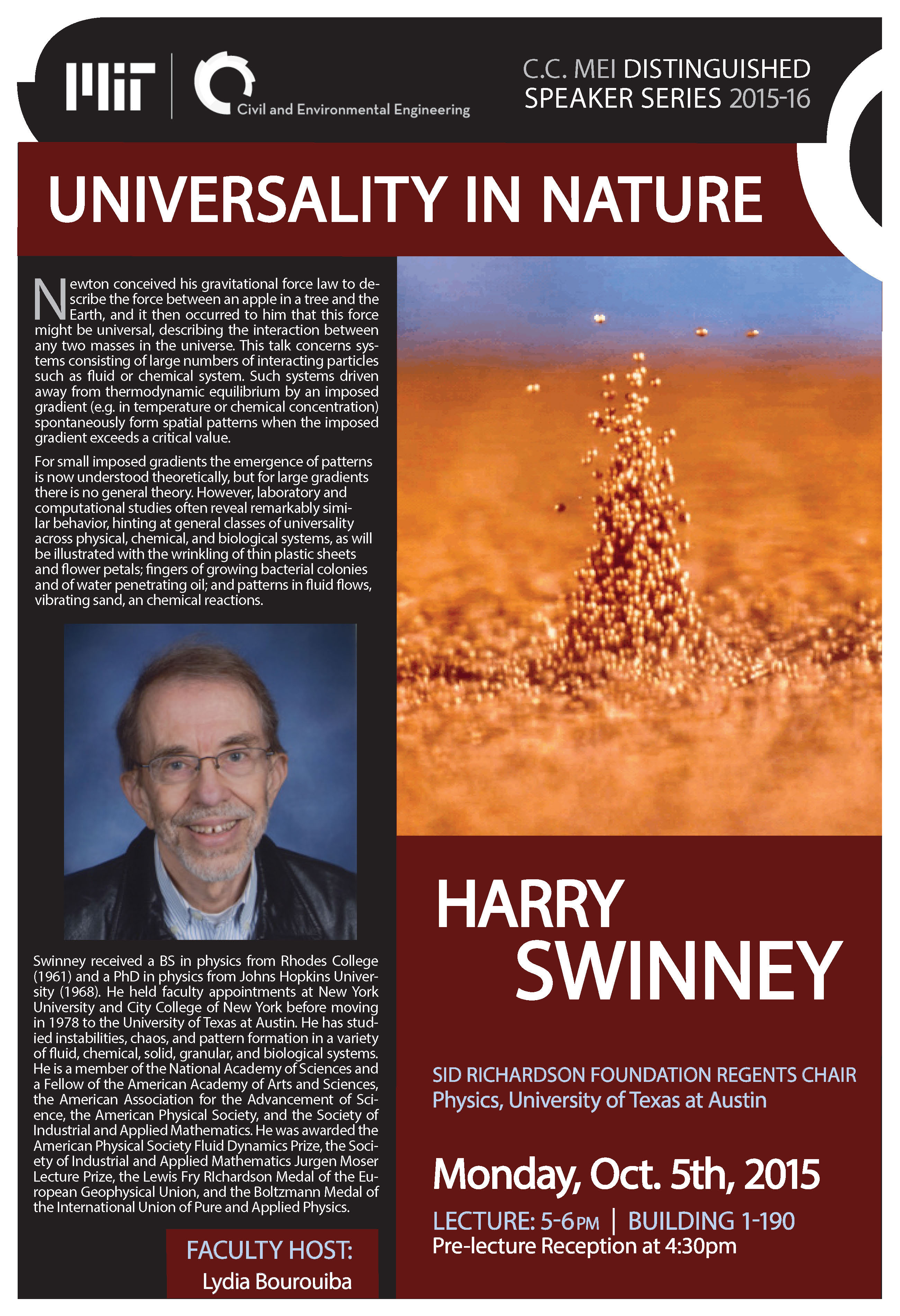
- "Universality in Nature", C. C. Mei Distinguished Speaker Series, Civil and Environmental Engineering, MIT 2015
- " Collective Dynamics, Deadly Competition, and a Shape-changing Transition in Bacterial Colonies", Mathematicl Biosciences Institute, OSU, 2015
Harry Swinney's Obituary from Austin American Statesman
Harry Swinney Obituary
Harry met Beth Kelley, his wife of twenty-five years, on a church mission trip to Honduras. He had suffered an unimaginable pair of losses a few years earlier when both his adolescent son, Brent, and Brent's mother, Harry's first wife, Gloria Luyas Swinney, died from brain tumors within two years of each other. Beth transformed Harry's life from one overshadowed by grief to one reclaimed by joy; bringing him two stepchildren and two grandchildren, great love, enduring lifelong friendships, and fellowship through their church, (and maybe just a tincture of chaos).
Harry, who died at home in Austin on Monday, July 13, was born in 1939 in Opelousas, Louisiana, started school at Lee Elementary here in Austin, and graduated high school in Homer, Louisiana.
In 1961 he earned a B.S. with honors from Southwestern at Memphis (now Rhodes College), and a Ph.D. in physics in 1968 from Johns Hopkins University in Baltimore, MD.
He loved teaching and working with young researchers. He started teaching at New York University, and then at City College of New York. For more than 40 years (1978-2018) he taught at The University of Texas at Austin where he held the Sid W. Richardson Foundation Regents Chair of Physics and served as director of the Center for Nonlinear Dynamics.
Harry was recognized for major research discoveries in nonlinear dynamics and chaos theory and received many academic awards and appointments throughout his career. Most significantly, he was invited into the National Academy of Sciences in 1992.
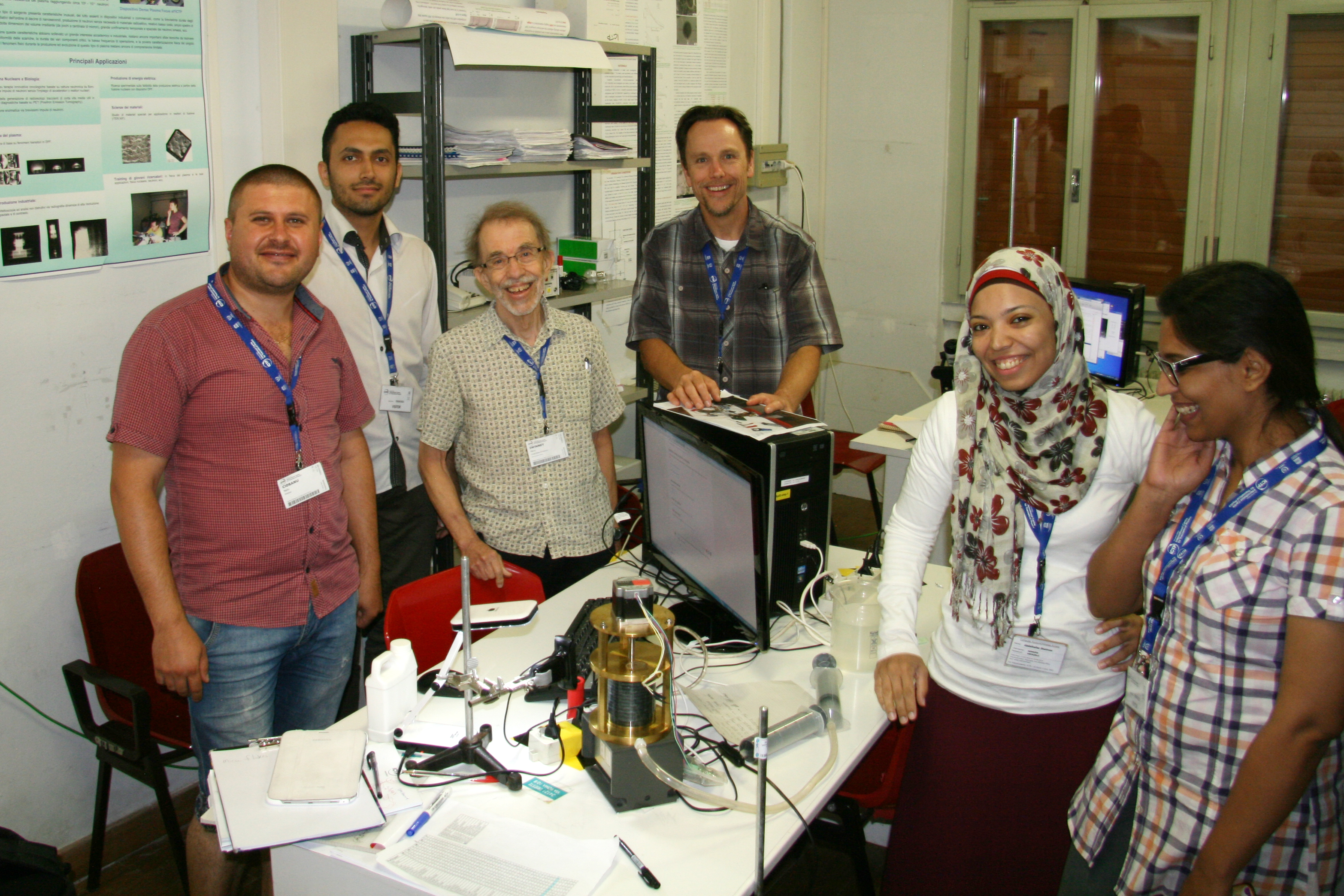
Harry may have been proudest of the innovative program he and his colleagues created to bring academic research excellence into underserved nations. Hands-On Research School for early career scientists from developing countries, now sponsored by the International Centre for Theoretical Physics, has been offered since 2008 in a variety of countries including Cameroon, Brazil, India, China and, most recently, Trieste, Italy.
Admiring colleagues recall him engaging students and post-docs in a lab experiment he designed at UT-Austin that provided a plausible explanation for the stability of Jupiter's famed Great Red Spot first observed in 1664 - landing Harry and his team on the front page of The New York Times.
Beneficiaries of these research opportunities and former students stayed in touch-many visiting Harry and Beth's Austin home as his health declined.
Harry loved sports cars of all vintages (though he never owned one), good coffee, ginger cookies, and weekly bike rides with his friends. Until a year ago, he could leave younger riders struggling to keep up during steep ascents - but always offering a big smile and encouraging words as he pedaled far ahead.
He also regularly volunteered on Saturdays at his beloved University United Methodist Church to help provide food and clothing to Austin's homeless and was a mainstay for many years in the church's interest-free microlending program to help lower income entrepreneurs grow a small business.
In addition to his wife Beth, Harry is survived by son Gus Sterneman, and his family, Austin, TX and daughter Katie Sterneman, Bloomington, IN; sister-in-law Dianne Harrington Swinney, Lakeway, TX; nephew Greg Swinney, and his family, The Woodlands, TX.
He is predeceased by his first wife, Gloria Luyas Swinney, and son Brent Swinney, both formerly of Austin; and his younger brother, Robert Swinney of Lakeway, TX. He will be forever admired and deeply missed.
A memorial and celebration of life will be held Saturday July 25, at 2 p.m. at University United Methodist Church, 2409 Guadalupe Street, Austin, TX.
Memorial donations in his honor may be made to UUMC, Hospice of Austin, or the charity of your choice. Better yet, find a place to donate your time and energy to a good cause; Harry would like that.
Celebration of Life for Harry Swinney
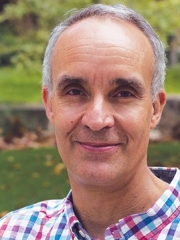
Miss Dessie McKensie….a math teacher at the Homer Public High School in northern Louisiana, was, in 1954, teaching geometry to a class of sophomores that included a boy, small in stature, who, by all accounts, even by the boy’s own admission, was a mediocre student. But she noticed something about him and one day said, “Harry, you seem to enjoy proving geometry theorems. If you meet me after school, I can give you some more of those to work out.” Harry and Miss McKensie worked together for the next several weeks and, with encouragement from Miss McKensie, Harry entered a regional math competition, in nearby Ruston, Louisiana-----to his great surprise, Harry won First Prize, which made him eligible to travel, for the first time, to the LSU campus in Baton Rouge, LA for the state math competition---in which he won First Prize.
Professor Bob Lea—in the early 70’s the chair of the Physics Department of the City College of the City University of New York. He noticed something about Harry---namely that Harry, through no fault of his own, fired from his faculty position at New York University (so that NYU could reallocate Harry’s salary to cover cost overruns at a library under construction). At the time, faculty positions were scarce as hen’s teeth, and Harry began exploring different career paths outside of science. Professor Lea called Harry and invited him, with 24 hrs notice, to come for an interview at City College, after which Harry was immediately hired as an Assistant Professor of Physics.
These two people changed the course of Harry’s life. There were others who were also very influential: Jack Taylor, Harry’s undergraduate research mentor, Herman Cummings, Harry’s Ph.D advisor, Jerry Gollub, Harry’s early and close collaborator on experiments with the arcane problem of Taylor-Couette flow---flow between concentric rotating cylinders---and many other people that Harry recognized with gratitude as having pivotal impacts on Harry’s scientific career-----and oh my, what a career.
Beginning with his findings on the Taylor-Couette flow I just mentioned, Harry became famously known worldwide as one of the founding fathers of the interdisciplinary field known as “Nonlinear Science”, which is connected in popular discourse to terms like “Chaos Theory” and the “Butterfly Effect”. Harry’s curiosity led to numerous clever lab experiments on a whole bevy of problems ranging from the unraveling of the fluid mechanics of the Great Red Spot of Jupiter, to the complex instabilities and patterns exhibited by reacting chemicals that provide insight into how cardiac arrhythmias occur and how cells in embryos differentiate….and many other scientific puzzles and lab experiments too numerous to mention here. He was recognized with a boatload of international awards, including membership in the exclusive US National Academy of Sciences. Some claim (myself included) that he should have won a Nobel Prize for his work in Nonlinear Science---but the fact that he didn’t never bothered him much because it was the science itself that mattered to Harry.
Harry loved science and doing science---and, yet, as important and as meaningful as the science itself was to Harry---to my mind, that wasn’t even the most important part of his professional life. For Harry never did science alone. Scientific challenges, puzzles provided the settings, the excuses for Harry to work together with others, to collaborate, to develop partnerships, to build relationships with scientists from all over the world, a number of whom are present here today. And it was those relationships which Harry loved even more so than the science itself.
For those of us who worked with Harry, Harry gave us many gifts in our working relationships---a preternatural ability to ask the right questions, an uncanny ability to identify and to amplify the strengths of each person he worked with, -a delightful sense of humor and wonderful laugh---- but to me, underlying it all…the secret sauce of his success as a scientist… was Harry’s wholehearted generosity of spirit. Harry certainly took personal satisfaction in his contributions to scientific advancements, but he wasn’t the kind of person who needed to be the spotlight---he took far more pleasure in seeing the positive impact of those contributions on the people he worked with and, at every turn, made those contributions known to the wider scientific community in service for the benefit of the people he worked with.
The importance of relationships to Harry showed up even more strongly outside the world of science. The special love and joy that he and Beth shared in more than 25 years of marriage; the deep friendships, some spanning decades---Kurt and Pat Weiman, John and Marylou Bell and many others in the community of this church. The generosity of spirit that he displayed in his Saturday volunteer work here at UUMC on behalf of Austin’s homeless and on trips abroad that, as one example, aimed to help aid victims of a hurricane in Honduras.
The way Harry gave of himself in relationships was shaped by a keen awareness of the uncertainties, the contingencies he experienced in his own life…experiences of outstanding professional success and, at the same time, awareness of how things could be so much different if it weren’t for the influence of the Miss McKensies, the Prof. Bob Lea’s in life. Even more profoundly, experiences and contingencies in his personal life---the joys of being a husband and father, the soul-crushing grief when Harry and Gloria lost their son Brent at a young age and shortly thereafter Gloria passed away.
Two Scripture passages come to my mind in thinking about how Harry chose to live under such circumstances:
From the Prophet Isaiah:
Here is my servant whom I uphold…in whom my soul delights---he does not break the bruised reed, he does not quench the smoldering wick….
And from the 13th Chapter of the Gospel of St Matthew:
“A sower, a planter of seeds, went out to sow…..and some of the seeds fell on rich ground and produced a crop, some a hunderdfold, some sixty, some thirtyfold.”
Harry was a generous sower of seeds in the souls of others---well aware that while the outcome was never certain and and at the same time recognizing how profoundly important is to plant those seeds, especially at those pivotal times when lives are bruised or smoldering, to plant in hopes for a bountiful harvest, just as Miss Dessie McKensie planted that seed of hope at a vulnerable time in the soul of that unremarkable student in Homer, Louisiana. Harry was a sower of seeds of hope, with resiliance, even when he himself was in a vulnerable place.
I’ll close with this example:
In his later years, Harry cofounded a program called the Hands On Research in Complex Systems School to foster the development of scientific leaders in low and middle income countries around the world. The School provides early career scientists from those countries a two-week immersion in the methods and mindsets of the science Harry practiced—tabletop, everyday scale science that could be performed at the leading edge of problems that participants had unique access to in their local surroundings and could be carried out with the highest quality even when resources, equipment were constrained. The Schools started in 2008, there are nearly 700 alumni of the Schools to date, and in one week, the 13th offering of the School will be held. As you might expect, Harry struck up many rich relationships with the participants…one striking case happened at the 2010 School held in Northwest Cameroon—Harry worked closely with Prof. Kennedy Fozao from the University of Buea---on the last day of the School, as we were on the bus about to depart of the airport--- Prof. Fozao ran out to the bus and held up for all of us to see his son who had been born on that very day---Harry Fozao. In the last few months while Harry was battling the advanced stages of metastatic cancer with the just recently FDA approved therapy called Pluvicto---each treatment of which left him both exhausted and radioactive—Harry, together with Beth, made thoughtful, extensive preparations to plant seeds in hopes for a bountiful future for the now 16 year old Harry Fozao.
I count myself among those who find much to be unsettled about in recent local, national and international events. Under these circumstances, I find inspiration in contemplating the examples Harry set in his life.... inspiration to plant, with courage and determination, seeds of hope in others like Harry planted in me. I hope for each of you the same.
Harry L. Swinney Photo and Document Album |
|
|---|---|
|
|
|
|
|
|
|
|
|
|
|
|
|
|
|
|
|
|
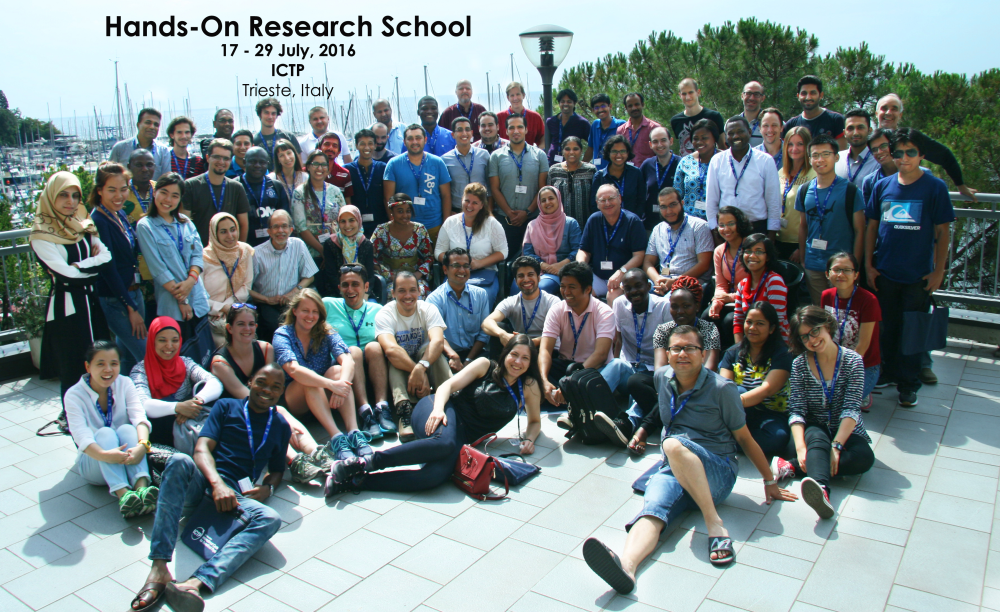
Hands On Research School, ICTP in Trieste, Italy, 2016, (Photo by Lizbeth Kelley.) Harry Swinney second from left in seated row. Swinney, together with Rajarshi Roy and Kenneth Showalter, founded a two-week Hands-On Research School for early career scientists from developing countries |
|
Hands On Research School, ICTP in Trie Harry Swinney third from left. |
|
|
|
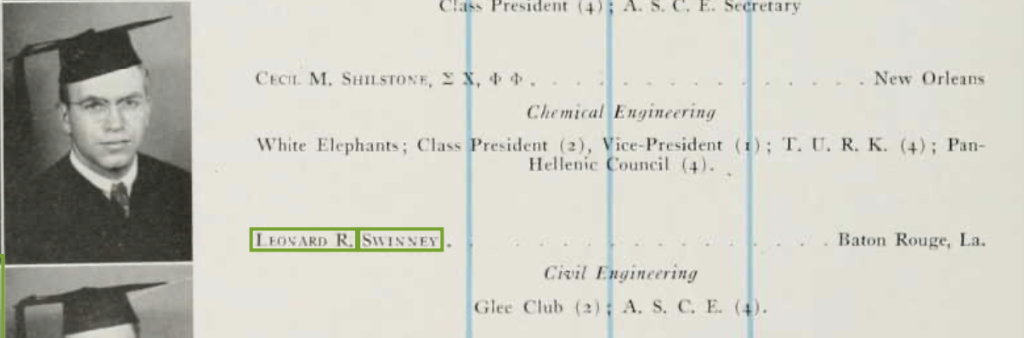
Leonard R. Swinney, Senior, Tulane University |
|
|
|
 Hands On Research School, ICTP in Trieste, Italy, 2016, (Photo by Lizbeth Kelley.))