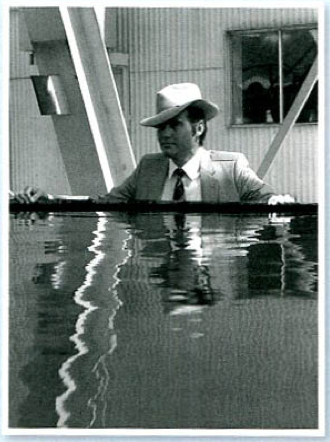
Thomas Gustave Muir, Jr. |
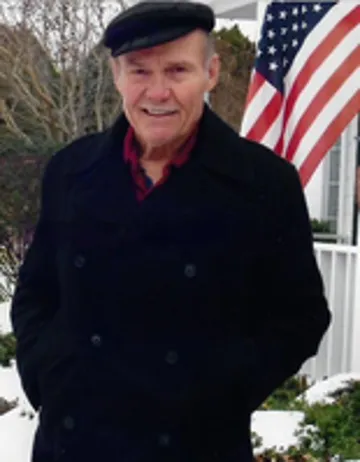
Thomas Gustave Muir, Jr. |
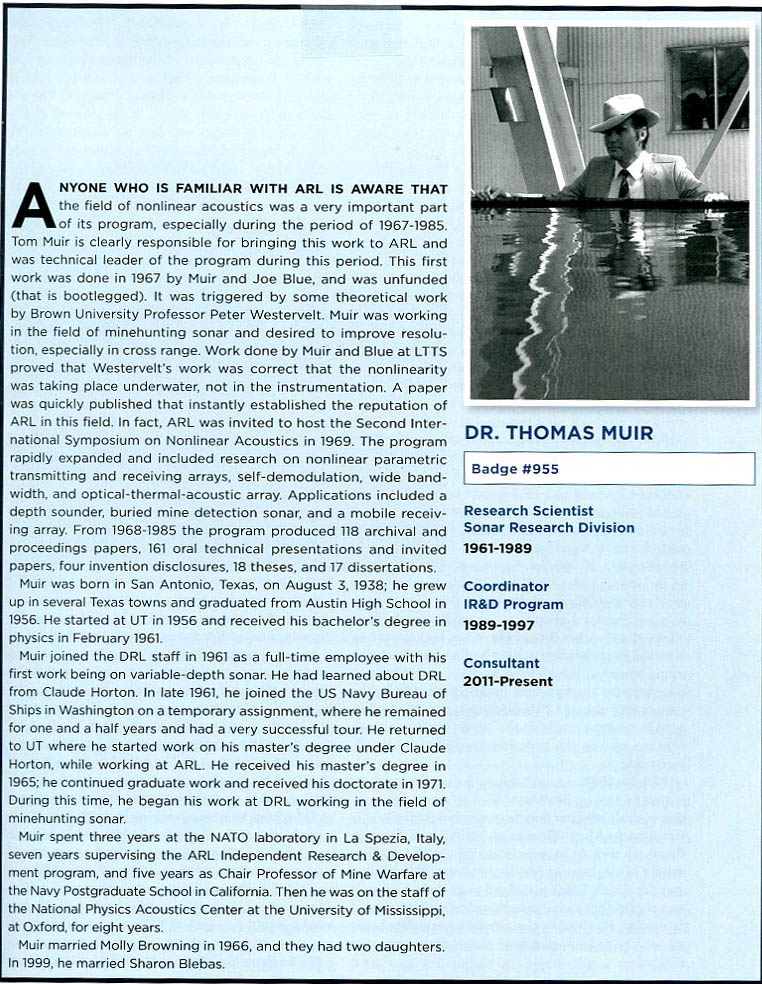
Chester McKinney, Emeritus Director of ARL, wrote in his history of the laboratory, "Anyone who is familiar with Applied Research Laboratories (ARL) is aware that the field of nonlinear acoustics was a very important part or its program, especially during the period of 1967–1985."
 "Tum Muir is clearly responsible for bring this work to ARL and was technical leader of the program during this period. This first work was done in 1967 by Muir and Joe Blue, and was unfunded (that is bootlegged). It was triggered by some theoretical work by Brown University Professor Peter Westervelt. Muir was working in the field of minehunting sonar and desired to improve resolution, especially in cross range. Work done by Muir and Blue at LTTS proved that Westervelt’s work was correct that the nonlinearity was taking place underwater, not in the instrumentation. A paper was quickly published that instantly established the reputation of ARL in this field. In fact, ARL was invited to host the Second International Symposium on Nonlinear Acoustics in 1969. The program rapidly expanded and included research on nonlinear parametric transmitting and receiving arrays, self-demodulation, wide bandwidth, and optical-thermal-acoustic array. Applications included a depth sounder, buried mine detection sonar, and a mobile receiving array. From 1968–1985, the program produced 118 archival and proceedings papers, 161 oral technical presentations and invited papers, four invention disclosures, 18 these, and 17 dissertations."
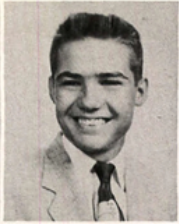
Muir was born in San Antonio, Texas, on August 3, 1938, to Thomas Gustave (1909–1976) and Martha Elizabeth Thompson (1911–1981) Muir. Tom's father worked for the Texas Employment Commission and his mother was a correspondent and worked for the Internal Revenue Service. Tom grew up in several Texas towns and graduated from Austin High School in 1956. He started at the University of Texas and received his bachelor’s degree in physics in February 1961.
Muir joined the Defense Research Laboratory (DRL) staff in 1961 as a full-time employee with his first work being on variable-depth sonar. He had learned about DRL from Claude Horton. In late 1961, he joined the US Navy Bureau of Ships in Washington on a temporary assignment where he started work on his master’s degree under Claude Horton, while working at ARL. He received his master’s degree in 1965 with a thesis entitled, An Analysis of Eckart's Sound Scattering Theory for Several Types of Rough Surfaces. He continued graduate work and received his doctorate in 1971. His dissertation was entitled, An Analysis of the Parametric Acoustic Array for Spherical Wave Fields. During this time, he began his work at DRL working in the field of minehunting sonar.
Muir spent three years at the NATO laboratory in La Spezia, Italy, seven years supervising the ARL Independent Research and Development program, and five years as Chair Professor of Mine Warfare at the Navy Postgraduate school in California. Then, he was on the staff of the National Physics Acoustics Center at the University of Mississippi at Oxford for eight years.
Below is as excerpt from Underwater Acoustics at the Applied Research Laboratories, The University of Texas at Austin by Thomas G. Muir and Clark S. Penrod
A link to the full article is: Underwater acoustics at the Applied Research Laboratories, The University of Texas at Austin
"D. Nonlinear Acoustics
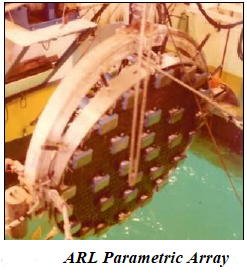 ARL:UT was an early player in nonlinear acoustics, from fundamental physics, to the nonlinear effects on working sonars, to the development of sonars designed to exploit nonlinear effects. The original staff members were Thomas Muir and Joseph Blue, who did the first field measurements on Westervelt’s parametric array in 1969. This work led to the hosting of the Second International Symposium on Nonlinear Acoustics at ARL:UT. David Blackstock joined the effort in 1970 and a number of investigations have resulted in many published papers by ARL staff, including Jim Truchard, Thomas Goldsberry and Jack Shooter, as well as those done by David Blackstock and his students, and many others. This continues today with ARL:UT staff member, Mark Hamilton, also a professor of Mechanical Engineering.
Research topics have included parametric reception, harmonic generation, acoustic saturation, and shock wave generation, focusing and propagation. Many visiting scientists have participated in this effort, including Orhan Berktay, Sigvie and Jacqueline Naze Tjøtta, Halvor Hobaek, Magne Vestrheim,Leif Bjørnø, Shigemi Saito and Bernard Lucas, as well as Evgenia Zabolotskaya, who also became a permanent staff member. Research in the early 1980’s involved the large ARL:UT parametric sonar transducer shown in at right, which had two interleaved arrays – the black area containing 720 primary frequency elements, operating from 10 to 16 kHz, and 20 low frequency receivers, operating from 1 to 5 kHz. This device was 10 ft. in diameter, weighed 10,000 pounds, and was driven with 78,000 watts of peak, electrical pulsed power. It was incorporated in a parametric sonar that was deployed on the Marine Physical Laboratory’s Ocean Research Buoy off the shallow coast of San Diego CA, to obtain backscattering measurements from a sand sediment. It was also deployed on the SWATH ship, RV Kaimalino off the island of Oahu Hawaii, to do experiments on sub-bottom profiling of buried volcanic streams."
Tom is an Acoustical Society of America Fellow. He is a Director's Fellow at the Applied Research Laboratories.
Muir married Sharon Elizabeth "Molly" Browning on February 3, 1966, in Austin, Texas. Sharon was born January 21, 1942, in Tarrant County, Texas, to Robert James and Alonzo Lee Johnston Browning. Sharon and Tom had two daughters. In 1999, he married Sharon Bleblas.
Some the information included here came from A History of Applied Research Laboratories, Vol. 1, 1945-1980, by Chester McKinney and Clark Penrod.
Tom Muir's Obituary from Austin American Statesman, Jan. 28, 2025.
Dr. Thomas Muir was an internationally known physicist, seafaring scientist, professional engineer for the U.S. Navy, and consummate Texan. Born into German-Scottish heritage in San Antonio, he was the only child of Thomas and Martha Elizabeth Thompson Muir. His great grandfather, Gustav Schattenberg of Boerne, harvested and planted 300 Guadalupe River cypress saplings along the course of the San Antonio Riverwalk, where these majestic cypress trees still exist today.
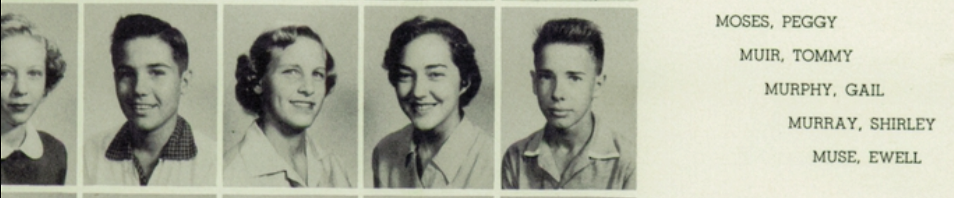
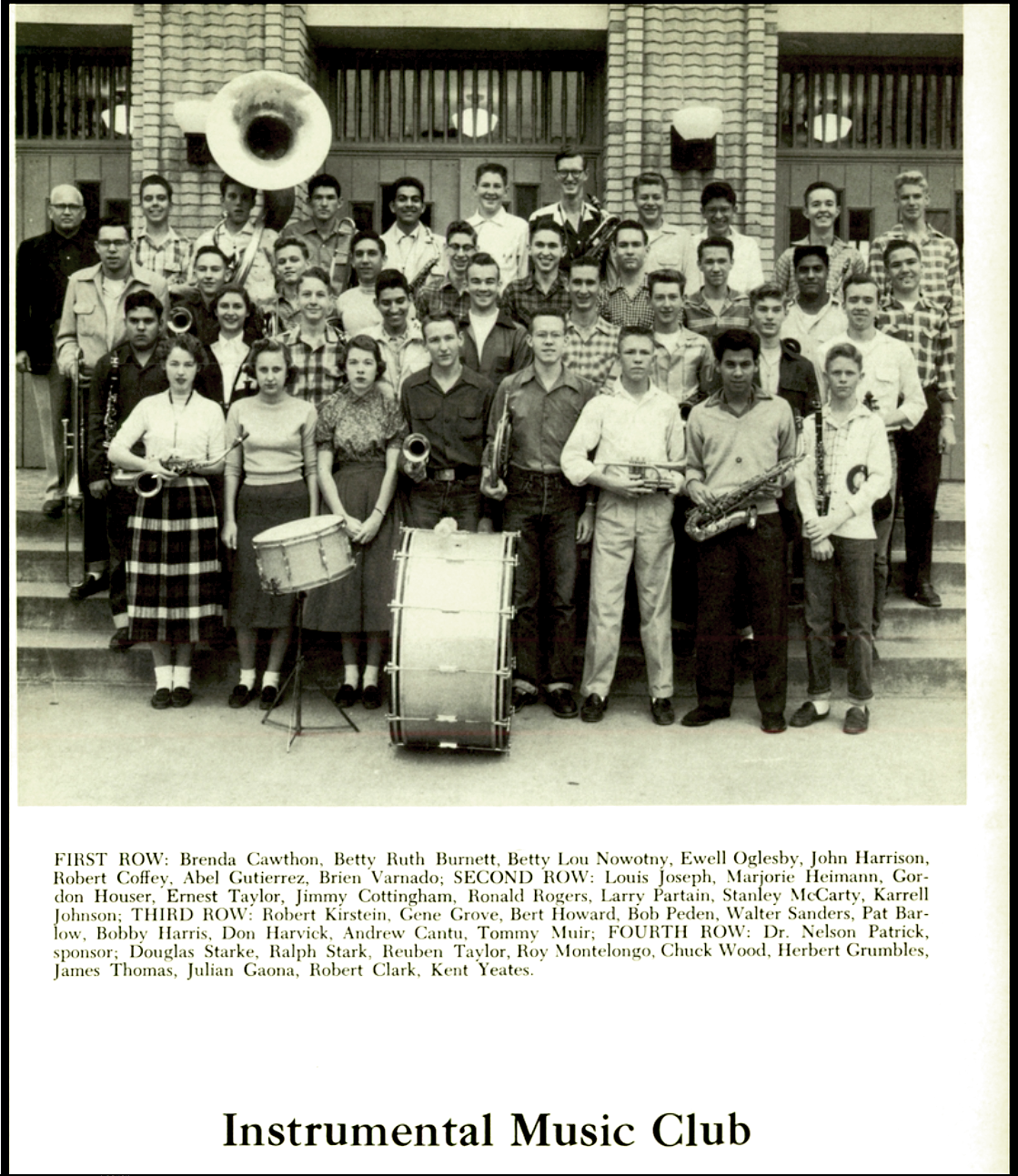
After his father joined the Marines in World War II, Tom moved with his mother and Aunt Gladys to Austin. There he attended Austin public schools, spent summers at Camp Craft and Camp Tom Wooten, and roamed Congress Avenue and the shores of Town Lake with his faithful dog, Bob. His father was Scout Master at the First United Methodist Church downtown and Tom fondly remembered being the troop bugler and going on camping trips, visiting Big Bend, and traveling by train to Los Angeles for Boy Scout Jamborees. Tom achieved the rank of Eagle Scout. He was a proud graduate of Austin High, class of '56, where he played clarinet in the band.
Tom received his bachelor's degree in physics in 1961 from the University of Texas at Austin. He first joined Applied Research Laboratories (ARL) at the University of Texas at Austin in 1961 and spent a year in Washington DC assigned to the US Navy Bureau of Ships, working on depth sonar. In 1964 Tom completed his master's degree in physics under Prof. Claude Horton. In 1971 Tom earned his PhD in mechanical engineering under Prof. David Blackstock with a dissertation on nonlinear acoustics.
Tom was a fellow of the Acoustical Society of America. His work was mainly dedicated to mine warfare in which he published over 25 works. He also worked on submarine warfare. His first scientific paper done with Dr. Joe Blue was published in the tome "Benchmark Papers in Underwater Acoustics." He served a tour of duty with the Royal Australian Naval Lab in Sydney and worked in San Diego with the Navy Dolphins. In 1986, Tom took a 3 year leave of absence to join SACLANT Undersea Research Center, a NATO lab in La Spezia, Italy. He researched ocean seismo-acoustics off the coast of Italy, Spain, and Norway. Returning to Austin in 1989, Tom renewed his work at ARL. He received the 1990 Jeffress Award given for exceptional lifetime technical achievement and contributions by an ARL UT scientist. Tom eventually became the Assistant Director for Basic Research and Educational programs at ARL UT. Tom accepted the position of Ellis A. Johnson Chair of Mine Warfare at the Naval PostGraduate School in Monterey, CA in 1997. There he taught classes, conducted research at sea on dolphin sonar and on seismic sonar for detection of buried mines in the surf zone. He also conducted a distinguished guest lecture series.
After a brief courtship of 5 years, Tom married his fellow educator and Texas Longhorn, Sharon Biebas in 1999. Tom greatly admired the close knit Biebas family with their Wendish noodles and annual production of crock dill pickles. He and Sharon enjoyed gardening and fishing, and spending time on her family farm in Giddings. Tom and Sharon moved to Oxford Mississippi in 2003 when Tom accepted the position of Principal Investigator at The National Center for Physical Acoustics at Ole Miss. Tom and Sharon loved the 8 years of small town life in Oxford.
Tom morphed into retirement by returning to ARL UT in 2011, where he conducted experiments in his lab. He and Sharon enjoyed travel throughout the US, Europe, and Canada attending meetings of the Acoustical Society of America. Tom worked on restoring his 1931 Model A Ford Deluxe delivery vehicle which he owned and drove since the 1960's. He enjoyed spending time with family and especially his grandchildren. Tom reconnected with his classmates from Austin High School Class of 1956, gathering each Thursday at "Klatch" where they all relived their "glory days." In addition to his scientific contributions to the field, Tom will be remembered for his leadership in mentoring young scientists, his unwavering love and service to the University of Texas, and his passion for Texas Longhorn Football.
Tom passed away on January 22 after a brief illness. He is survived by his devoted wife, Sharon, daughters Dr. Meredith Roddy and husband Ted Roddy, Rachel Muir and husband Mark Gronquist, grandchildren Joe Seth and Georgia Roddy, Luke and Scarlett Gronquist, sister-in-law, Dr. Carolyn Biebas, brother-in-law, Bob Biebas and his wife, Julie, nieces and nephews, Kacie Biebas and husband Spike, Kelley Biebas Church and husband Wyatt, Scott Biebas, Paige Biebas, great nephews Bennett Church and Dutton Weaver. He is also survived by former wife, Molly Browning, his cousins, and a host of friends.
A celebration of life service will be held on Friday, January 31 at 2:00 pm at Triumphant Love Lutheran Church at 9508 Great Hills Trail, Austin, 78759. Memorials in his name may be made to Austin High School Scholarship Fund (Austin Trust, 338 S. Congress Ave., Suite 100, Austin, Tx 78704 ), the Christopher House Hospice Austin, or your favorite charity. The family invites you to leave a message for them or memory of Tom at Dignitymemorial.com or his page at Weed Corley Fish.
Thomas G. Muir Jr. Photo and Document Album |
|
|---|---|
|
|
|
|
|
|
|
|