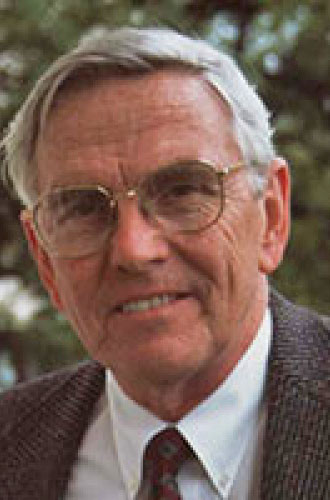
Austin Gleeson |
For many years, Austin Glesson taught a modern physics course for University of Texas Plan II students. The course was required of all students. It introduced the students to modern physics in a unique way.
Anyone interested in modern physics will find Gleeson's presentation novel and includes insights unavailable in any existing book. Some of the material will be quite challenging for the nonscientist, however any effort will lead to important rewards.
We acknowledge Professor Gleeson's generosity in providing permission for the reading or for chapters to be downloaded at no charge.
Professor Gleeson describes the course:
"The discoveries and the methods of analysis that are the basis of Twentieth Century Physics have dominated our lives and in many cases set the tone of our intellectual debate. Discoveries from quantum mechanics are the basis for all the current work in the development of modern materials and in modern electronics devices such as transistors. The modern view of space-time is a rich structure that allows for marvelous objects such as black holes and even allows a solid basis for our understanding of the origin of the universe. Unfortunately, in most undergraduate University curricula, this material is not covered. This omission is usually due to the need to prepare the students in both the requisite classical physics and mathematics as a background for other course work. This course covers the modern subjects without the use of sophisticated mathematics but in a coherent and correct presentation of the modern physics. The emphasis in the course will be on the conceptual development of the ideas.'
The course begins with a general review of several of the basic ideas that are relevant to all of physics but quickly relates them to discoveries made in the twentieth century. We start the discussion of the current approach to microscopic matter. Beginning with Planck's work on black body radiation and the Einstein on the photoelectric effect, we will develop the modern theory of light and matter. From this we will study the modern theory of space and time. This is covered using the geometrical concepts to outline the basic ideas of special and general relativity. This is followed by a descriptive analysis of some of the more spectacular of the objects predicted by these theories. If time allows, this will be followed by connecting the two threads of space time and quantum mechanics will. Again the emphasis in all our discussion is on conceptual foundations. In addition, the content of the course allows for discussions of important philosophical issues such as "What is energy and matter?" and significantly the role of mathematics."
Below is a link to a copy of the complete book. Following that are copies of Gleeson's note to his graduate course on Electricity and Magnetisma and to his senior course on Relativity.
Introduction to Modern Physics

Below is a version by chapters.
Introduction to Modern Physics
Chapter 3: Pre 19th Century Physics
Chapter 4: Fresnel/Young/Huygens Theory
Chapter 5: 19th Century Physics
Chapter 6: Dynamics and Action
Chapter 7: Basic Principles of Physics
Chapter 8: Special Classical Physical Systems
Chapter 9: The Special Theory of Relativity
Chapter 10: Kinematics of Special Relativity
Chapter 11: The Nature of Space-time
Chapter 12: Events, Worldlines, Intervals
Chapter 13: Pardoxes of Relativity
Chapter 14 Uniform Acceleration
Chapter 15: Relativistic Dynamics
Chapter 16: Introduction to General Relativity
Chapter 17: Geometry and Gravitation
Chapter 18: Effects of Gravitation
Chapter 19: Introduction to Quantum Theory
Chapter 20: Single Particle Quantum Mechanics
Chapter 21: EPR, Quantum Measurement and Bell's Theorem
Chapter 22: Quantum Field Theory
Chapter 23: Interface of Large Scale and Micro-physics
Special Cosmology Lectures Part 1
Special Cosmology Lectures Part 2
Special Cosmology Lectures Part 3
Graduate Electricity and Magnetism
Professor Gleeson taught a graduate course on electricity and magnetism. His "take" on the subject varies greatly from the standard course taught from Jackson, Panosky and Philips or Stratton. His approach is formal, modern and deeply insightful. It is included here with the hope that many will read it and find that it deepens their understanding of this important subject.
Chapter 1 Introduction
Chapter 2 Introduction to Field Theory
Chapter 3 String Field Theory
Chapter 4 Intorduction to Maxwell's Theory
Chapter 5 The Electromagnetic Field
Chapter 6 Covariant Electromagnetic Fields
Chapter 7 E & M in Bounded Spaces
Chapter 8 QED: A Start
Appendix A Primer on Action
Appendix B Fourier Transforms & Generalized Functions
Appendix C Propagators and Green’s Functions
Appendix D Group Theory
Appendix E Vector Spherical Harmonics
Appendix F Indexology
Senior Course on Relativity
Senior courses on relativity usually and limited to special relativity. Professor Gleeson's course included an accessible instroduction to Gerneral Relativity. His course contains a number of inventive examples that students will find instructive, challenging and entertaining.
Chapter 1 The Special Theory of Relativity
Chapter 2 Kinematics of special relativity
Chapter 3 The Nature of Space-Time
Chapter 4 Events, Worldlines, Intervals
Chapter 5 Paradoxes of Relativity
Chapter 6 Uniform Acceleration
Chapter 7 Relativistic Dynamics
Chapter 8 Introduction to General Relativity
Chapter 9 Geometry and Gravitation
Chapter 10 Effects of Gravitation
Chapter 11 Large Scale and Micro-physics
Appendix A Primer on Action
Appendix B Introduction to Field Theory
Appendix C Indexology
Bibliograpy Bibliography